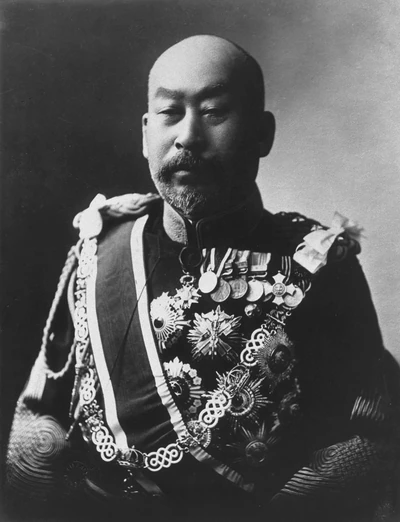
Terauchi Masatake
| Name | Terauchi Masatake |
| Title | Japanese general (1852-1919) |
| Gender | Male |
| Birthday | 1852-02-05 |
| nationality | Japan |
| Source | https://www.wikidata.org/wiki/Q315559 |
| pptrace | View Family Tree |
| LastUpdate | 2025-11-17T10:08:14.935Z |
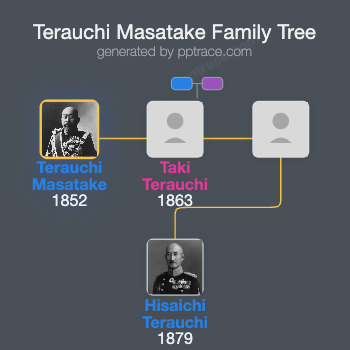
Family Tree
Tap  to expand more relatives
Introduction
Terauchi Masatake (Japanese: 寺内 正毅), born on 5 February 1852 and deceased on 3 November 1919, was a Japanese military officer and politician. He was promoted to the rank of Gensui (Marshal) in the Imperial Japanese Army and served as the Prime Minister of Japan from 1916 to 1918.
Early Life and Education:
Terauchi was born in Hirai Village, Suo Province, in what is now Yamaguchi city, Yamaguchi Prefecture. He was the third son of Utada Masasuke, a samurai affiliated with Chōshū Domain. He was later adopted by a relative on his mother's side, Terauchi Kanuemon, adopting the family name "Terauchi." As a youth, he was a member of the Kiheitai militia starting in 1864 and participated in the Boshin War against the Tokugawa shogunate beginning in 1867, notably at the Battle of Hakodate.
Military Career:
Following the victory at Hakodate, Terauchi traveled to Kyoto and joined the Ministry of War, where he received training from French instructors in Western weaponry and tactics. In 1870, he became a member of Emperor Meiji's personal guard and traveled with the Emperor to Tokyo. He left military service in 1871 to study languages but was recalled to service with the formation of the Imperial Japanese Army and was commissioned as a second lieutenant after attending the Army's Toyama School.
He was appointed to the staff of the Imperial Japanese Army Academy in 1873. Terauchi fought in the Satsuma Rebellion in 1877, during which he sustained injuries and lost his right hand at the Battle of Tabaruzaka. Despite this disability, he advanced in his career. In 1882, he was dispatched to France as aide-de-camp to Prince Kan'in Kotohito and became a military attaché in 1883. He studied in France until 1886.
Upon returning to Japan, he served as deputy secretary to the Minister of the Army. He became commandant of the Army Academy in 1887, chief of staff of the IJA 1st Division in 1891, and Chief of the First Bureau (Operations) of the Imperial Japanese Army General Staff in 1892. During the First Sino-Japanese War (1894–1895), Terauchi was appointed Secretary of Transportation and Communication for the Imperial General Headquarters, overseeing troop movements and supplies.
He commanded the IJA 3rd Infantry Brigade in 1896. In 1898, he was appointed as the first Inspector General of Military Training, one of the army's top positions. He became Deputy Chief of Staff of the Army in 1900 and participated personally in overseeing Japanese forces during the Boxer Rebellion in China.
Political Career:
Terauchi was appointed Minister of the Army in 1901 during the first Katsura administration, coinciding with the Russo-Japanese War (1904–1905). After Japan's victory, he was ennobled with the title of danshaku (baron) in the kazoku peerage system and became chairman of the South Manchurian Railway Company in 1906. His peerage was elevated to shishaku (viscount) in 1907, acknowledging his service in four wars. He continued as Army Minister under multiple cabinets until 1911.
Governor-General of Korea:
After the assassination of former Prime Minister Itō Hirobumi in Harbin in 1909, Terauchi was appointed as the third and last Japanese Resident-General of Korea in May 1910. Following the Japan–Korea Annexation Treaty in August 1910, he became the first Japanese Governor-General of Korea. In this role, he had wide-ranging powers and reported directly to the Emperor. His administration employed military force to suppress resistance and promoted policies aimed at assimilation, including establishing many schools with curricula focused on Japanese language and history. His land reform policies involved cadastral surveys that reestablished land ownership based on written proof, often resulting in the seizure of Korean lands and contributing to hostility.
In 1911, his title was further elevated to hakushaku (count). His governance in Korea was marked by infrastructural development but also by policies that increased tensions with the Korean population.
Prime Minister:
In June 1916, Terauchi was promoted to Gensui (Field Marshal). In October of the same year, he was appointed Prime Minister, serving until 1918. During his premiership, he concurrently held the posts of Foreign Minister and Finance Minister. His government was composed primarily of bureaucrats, as he distrusted civilian politicians. His foreign policies included supporting the Chinese Warlord Duan Qirui through the Nishihara Loans, and he affirmed Japan's interests in China via the Lansing–Ishii Agreement. Japan participated actively in World War I, dispatching naval forces abroad and seizing German colonies. Japan also participated in the Siberian Intervention against Soviet forces post-World War I.
He resigned in September 1918 amid widespread protests related to inflation and food shortages. He died in 1919. His decorations included the Order of the Rising Sun (1st class) and the Order of the Golden Kite (1st class). The popular toy Billiken, created in 1908, was associated with his administration due to its resemblance to his bald head.
Family and Legacy:
Terauchi's eldest son, Count Hisaichi Terauchi, served as the commander of the Imperial Japanese Army's Southern Expeditionary Army Group during World War II. The family held noble ranks, and his eldest daughter married Count Hideo Kodama, son of General Kodama Gentaro.