Dilsia
| Name | Dilsia |
| Title | person enslaved by President William Henry Harrison, with whom he had children |
| Gender | Female |
| Birthday | — |
| nationality | — |
| Source | https://www.wikidata.org/wiki/Q107102400 |
| pptrace | View Family Tree |
| LastUpdate | 2025-11-16T10:37:00.096Z |
Family Tree
Tap  to expand more relatives
Introduction
Walter Francis White was born on July 1, 1893, in Atlanta, Georgia. His parents were George and Madeline White. His father attended Atlanta University, one of the historically black colleges in the southern United States, and worked as a postal worker in the federal government. His mother was a graduate of Atlanta University and worked as a teacher. The family belonged to the First Congregational Church in Atlanta, a prominent religious organization founded after the Civil War by freedmen and the American Missionary Association.
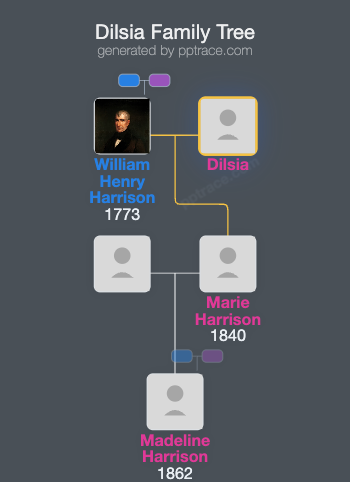
White's ancestry included both African and European roots, with he and his family exhibiting traits considered to be of European descent, such as fair skin and blue eyes. White noted in his autobiography that he identified as a Negro despite his light complexion. His maternal lineage traces to Dilsia, an enslaved woman and concubine of William Henry Harrison, who later became the 9th President of the United States, serving only for 31 days in 1841. Harrison's children with Dilsia, including White's great-great-grandmother Marie Harrison, were born into slavery in Georgia. Marie was later sold and became a concubine to Augustus Ware, a white man who provided her with a house and wealth for her descendants. White's family inherited some of this history but identified as part of the African-American community.
White attended Atlanta public schools and graduated from Atlanta University High School in 1912, followed by completion of his college studies there in 1916. During his time at Atlanta University, White was influenced by the intellectual environment enriched by the work of W. E. B. Du Bois, who had already moved to the North before White enrolled. White’s early education provided him exposure to ideas about race and civil rights.
In 1916, White graduated and initially worked for Standard Life Insurance Company, an enterprise started by African Americans in Atlanta. He also participated in organizing a chapter of the National Association for the Advancement of Colored People (NAACP), which had been founded in 1909. His efforts contributed to improvements in education for black children in Atlanta, where segregated schools were underfunded.
In 1918, White moved to New York City at the invitation of James Weldon Johnson, who was then serving as the NAACP's executive secretary. White began working at the national headquarters as a secretary assistant. His investigative skills and light complexion enabled him to travel to the South undercover to document lynchings and race riots, which were prevalent during that period. These investigations became a significant part of his role in the NAACP.
White's career in civil rights also involved advocacy against segregation and disfranchisement. He helped organize the NAACP's Legal Defense Fund, which challenged segregation laws and practices. Under his leadership, the organization achieved notable successes, including the 1954 Supreme Court decision in Brown v. Board of Education, which declared segregated schools inherently unequal. He succeeded James Weldon Johnson as the head of the NAACP in 1929, officially assuming the role in 1931, and remained in leadership until his death in 1955.
Throughout his tenure, White worked with President Harry S. Truman on efforts to desegregate the U.S. armed forces after World War II, providing a draft for the Presidential Executive Order to implement this policy. Membership in the NAACP increased from fewer than 100,000 to nearly 500,000 under his leadership.
White married Gladys Powell in 1922, and they had two children, Jane and Walter Carl. The marriage ended in divorce in 1949. Subsequently, White married Poppy Cannon, a white South African magazine editor, which led to controversy and the alienation of his family members, including his children, with his son changing his name in protest.
White served on the Advisory Council for the Government of the Virgin Islands beginning in 1934 but resigned in 1935 in protest of President Franklin D. Roosevelt’s silence on Southern opposition to anti-lynching legislation. White died on March 21, 1955.