Takeru Inukai
| Name | Takeru Inukai |
| Title | Japanese politician |
| Gender | Male |
| Birthday | 1896-07-28 |
| nationality | Japan |
| Source | https://www.wikidata.org/wiki/Q7678089 |
| pptrace | View Family Tree |
| LastUpdate | 2025-11-17T10:08:43.295Z |
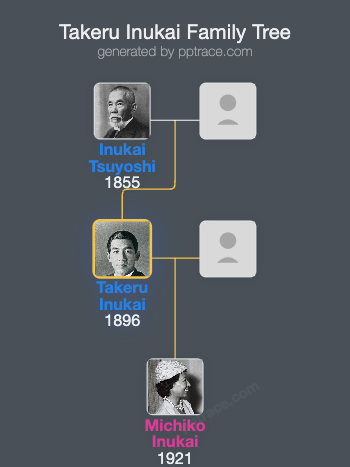
Family Tree
Tap  to expand more relatives
Introduction
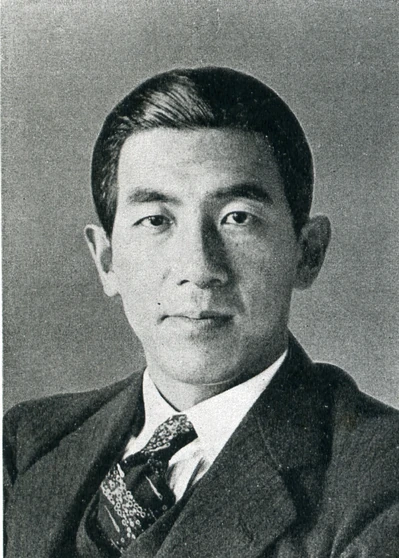
Takeru Inukai (犬養 健, Inukai Takeru) was born on 28 July 1896 and died on 28 August 1960. He was a Japanese politician and novelist active during the Shōwa period in Japan. He was also known by the name "Inukai Ken" and was the third son of Prime Minister Inukai Tsuyoshi.
Early Life
Inukai was born in the Ushigome district of Tokyo. His father, Tsuyoshi Inukai, was a member of the House of Representatives representing Okayama at the time of Takeru's birth. The Inukai family had a history of serving as village headmen during the Edo period. In 1907, his elder sister married Kenkichi Yoshizawa, a diplomat.
Education and Literary Interests
Inukai attended the School of Philosophy at Tokyo Imperial University but did not graduate, choosing to pursue a career as a writer. His literary interests from his student days led him to associate with the Shirakaba ("White Birch") literary society, which was known for its liberal and humanistic outlook. His literary works were influenced by Mushanokōji Saneatsu and Nagayo Yoshirō. He also became a member of the Japanese chapter of the International PEN.
Family
Inukai married Nakako In, who was the niece of Nagayo Yoshirō.
Political Career
Inukai was elected to the House of Representatives in the 1930 election as a member of the Rikken Seiyūkai party, representing a Tokyo constituency. In 1931, his father was appointed Prime Minister of Japan, and Takeru served as his secretary. Following Tsuyoshi Inukai's assassination in the May 15 Incident of 1932, Takeru Inukai took over his father's constituency seat in Okayama.
He served as a parliamentary counsellor to the Ministry of Communications during the first Konoe cabinet. During the split of the Rikken Seiyūkai in 1939, he aligned with the neutral faction led by Tsuneo Kanemitsu. He was questioned by police in connection with the Sorge Spy Incident. Notably, he had maintained contacts with Chinese politicians and aimed to foster better relations between Japan and China. He supported efforts to negotiate peace with Chiang Kai-shek's government and to facilitate defections to Wang Jingwei's government of the Republic of China from 1938 to 1940.
In the 1942 General Election, Inukai was reelected as an independent candidate opposing the Imperial Rule Assistance Association.
Post-War Activities
Following Japan's surrender in 1945, Inukai was appointed as the parliamentary vice minister for foreign affairs under Prime Minister Shidehara Kijūrō. He played a role in organizing the Japan Progressive Party, which was the largest party in the Diet upon its formation. However, due to purges affecting many members affiliated with the Imperial Rule Assistance Association, a significant portion of the party's founding members, including 259 out of 273, were purged. Inukai remained unpurged, as he had maintained independence throughout the war.
The Japan Progressive Party experienced some recovery in the 1946 elections, becoming the second-largest party after Ichiro Hatoyama's Japan Liberal Party. Hatoyama was subsequently purged, and Shigeru Yoshida replaced him. The two parties formed a coalition government under Yoshida's leadership.
In March 1947, the Japan Progressive Party merged with a faction led by Hitoshi Ashida within the Liberal Party to establish the Democratic Party, with Ashida as its president. Post-1947 elections, the Democratic Party formed a coalition with the Japan Socialist Party, led by Tetsu Katayama, with Katayama as prime minister and Ashida as deputy prime minister and foreign minister. Internal disagreements led to the collapse of this coalition in 1948, after which Ashida became prime minister and later resigned amid scandals. Yoshida returned as prime minister, and Ashida was arrested in December. Inukai then became president of the Democratic Party.
In the 1949 general election, Yoshida's victory prompted Inukai to lead his faction to support a coalition with Yoshida's Liberal Party, which most party members opposed. Ultimately, Inukai merged his faction into the Liberal Party in 1950. He served as Minister of Justice from October 1952.
Inukai was involved in the Shipbuilding Scandal of 1954, where Prime Minister Yoshida pressured him to suspend the arrest of Eisaku Sato for alleged corruption. He resigned as Minister of Justice the following day. In 1955, he participated in the merger of the Liberal Party with the Democratic Party to establish the Liberal Democratic Party (LDP).
Death and Family
Takeru Inukai died in 1960 at the age of 64. His final resting place is at Aoyama Cemetery in Tokyo. His son, Yasuhiko Inukai, was the president of Kyodo News. His daughter, Michiko (who died in 2017), was an author and philanthropist.
References
- Iwao Hoshii, Japan's Pseudo-democracy, Routledge, 1993.
- Richard H. Mitchell, Political bribery in Japan, University of Hawaii Press, 1996.
- J.A.A. Stockwin, Dictionary of the Modern Politics of Japan, Taylor & Francis, 2003.