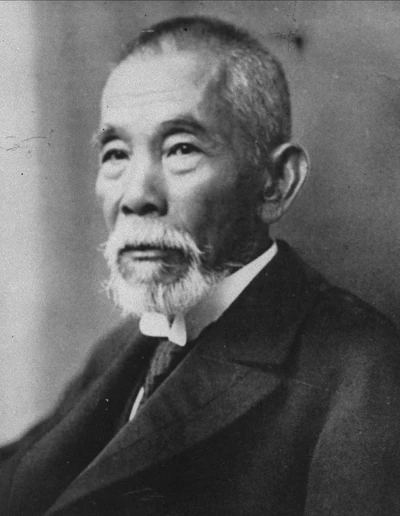
Inukai Tsuyoshi
| Name | Inukai Tsuyoshi |
| Title | Japanese politician and Prime Minister of Japan (1855–1932) |
| Gender | Male |
| Birthday | 1855-06-04 |
| nationality | Japan |
| Source | https://www.wikidata.org/wiki/Q354687 |
| pptrace | View Family Tree |
| LastUpdate | 2025-11-17T10:08:42.339Z |
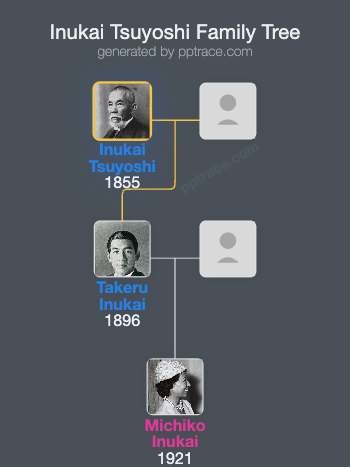
Family Tree
Tap  to expand more relatives
Introduction
Inukai Tsuyoshi (犬養 毅) was a Japanese politician born on June 4, 1855, in Kawairi, Kaya, Bitchū Province, which is present-day Okayama Prefecture. He was the second son of Inukai Genzaemon, a samurai and local official affiliated with the Niwase Domain. His family was a branch of the Itakura clan, historically granted the privilege to wear a katana.
Inukai moved to Tokyo in 1876, where he graduated from Keio Gijuku (now Keio University) with a focus on Chinese studies. Early in his career, he worked as a journalist for the Yūbin Hōchi Shimbun, a sports newspaper subsidiary of the Yomiuri Shimbun, and the Akita Sakigake Shimpō. He participated as a reporter in the Satsuma Rebellion alongside the Imperial Japanese Army.
His entry into politics was facilitated by Ōkuma Shigenobu, who invited Inukai to help establish the Rikken Kaishintō, a political party founded in 1882 that advocated liberal causes, constitutional monarchy, and parliamentary democracy. Inukai was elected to the Lower House of the Imperial Diet in 1890 and was subsequently reelected 17 times, maintaining his seat for over four decades until his death in 1932.
He held his first cabinet position as Minister of Education during the first Ōkuma Shigenobu administration in 1898, succeeding Ozaki Yukio. His tenure lasted only eleven days amid political upheaval. Inukai was also associated with successor parties such as the Shimpotō, Kenseitō, and Rikken Kokumintō, which eventually led to the fall of Prime Minister Katsura Tarō’s government in 1913. During this period, he became increasingly conservative and developed connections with both Pan-Asian movement leaders and Japanese nationalists.
Inukai supported the Chinese republican movement and visited China in 1907. He also aided Sun Yat-sen during the Xinhai Revolution of 1911 and after Sun fled to Japan following failed uprisings against Yuan Shikai. He held a deep respect for Chinese culture and believed in the importance of Sino-Japanese cooperation for Asian solidarity, maintaining close personal and political ties with Chinese figures, including Prince Cường Để, whom he invited to Japan in 1915.
He returned to cabinet roles later, serving as Minister of Communications from 1923 to 1924 under Prime Minister Yamamoto Gonnohyōe, and briefly as Education Minister in September 1923. In 1922, the Rikken Kokumintō became the Kakushin Club, which merged with other parties to form part of the governing coalition during Katō Takaaki’s premiership. In 1924, Inukai supported the coalition as a senior member and continued his political career within the merged parties.
Traveling to China in 1929, Inukai attended a memorial for Sun Yat-sen in Nanjing and observed growing anti-Japanese sentiment in China. Following the death of Tanaka Giichi in 1929, he became president of the Rikken Seiyūkai. He was an outspoken critic of Japan’s signing of the London Naval Treaty, which aimed to limit naval armament. He supported the Japanese Army’s invasion of Manchuria in 1931 and rejected international criticism following the Mukden Incident, which led to the establishment of the puppet state of Manchukuo.
Inukai’s tenure as Prime Minister began in 1931 after Saionji Kinmochi advised Emperor Hirohito to appoint him following the resignation of Wakatsuki Reijirō. His government was characterized by a fragile coalition and reliance on the Privy Council to pass measures circumventing the Diet. Inukai implemented economic policies including devaluation of the yen and protective tariffs, and attempted to control military expansion, despite pressure from the military.
His administration faced increasing turbulence, culminating in the May 15 Incident of 1932, when he was assassinated by junior Navy officers. The attack took place at his residence in Tokyo, during which he was shot multiple times. His last words are reported to have been "If we could talk, you would understand," before the officers responded with "Dialogue is useless." The incident marked a turning point in Japanese politics, emphasizing military dominance over civilian government.
Inukai Tsuyoshi’s descendants include his son, Inukai Takeru, a writer and politician, and his granddaughter Sakura Ando, an actress. His family also includes notable figures such as diplomat Kenkichi Yoshizawa and Sadako Ogata, a former United Nations High Commissioner for Refugees.