Edith Roosevelt
| Name | Edith Roosevelt |
| Title | First Lady of the United States from 1901 to 1909 |
| Gender | Female |
| Birthday | 1861-08-06 |
| nationality | United States of America |
| Source | https://www.wikidata.org/wiki/Q237590 |
| pptrace | View Family Tree |
| LastUpdate | 2025-11-29T01:00:47.685Z |
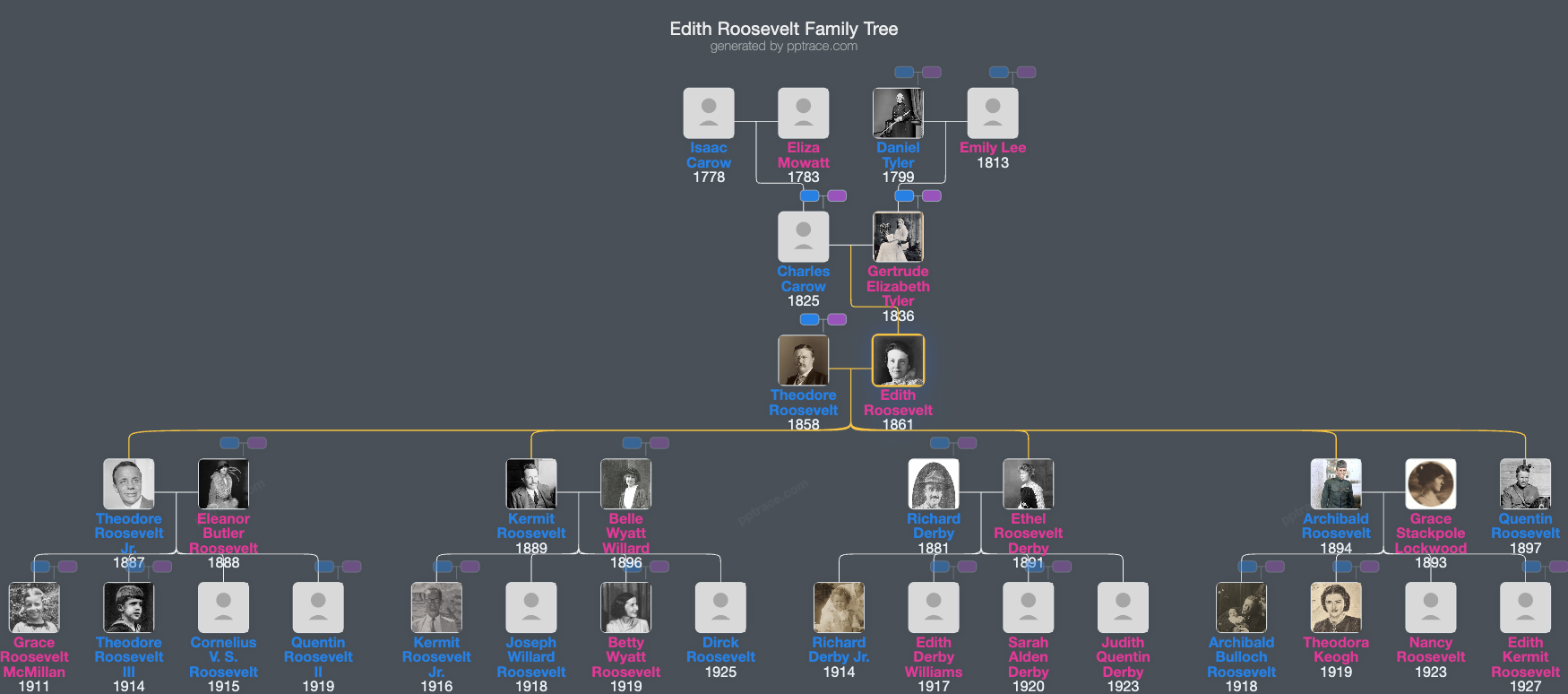
Family Tree
Tap  to expand more relatives
Introduction
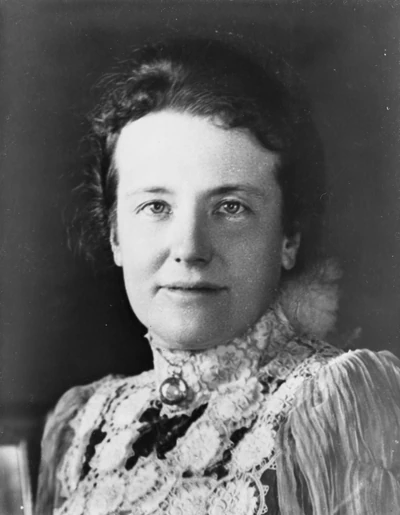
Edith Kermit Roosevelt (née Carow) was born on August 6, 1861, in Norwich, Connecticut. She was the eldest of two daughters of Charles Carow and Gertrude Elizabeth Tyler. Her family was of significant social standing, though her father experienced financial difficulties due to unsuccessful business ventures, chronic gambling, and alcoholism. Her mother suffered from hypochondria. During her childhood, her family was intermittently compelled to reside with relatives due to their financial situation. Edith rarely discussed her parents in her adult life.
She was raised in a socially prominent environment and received her early education at the Roosevelt family home and at the Dodsworth School, where she was instructed in etiquette. Corinne Roosevelt was her closest childhood friend, and Edith was often included in Roosevelt family activities. At the age of four, she witnessed Abraham Lincoln's funeral procession from the Roosevelt balcony. As a child, Edith and Corinne formed a literature club called the "Party of Renowned Eligibles," with Edith serving as club secretary for three years. She also developed a bond with Theodore Roosevelt, Corinne's brother, over shared interests in literature.
In 1871, the Carow family moved uptown, and Edith attended Miss Comstock's School, where she developed a strong sense of religious morality and learned to speak fluent French. Her education particularly emphasized English literature, focusing on William Shakespeare.
In 1876, during the U.S. centennial celebrations, Edith visited the White House and noted the improbability of future visits. After graduating in 1879, she participated in New York social life, though her ability to travel was limited due to responsibilities for her ill parents. During her adolescence, she and Theodore Roosevelt grew closer, developing romantic feelings. They maintained contact when Theodore attended Harvard University, although they experienced a falling-out in August 1878. The reasons for this break are uncertain, with speculations including family disapproval over Theodore's first engagement or personal clashes. The pair rekindled their relationship in December 1879.
By 1884, Theodore Roosevelt had suffered the deaths of his wife, Alice Hathaway Lee, and his mother, Martha Bulloch Roosevelt. He moved west to distance himself from New York. Edith did not see him for about a year but reconnected when Theodore returned to New York in September 1885. They became secretly engaged in November 1885 and maintained correspondence during a period when Edith helped her family relocate to Europe, although she preserved only one of their letters.
In 1886, Edith and her sister inherited a building interest on Stone Street, New York. They engaged in legal proceedings related to damage caused during rail construction, securing a favorable ruling in 1890.
Edith Carow married Theodore Roosevelt on December 2, 1886, at St George's, Hanover Square, London. Their honeymoon spanned France and Italy. Returning to New York in March 1887, they initially stayed with Theodore’s sister, Bamie Roosevelt, and then moved into Leeholm, later renamed Sagamore Hill, at Oyster Bay. Edith brought her family's furniture into the home, and she became the stepmother to Theodore’s daughter, Alice Roosevelt. The couple had five children, beginning with Theodore Roosevelt III, born September 13, 1887.
At Sagamore Hill, Edith managed household affairs, overseeing servants and estate operations alone at times, while Theodore focused on writing and political activities. She experienced postpartum depression after her first childbirth and suffered a miscarriage the following year. She participated in Theodore's 1888 presidential campaign for Benjamin Harrison and gained firsthand experience in political life.
Throughout her life, Edith Roosevelt was active in social organization and household management. She played a significant role in the White House as First Lady from 1901, following Theodore Roosevelt’s ascension to the presidency after William McKinley's assassination. Her influence on her husband's administration, including overseeing White House renovations and organizing social functions, has been documented by historians.
After leaving the White House, she traveled extensively in Europe and Latin America. Her health declined during the 1910s, compounded by the deaths of her sons Quentin in 1918 and Theodore in 1919, as well as her continuing mourning of her husband. In subsequent years, Edith supported political candidates such as Warren G. Harding in 1920 and Herbert Hoover in 1932. She developed an interest in her ancestry, authored a book about her family history, and bought her ancestral home in Brooklyn, Connecticut, in the 1920s.
She suffered further personal losses in the 1940s with the deaths of two more sons and was bedridden toward the end of her life. Edith Roosevelt died on September 30, 1948. Her legacy includes recognition in periodic evaluations of First Ladies, with rankings generally placing her in the upper half.