Theodore Roosevelt
| Name | Theodore Roosevelt |
| Title | 26th President of the United States from 1901 to 1909 |
| Gender | Male |
| Birthday | 1858-10-27 |
| nationality | United States of America |
| Source | https://www.wikidata.org/wiki/Q33866 |
| pptrace | View Family Tree |
| LastUpdate | 2025-11-17T06:42:15.876Z |
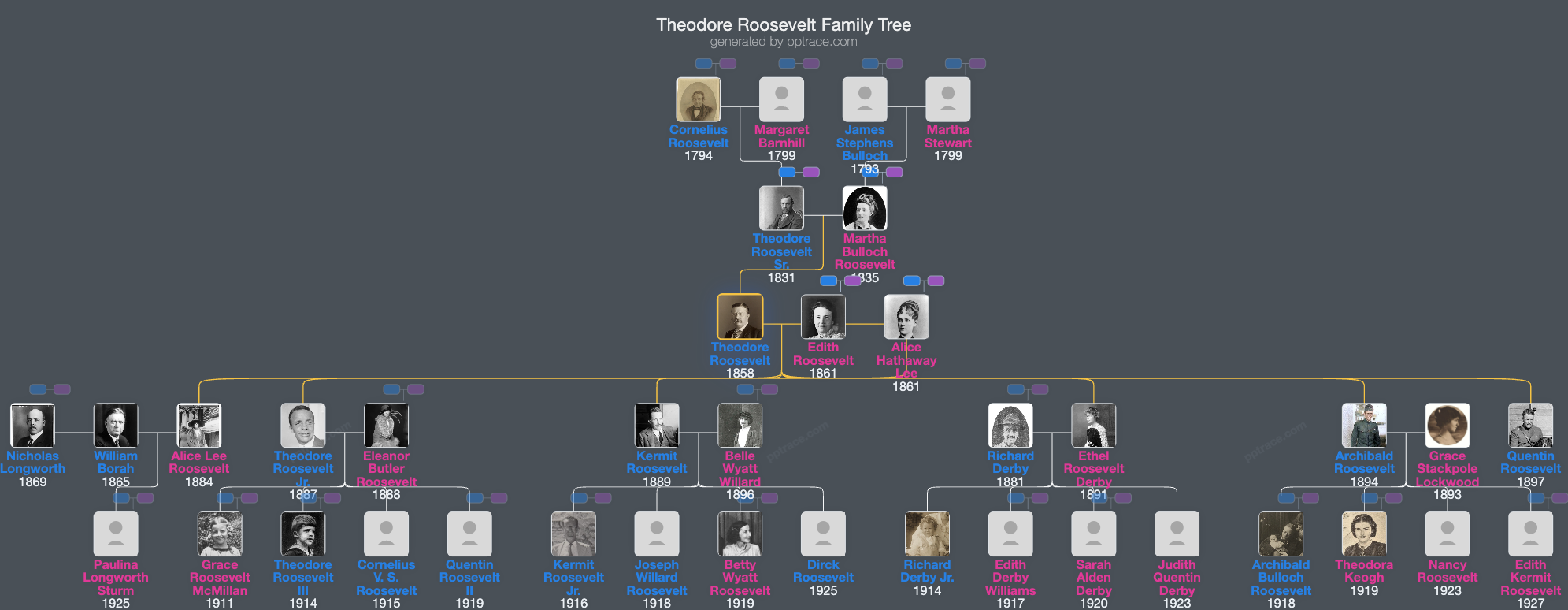
Family Tree
Tap  to expand more relatives
Introduction
Theodore Roosevelt Jr., commonly referred to as Teddy or T. R., was born on October 27, 1858, in Manhattan, New York City. His parents were Martha Stewart Bulloch and Theodore Roosevelt Sr., a businessman. Roosevelt had an older sister named Anna (commonly called Bamie), a younger brother Elliott, and a younger sister Corinne.
Roosevelt's early years were characterized by fragile health and severe asthma, which influenced him throughout childhood. Despite his health challenges, he demonstrated a vigorous interest in natural history from a young age. At age seven, he developed a fascination with zoology after observing and dissecting a dead seal. He and his cousins established a makeshift "Roosevelt Museum of Natural History," which included specimens collected through hunting and exploration. Roosevelt also engaged in early scientific writing, including a paper titled "The Natural History of Insects" at age nine. Family travels, including trips across Europe, Egypt, and the Alps, exposed him to diverse environments and underscored the benefits of physical activity in managing his asthma.
Roosevelt was homeschooled during his early education. His academic strengths included geography, history, biology, French, and German, although he struggled with mathematics and classical languages. In 1876, he entered Harvard University, where he was guided by a focus on character and health as advised by his father. He graduated in 1880, Phi Beta Kappa, magna cum laude, with an A.B. degree. During his time at Harvard, Roosevelt was active in rowing, boxing, and various student organizations, including the Alpha Delta Phi fraternity and the Porcellian Club. His academic work showed an early commitment to natural sciences and literature, although he found some coursework formalistic and disconnected from practical applications.
After Harvard, Roosevelt attended Columbia Law School but soon left to pursue a career in politics. Influenced by his father’s involvement in the Republican Party, Roosevelt became involved in local Republican politics in New York, notably defeating a machine-backed candidate for a seat in the state assembly in the early 1880s.
Roosevelt also demonstrated a keen interest in naval history and strategy. While at Harvard, he studied the role of the U.S. Navy during the War of 1812 and published the book "The Naval War of 1812" in 1882. This work gained recognition for its scholarship and remains a significant contribution to naval history. His naval ideas were associated with, but predated, the influence of Alfred Thayer Mahan.
In 1880, Roosevelt married Alice Hathaway Lee, a socialite. They had a daughter named Alice Lee Roosevelt, born on February 12, 1884. Two days later, Alice Hathaway Lee died from undiagnosed kidney failure, coinciding with the death of Roosevelt's mother, Martha, from typhoid fever. This personal tragedy profoundly affected Roosevelt, leading him to withdraw temporarily from public life and focus on mourning and reflection. He left the care of his young daughter to his sister Bamie and later assumed custody of Alice.
In his political career, Roosevelt was elected to the New York State Assembly, serving from 1882 to 1884. His early legislative efforts and political involvement marked the beginning of a prominent career that would eventually include roles such as New York City Police Commissioner, Assistant Secretary of the Navy, and Governor of New York prior to his presidency.
Roosevelt served as the 25th Vice President of the United States under President William McKinley for six months in 1901, after which he assumed the presidency following McKinley's assassination. He was inaugurated as the 26th president at the age of 42, becoming the youngest person to hold the office. During his presidency from 1901 to 1909, Roosevelt was recognized for his leadership in progressive reforms, including antitrust policies, conservation efforts, and expansion of U.S. naval power. His domestic policies, known as the "Square Deal," aimed to promote fairness, regulate industries, and preserve natural resources through the establishment of national parks and monuments.
Roosevelt’s foreign policy initiatives included the construction of the Panama Canal, expansion of the U.S. Navy, and the deployment of the Great White Fleet on a global voyage to demonstrate American naval strength. He was awarded the Nobel Peace Prize in 1906 for mediating the Russo-Japanese War, the first American and first non-European recipient of that honor.
He was elected to a full term in 1904 and later sought the Republican nomination in 1912. Frustrated with the conservative direction of his party, he founded the Progressive Party, known as the Bull Moose Party, and ran for president that year, splitting the Republican vote and allowing Democrat Woodrow Wilson to win. Roosevelt’s later years included a significant Amazon expedition and vocal criticism of President Wilson during World War I. He offered to lead American volunteers to France, but his offer was declined. Roosevelt’s health diminished, and he died on January 6, 1919.
Throughout his life, Roosevelt was recognized by historians and political scientists as one of the significant presidents in American history.