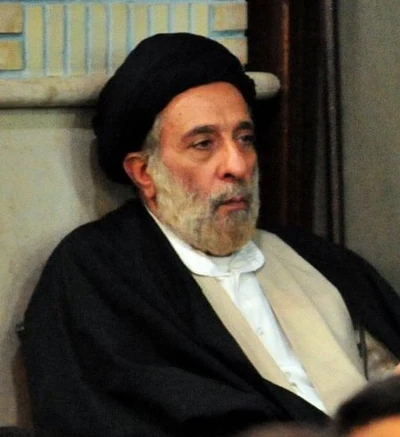
Hadi Khamenei
| Name | Hadi Khamenei |
| Title | Iranian politician |
| Gender | Male |
| Birthday | 1947-01-01 |
| nationality | Iran |
| Source | https://www.wikidata.org/wiki/Q3893843 |
| pptrace | View Family Tree |
| LastUpdate | 2026-05-07T09:15:46.494Z |
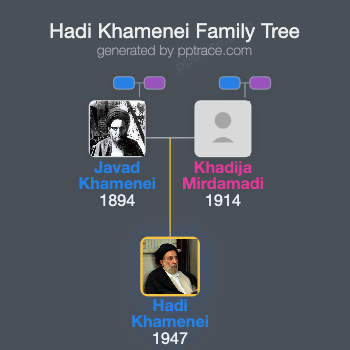
Family Tree
Tap  to expand more relatives
Introduction
Hadi Khamenei (Persian: هادی خامنهای), born on 26 January 1948, is an Iranian politician, mujtahid, and linguist. He is a member of the reformist Association of Combatant Clerics and has served as a deputy in the Iranian Parliament representing a district in Tehran.
Family and Early Life:
Hadi Khamenei is the younger brother of Ayatollah Ali Khamenei, the former Supreme Leader of Iran. Their father was Javad Khamenei, an Iranian Azerbaijani cleric, and their mother was an ethnic Persian from Yazd. He grew up in the 1950s as one of eight siblings. During his childhood, he spent his free time raising birds and playing sports. He has stated that his father did not compel him into religious studies.
Education and Early Career:
Details about his higher education are not specified, but he became active in politics and religious affairs. In the 1980s, he served as a deputy minister. He also held the position of Secretary-general of the Assembly of the Forces of Imam's Line.
Political Activities:
Hadi Khamenei became a prominent reformist figure in the 1990s, which put him at odds with his older brother, Ayatollah Ali Khamenei, whose official authority he criticized for concentrating excessive power. He was an influential adviser to reformist President Mohammad Khatami. As a member of the Assembly of Combatant Clerics, he has voiced concerns about the concentration of power in the hands of the Supreme Leader, criticizing the notion that the leader is above the law and can unilaterally change or decree laws.
Khamenei has expressed opposition to the Guardian Council's vetting process for candidates in elections, arguing that it endangers Iranian democracy. He contended that some reformist candidates are unjustly barred from participating in elections. His own candidacy for a seat in the Assembly of Experts in 1998 was rejected by the Guardian Council under the claim of "insufficient theological qualifications."
Legal and Social Challenges:
Throughout the 1990s, Hadi Khamenei engaged in seminarian activities across Iran and launched reformist media outlets to challenge government-controlled media. He faced organized opposition from hard-line critics, who targeted him for physical attacks during lectures critical of hard-line leadership. In 1999, he was assaulted in Qom by a mob believed to number around one hundred, which resulted in a fractured skull. Authorities arrested 45 suspects related to the attack. Leading Iranian newspapers and various official bodies condemned the violence, though some conservative figures accused him of inciting the attack for publicity. Others, such as parliament member Rajab Rahmani, suggested he staged the event to garner sympathy.
Media Involvement:
Hadi Khamenei was the publisher of multiple newspapers, including Hayat-e-No, which was associated with reformist viewpoints. The newspaper faced accusations from the Special Court for the Clergy of insulting Ruhollah Khomeini, Iran's founder, due to a cartoon, leading to its temporary ban in January 2000. The paper was characterized by sources like The Guardian as reliable and by the Financial Times as pro-reform before its ban in December 2009 by the Press Supervisory Board for operating outside the regulations. Another publication, Jahan-e Islam, was shut down in 1995 after being accused of insulting Islamic beliefs and publishing false information. It was described variably as a moderate and as a hard-line Islamic newspaper in different reports.
References:
[Details omitted for brevity; source data includes various news reports and official statements.]