Maria Fitzherbert
| Name | Maria Fitzherbert |
| Title | Mistress of British king (1756-1837) |
| Gender | Female |
| Birthday | 1756-07-26 |
| nationality | United Kingdom of Great Britain and Ireland |
| Source | https://www.wikidata.org/wiki/Q449574 |
| pptrace | View Family Tree |
| LastUpdate | 2025-11-12T01:17:00.904Z |
Family Tree
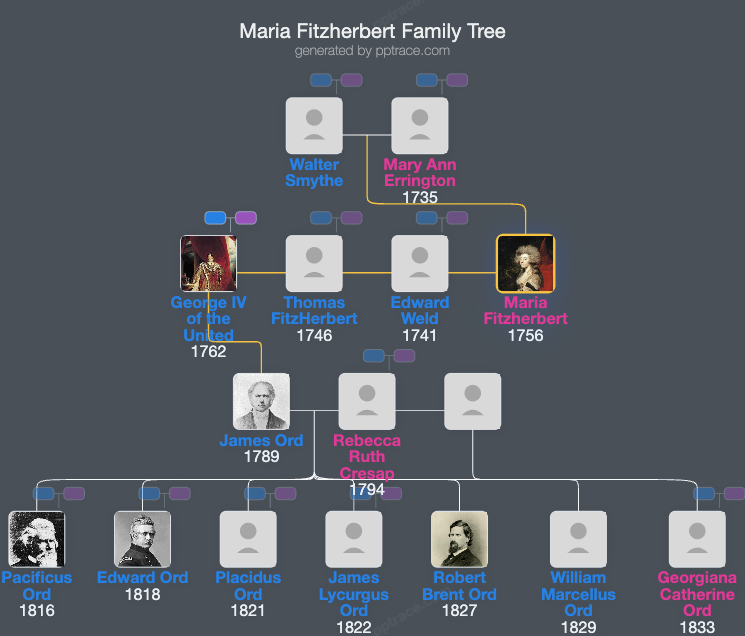
Tap  to expand more relatives
Introduction
Maria Anne Fitzherbert (née Smythe, previously Weld) was born on 26 July 1756 at Tong Castle in Shropshire. She was the eldest child of Walter Smythe of Brambridge, Hampshire, and Mary Ann Errington of Beaufront, Northumberland. Her paternal grandfather was Sir John Smythe, 3rd Baronet, of Acton Burnell, Shropshire. Fitzherbert received education at a French convent in Paris.
She was married twice before her relationship with George, Prince of Wales. In July 1775, at age 18, she married Edward Weld, a wealthy Catholic widower of Lulworth Castle, who was 16 years her senior. Edward Weld died three months later following a fall from a horse. She was left effectively destitute, having failed to sign Weld’s will, which resulted in his estate passing to his younger brother Thomas Weld. After her widowhood, Fitzherbert remarried in 1778 to Thomas Fitzherbert of Swynnerton Hall, Staffordshire; he was ten years her senior. They had a son who died young. Thomas Fitzherbert died on 7 May 1781, leaving Fitzherbert with an annuity of £1,000 and a town house in Park Street, Mayfair.
In spring 1784, Fitzherbert was introduced into London high society and became acquainted with the then Prince of Wales, George. The prince was six years her junior and became infatuated with her, pursuing her persistently. They married secretly on 15 December 1785 in a ceremony conducted in her house’s drawing room by Reverend Robert Burt, one of George’s chaplains. The witnesses were her uncle, Henry Errington, and her brother, John Smythe. This marriage was invalid under English law because it lacked the prior consent of King George III and the Privy Council, as mandated by the Royal Marriages Act 1772. Additionally, her Catholic faith would have disqualified her from marriage to the heir apparent.
Despite the invalidity of their marriage, George regarded Fitzherbert as his wife publicly and privately. In 1794, George informed Fitzherbert that their relationship was over and intended to marry Caroline of Brunswick, which he did in April 1795. Nevertheless, in his 1796 last will, George explicitly expressed affection for Fitzherbert, referring to her as his wife of the heart and soul. Afterward, George and Fitzherbert maintained a complex relationship, with occasional references to reconciliation and acknowledgment of their marriage in private documents.
George’s reign as King George IV saw periods of hostility towards Fitzherbert, especially during his kingship when he distanced himself publicly. It was only towards the end of his life that he showed some recognition of her, including asking to be buried with her eye miniature. After George IV’s death on 26 June 1830, Fitzherbert was found to have kept all of his letters, which he had preserved. She informed King William IV of her marriage to George and displayed a document to this effect.
Fitzherbert lived at Steine House in Brighton from 1804 until her death. She died on 27 March 1837 and was buried at St John the Baptist’s Church in Brighton, which she helped fund. Her memorial sculpture depicts her wearing three wedding rings.
There are claims suggesting Fitzherbert may have had one or two children by George IV, though these are subject to controversy and lack definitive historical verification. Some scholars and families, such as the Wyatts, have asserted descent from her or her purported children, but such claims have not been conclusively established.
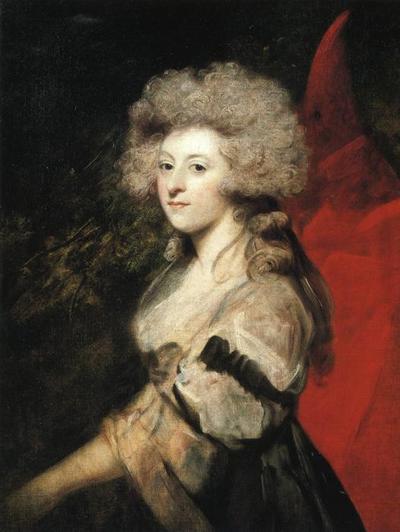
Fitzherbert was described as having hazel eyes, silky blonde hair, an aquiline nose, and a complexion considered flawless. Her appearance has been depicted in various films and television series, including portrayals by Nora Swinburne (1943), Joyce Howard (1947), Rosemary Harris (1954), Susannah York (1979), and Caroline Harker (1994).