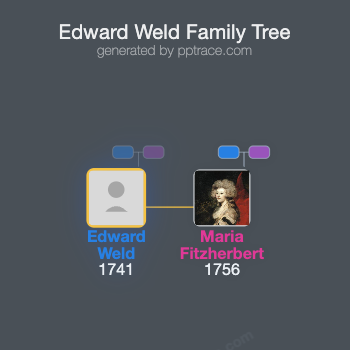
Edward Weld
| Name | Edward Weld |
| Title | English recusant landowner |
| Gender | Male |
| Birthday | 1741-01-01 |
| nationality | — |
| Source | https://www.wikidata.org/wiki/Q75388841 |
| pptrace | View Family Tree |
| LastUpdate | 2025-11-12T00:47:02.000Z |
Family Tree
Tap  to expand more relatives
Introduction
Edward Weld (1740–1775) was a British landowner associated with the Weld family, a notable recusant family in England. He was born in 1740 as the eldest son of Edward Weld (1705–1761) and Dame Maria Vaughan, and he was the heir to the Lulworth Estate in Dorset, including Lulworth Castle and the surrounding coastline. Weld was part of a wealthy and influential Catholic family, which maintained its recusant status during a period when Catholics faced significant legal restrictions in Britain.
During his youth, Weld received his education abroad, a common practice for sons of Catholic gentry at the time. His educational journey began in the Austrian Netherlands, where he was placed under the tutelage of Jesuit preceptors at Watten, and continued in St. Omer. In 1754, during his time abroad, his mother died. While at St. Omer, his younger brother John became ill and died in September 1759.
Following his education, Weld prepared for the Grand Tour by engaging in social and cultural pursuits. He was known to have stayed at the Jesuit house in Rheims and visited the court of Stanislaw Leszczynski, the former Polish king, in Lorraine. Upon returning to England, Weld was an orphan, having lost both parents, and inherited considerable wealth along with his status as an eligible bachelor.
In 1763, Weld married Juliana Petre, daughter of Robert James Petre, 8th Baron Petre. Juliana died in 1772. Weld remarried in 1775 to Maria Smythe, who was sixteen years his junior and impoverished. He became her first husband. Weld died in 1775, shortly after his marriage, as a result of injuries sustained from a fall from his horse. His death occurred before he could sign a new will, and as he left no children from either marriage, his estate was inherited by his younger brother Thomas Weld, who was nine years his junior.
Maria Smythe, Weld’s widow, later married Thomas Fitzherbert of Swynnerton, who predeceased her in 1781. She became known as "Mrs. Fitzherbert" and is historically notable for her subsequent marriage in 1785 to the future King George IV, which was a morganatic marriage not recognized as equal under the law.
The marriage between Maria Fitzherbert and the Prince of Wales later became a subject of controversy. Maria maintained a correspondence with Lord William Stourton, who was related to her through family connections and served as her confidant, trustee, and executor. Records indicate that she trusted Stourton with her private papers, and she dictated a memoir that detailed her relationship with the Prince of Wales. These documents, held at Coutts Bank and destroyed in part in 1833 at her request, are considered valuable for insights into her relationship with the future king.
Landholdings associated with the Weld family, as of 1775, included properties in Dorset, Hampshire, and Merseyside. In 1801, Thomas Weld, Edward’s brother, acquired Pylewell Park in Hampshire for his son Joseph. Additionally, in 1837, Thomas Weld’s descendants inherited Ince Blundell Hall on Merseyside from a collateral branch of the family.
References to the Weld family history and associated estates are documented in historical records related to landownership and family lineage.