Juliana Fermor Penn
| Name | Juliana Fermor Penn |
| Title | noblewoman; (1729-1801) |
| Gender | Female |
| Birthday | 1729-05-21 |
| nationality | — |
| Source | https://www.wikidata.org/wiki/Q19668723 |
| pptrace | View Family Tree |
| LastUpdate | 2025-11-26T23:25:28.222Z |
Family Tree
Tap  to expand more relatives
Introduction
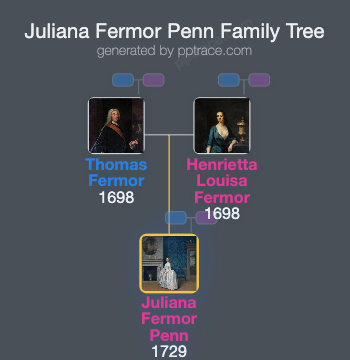
Lady Juliana Penn (née Fermor) was born on 21 May 1729 at Easton Neston in Northamptonshire, England. She was the fourth daughter of Thomas Fermor, 1st Earl of Pomfret, and Henrietta Louisa Jeffreys. On 22 August 1751, she married Thomas Penn, who was thirty years her senior. Prior to her marriage, Thomas Penn was associated with Quaker beliefs; however, after marrying Juliana, he attended Anglican church services regularly but did not participate in the sacrament of Communion. The couple resided at Stoke Park in Buckinghamshire.
Jane and Thomas Penn had eight children, of whom four died in infancy or childhood. Their daughter Juliana died in childbirth at the age of 19. During the early 1770s, Thomas Penn's health declined, and their sons John Penn and Granville Penn were still young. During this period, Juliana became actively involved in the management of the Pennsylvania proprietorship, assisting her husband by corresponding with colonial officials and discussing administrative documents, including maps.
Thomas Penn passed away in March 1775. Following his death, Juliana was appointed co-executor of his estate. The subsequent years saw the outbreak of the American Revolutionary War, which resulted in the loss of the Penn family's proprietorship over Pennsylvania and consequently impacted their wealth. Throughout this period, Juliana maintained correspondence with prominent American leaders such as Henry Laurens and John Adams, advocating on behalf of her family with regard to their interests and situation.
Juliana and her co-executor William Baker showed particular interest in the surveying of land holdings of the Susquehanna Land Company in the Wyoming Valley. They expressed hopes for favorable resolutions in their communications with officials like James Tilghman. In 1783, Reverend Jacob Duché wrote to Benjamin Franklin about visiting Lady Juliana during his official trip to England, referring to her as "my most Amiable Friend Lady Juliana Penn." Additionally, John Jay wrote to her from the negotiations of the Treaty of Paris (1783), informing her of the progress made during the peace talks.
Lady Juliana Penn died in 1801 at the age of 72 at Beaufort House, Ham. She was buried alongside her husband and children at Stoke Poges.
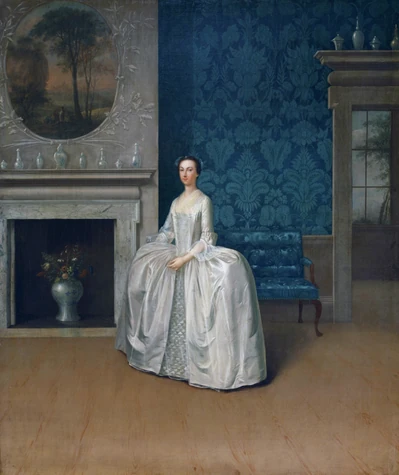
Her legacy includes having been portrayed in three portraits by Sir Joshua Reynolds, completed in 1755, 1764, and 1767. Another portrait, dated 1752 by Arthur Devis, is part of the collection at the Philadelphia Museum of Art. In 1763, the Juliana Library Company of Lancaster, Pennsylvania, was named in her honor after she donated books to the library's collection. A memorial urn created by James Wyatt, commissioned by her son John Penn, is located in the Stoke Poges Memorial Gardens, which is a designated Grade I historic site and was part of the Penn estate at Stoke Park.