George Cavendish-Bentinck
| Name | George Cavendish-Bentinck |
| Title | British politician (1821-1891) |
| Gender | Male |
| Birthday | 1821-07-09 |
| nationality | United Kingdom of Great Britain and Ireland |
| Source | https://www.wikidata.org/wiki/Q600636 |
| pptrace | View Family Tree |
| LastUpdate | 2025-11-26T23:25:37.029Z |
Family Tree
Tap  to expand more relatives
Introduction
George Augustus Frederick Cavendish-Bentinck, known as George Bentinck, was born on 9 July 1821 in Westminster, Middlesex, and died on 9 April 1891. He was a British barrister, Conservative politician, and cricketer.
Family Background:
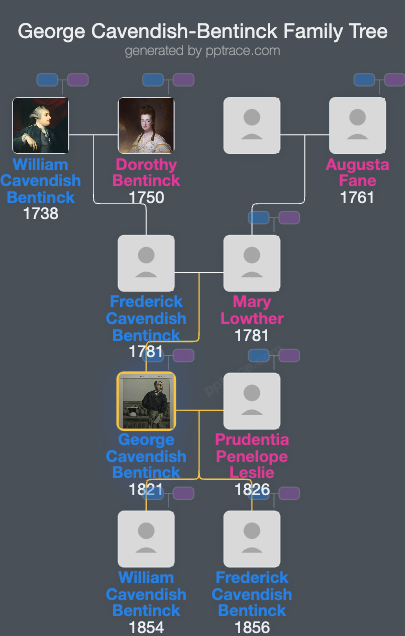
He was the only son of Major-General Lord Frederick Cavendish-Bentinck (1781–1828), who was the fourth son of William Cavendish-Bentinck, 3rd Duke of Portland, a British Prime Minister. His mother was Mary Lowther (d. 1863), daughter of William Lowther, 1st Earl of Lonsdale, a Tory politician and Member of Parliament for several constituencies including Appleby, Carlisle, Cumberland, and Rutland.
Education:
Cavendish-Bentinck attended Westminster School, where he played for the school's First XI cricket team. He then studied at Trinity College, Cambridge.
Early Cricket Involvement:
While at Westminster School, he participated in cricket matches against the Marylebone Cricket Club (MCC) in June 1837 and July 1839, scoring 14, 13, 2, and 6 in these matches. His first-class cricket debut was in 1840 when he played for MCC against Oxford University. He also made a single appearance for Cambridge University cricket team in 1841 and played various matches for MCC against school sides and invitational teams. Over his cricket career, he played in eleven first-class matches, scoring a total of 66 runs with a highest score of 29 not out.
Military and Legal Career:
In 1840, Cavendish-Bentinck was commissioned into the Grenadier Guards but retired in 1841 after one year of service. In 1846, he qualified as a barrister from Lincoln's Inn, practicing as an equity draftsman and conveyancer.
Political Career:
He first unsuccessfully contested the borough of Taunton in the general election of April 1859. Subsequently, he was elected Member of Parliament (MP) for Taunton in a by-election in August 1859. He held this seat until 1865, when he was elected unopposed for Whitehaven. Cavendish-Bentinck served as MP for Whitehaven until his death in 1891.
He served in Benjamin Disraeli's government as Parliamentary Secretary to the Board of Trade from 1874 to 1875 and as Judge Advocate General from 1875 to 1880. In 1875, he was sworn into the Privy Council. Additionally, he served as a Trustee of the British Museum from 1875 until his death and was a Justice of the Peace for Cumberland and Dorset.
Involvement in Scandal:
In 1889, he was mentioned by rentboy John Saul in a police statement as a client of the Cleveland Street male brothel scandal.
Personal Life:
On 14 August 1850, Cavendish-Bentinck married Prudentia Penelope Leslie, daughter of Colonel Charles Powell Leslie. They had four children:
- Christina Anne Jessica Cavendish-Bentinck (d. 1912), who married Sir Tatton Sykes and was the mother of Sir Mark Sykes.
- William George Cavendish-Bentinck (1854–1909), who married Elizabeth Livingston.
- Frederick Cavendish-Bentinck (1856–1948), who married Ruth St Maur and was father to the 8th and 9th Dukes of Portland.
- Mary Venetia Cavendish-Bentinck (1861–1948), who married Arthur James and was a godmother to Queen Elizabeth (the Queen Mother).
Land and Later Life:
He purchased Branksea Castle on Brownsea Island in 1873, where he introduced Jersey cows and developed agriculture. He died at Brownsea Island in April 1891, aged 69. His wife survived him by five years, passing away in 1896.
References:
His contributions in Parliament and additional biographical details are recorded in sources such as Hansard and CricketArchive.