William Cavendish-Bentinck
| Name | William Cavendish-Bentinck |
| Title | English politician, died 1909 |
| Gender | Male |
| Birthday | 1854-00-00 |
| nationality | United Kingdom of Great Britain and Ireland |
| Source | https://www.wikidata.org/wiki/Q26701524 |
| pptrace | View Family Tree |
| LastUpdate | 2025-11-26T12:30:41.147Z |
Family Tree
Tap  to expand more relatives
Introduction
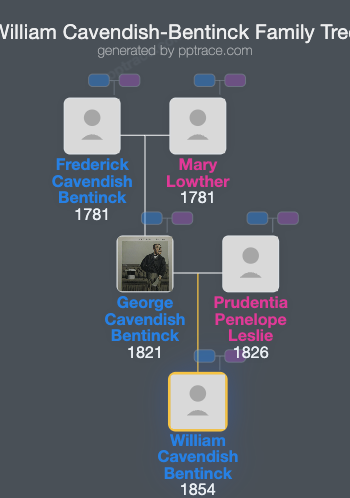
William George Cavendish-Bentinck was born on March 6, 1854, in London. His parents were The Rt. Hon. George Augustus Frederick Cavendish-Bentinck (1821–1891) and Prudentia Penelope Leslie (d. 1896). His paternal grandfather was Major-General Lord Frederick Cavendish-Bentinck (1781–1828), who was the fourth son of William Cavendish-Bentinck, 3rd Duke of Portland (1738–1809), a Prime Minister of Great Britain. His mother was the daughter of Col. Charles Powell Leslie II (1769–1831).
William was educated in London at Marlborough College and Harrow School. He attended Cambridge University, earning a Bachelor of Arts degree in 1876 and a Master of Arts in 1879.
He had several siblings, including an elder sister, Christina Anne Jessica Cavendish-Bentinck (d. 1912), who was married to Sir Tatton Sykes, 5th Baronet, and was the mother of Sir Mark Sykes, 6th Baronet (1879–1919). His younger brother, William George Frederick Cavendish-Bentinck (1856–1948), was the father of the 8th and 9th Dukes of Portland. Another sister, Mary Venetia Cavendish-Bentinck (1861–1948), was married to John Arthur James (1853–1917) and served as a godmother to Queen Elizabeth the Queen Mother.
Through his father, he was related to the British royal family; he was second cousins, thrice removed, to King Charles III.
In his career, William served as private secretary to Henry Holland, 1st Viscount Knutsford, at the Colonial Office, and to Frederick Stanley, 16th Earl of Derby, at the Board of Trade. He held the military rank of Captain in the Dorsetshire Regiment and was a Justice of the Peace for Dorset. Additionally, he was a barrister-at-law.
He made two unsuccessful attempts to be elected to Parliament in 1885 and lost to David James Jenkins. He was elected as a Member of Parliament for Penryn and Falmouth in the 1886 general election, securing 52.2% of the vote. He was re-elected in 1892 but lost his seat in the 1895 election to Liberal candidate Frederick John Horniman.
In 1903, Cavendish-Bentinck traveled to the Durbar through Egypt, visiting Cairo, Brindisi, and Rome. He also served as a Trustee of the British Museum. In 1904, while residing at Highcliffe Castle, the family hosted King Edward VII in Christchurch.
William George Cavendish-Bentinck married Elizabeth Livingston on August 12, 1880. Elizabeth was born in 1855 and died in 1943. She was the daughter of Ruth Baylies (1817–1918) and Maturin Livingston Jr. (1815–1888) of Staatsburg, New York, and granddaughter of Maturin Livingston (1769–1847), a notable American lawyer and politician. Elizabeth had a twin sister, Ruth T. Livingston, who married Ogden Mills and was mother to Ogden Livingston Mills, a U.S. Secretary of the Treasury.
William and Elizabeth had four children:
- Mary Augusta Cavendish-Bentinck (1881–1913), who married John Gorman Ford, the first Secretary of the British Legation to Rome, in 1906.
- Ruth Evelyn Cavendish-Bentinck (1883–1978), who married Walter Spencer Morgan Burns in 1907. He was a nephew of J. P. Morgan.
- An additional two children are referenced but not named in the provided information.
In 1899, a social reception was held in her honor, organized by Louisa Matilda Livingston, a cousin of Elizabeth, to mark her debut in London society.
William George Cavendish-Bentinck died on August 22, 1909, at the age of 55, at Forest Farm in Windsor, Berkshire. In 1914, his widow Elizabeth commissioned the construction of a family mausoleum in the Churchyard of St Giles, Hertfordshire, designed by architect Robert Weir Schultz.