Harriet Osborne, Baroness Godolphin
| Name | Harriet Osborne, Baroness Godolphin |
| Title | British noblewoman |
| Gender | Female |
| Birthday | 1801-01-01 |
| nationality | United Kingdom of Great Britain and Ireland |
| Source | https://www.wikidata.org/wiki/Q47012071 |
| pptrace | View Family Tree |
| LastUpdate | 2025-11-26T12:38:20.412Z |
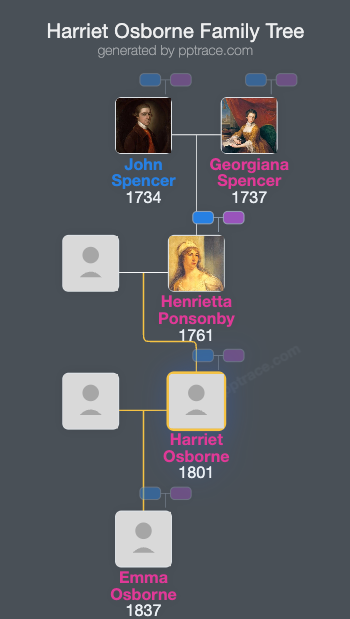
Family Tree
Tap  to expand more relatives
Introduction
Harriet Osborne, Baroness Godolphin (née Arundel Stewart), was born on 17 August 1800 and died on 28 October 1852. She was a British noblewoman known for her familial connections and her marriage into the aristocracy.
Harriet was born as an illegitimate child. Her mother was Henrietta Ponsonby, Countess of Bessborough, a woman involved in high society. At the time of Harriet's conception, Lady Bessborough was in a long-term romantic relationship with Lord Granville Leveson-Gower. By the end of 1799, Lady Bessborough discovered she was pregnant and subsequently kept her pregnancy secret to avoid potential social scandal and the risk of divorce. The birth of Harriet occurred in August 1800, and she was given the surname Arundel Stewart, influenced by family names and her mother’s pet name for Leveson-Gower.
Due to societal disapproval of illegitimate children, Lady Bessborough arranged for Harriet to be raised by a foster mother. Nevertheless, she and her mother maintained a close relationship through correspondence and gifts. When Harriet was two years old, her mother purchased a locket and sought a lock of Lord Leveson-Gower’s hair to send to her daughter, indicating ongoing maternal contact. In August 1812, Harriet moved to live with her father’s household at Tixall Hall in Staffordshire. Her arrival was initially intended to be temporary, but her stepmother, Lady Harriet, a niece of her mother and a first cousin to Harriet, adopted her into the family. Harriet was included as part of the household, which comprised her half-siblings and her brother George Arundel Stewart. Throughout her childhood, Harriet was not informed of her true parentage and referred to Lord Leveson-Gower as “her guardian.”
In 1824, the family moved to Brussels due to Lord Granville’s appointment as British ambassador to The Hague. During this period, arrangements were made for Harriet’s marriage prospects. She received etiquette lessons and was considered well-mannered and physically attractive. While in the Netherlands, Harriet met Hon. George Osborne, the son of Francis Osborne, 1st Baron Godolphin, and a first cousin to the 7th Duke of Leeds. Osborne was the heir to the dukedom of Leeds, which awarded him the courtesy title of "Honorable."
Harriet married George Osborne on 21 October 1824 at the British Embassy in Paris. The couple initially resided in the Bois de Boulogne and became part of French society. They experienced significant financial difficulties, often living beyond their means. Both Harriet and her brother George Arundel Stewart inherited a tendency toward financial imprudence. While Harriet's debts were more substantial, her father and guardian, now the 1st Earl Granville, frequently assisted her in managing these debts, which caused her some embarrassment.
George Arundel Stewart traveled extensively and served as a private secretary to his father. He died in 1875. Harriet and George Osborne had eleven children, three of whom died in early childhood. Their surviving children included George Godolphin Osborne, who became the 9th Duke of Leeds, and other children with various familial and societal roles. Harriet was present at the family estate in Stapleford, Cambridgeshire, where she died in 1852.
Following her death, her husband inherited the dukedom of Leeds in 1872 after the death of his cousin. George Osborne did not remarry and died in 1872. Their eldest surviving son succeeded to the dukedom. A hatchment depicting the family arms shows that Harriet’s coat of arms was excluded from the traditional heraldic representation due to her illegitimate status, although the depiction subtly acknowledges her as the wife of the duke.