Tomiichi Murayama
| Name | Tomiichi Murayama |
| Title | 81st Prime Minister of Japan |
| Gender | Male |
| Birthday | 1924-03-03 |
| nationality | Japan |
| Source | https://www.wikidata.org/wiki/Q310126 |
| pptrace | View Family Tree |
| LastUpdate | 2025-11-17T06:48:11.200Z |
Family Tree
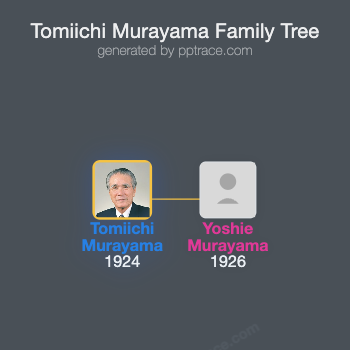
Tap  to expand more relatives
Introduction
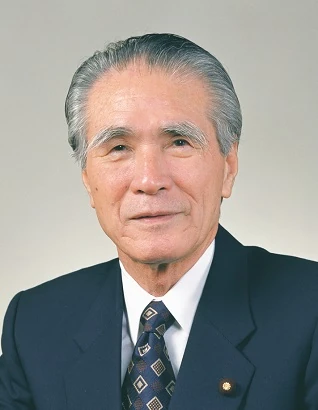
Tomiichi Murayama (村山 富市, Murayama Tomiichi), born on 3 March 1924 in Ōita Prefecture, Japan, and deceased on 17 October 2025, was a Japanese politician who served as the Prime Minister of Japan from 1994 to 1996. He was the first socialist to hold the office since Tetsu Katayama in 1948. Murayama is known for his 1995 "Murayama Statement," which included an official apology for Japan's past colonial wars and aggression during the first half of the 20th century.
Early Life and Education:
Murayama was the sixth son of eleven children in a family where his father was a fisherman. His father died when Murayama was fourteen years old, necessitating his work delivering newspapers and holding small jobs to support his family. He completed his high school education at Oita Municipal High School in 1938, after which he moved to Tokyo. There, he worked at a printing factory during the day and studied at the Tokyo Municipal School of Commerce at night. In 1943, he entered Meiji University as a philosophy student. During World War II, he was mobilized in 1944, working at Ishikawajima shipyards, and was drafted into the Imperial Army later that year. He served in the 72nd Infantry of the 23rd Brigade of the 23rd Division as a private second class. Following Japan's surrender, he was demobilized with the rank of officer candidate, finishing the war as a cadet with the rank of sergeant. He graduated from Meiji University in 1946.
Post-War Career:
After university, Murayama became general secretary of the Oita Prefecture Fishing Village Youth League in 1948, working to establish fisheries cooperatives. Subsequently, he served as secretary of the Oita Prefectural Employees' Labor Union. In 1951, he first ran unsuccessfully for the Oita City Council. He married Yoshie Murayama in 1953.
Political Career:
Murayama was elected to the Oita City Council in 1955 as a member of the Japan Socialist Party (JSP), serving two terms. In 1963, he was elected to the Oita Prefectural Assembly, serving nine years. He was elected to Japan's national legislature, the Diet, in the 1972 general election for the Oita 1st district, and was re-elected nine times.
Rise to Prime Ministership:
Following the 1993 general election, in which the Liberal Democratic Party (LDP) lost its majority, the JSP, under leader Sadao Yamahana, also lost seats. The Hosokawa Cabinet was formed as the first non-LDP government since the party’s inception. However, Hosokawa resigned in 1994 amid scandals, and there was considerable political turbulence. Murayama was elected leader of the JSP and eventually became Prime Minister on 9 June 1994, after negotiations that resulted in a coalition government comprising the JSP, the LDP, and New Party Sakigake.
Prime Ministership (1994–1996):
Murayama’s tenure was characterized by efforts to stabilize Japanese politics and address historical issues. He issued the "Murayama Statement" on the 50th anniversary of the end of World War II, in which he apologized for Japan's military actions and colonial rule. This statement has been regarded as a formal acknowledgment of Japan’s wartime actions and a stance taken by successive governments.
During his time in office, Murayama managed a coalition government often described as a grand coalition, which aimed to reconcile longstanding conflicts between the LDP and JSP. His administration faced challenges including deteriorating Japan-U.S. relations, responses to the 1995 Great Hanshin Earthquake, and the Tokyo subway sarin attack. He resigned on 11 January 1996, and the JSP was reorganized into the Social Democratic Party, which subsequently lost many seats in the 1996 elections, leading to Murayama’s resignation as party leader.
Legacy:
Murayama’s political career spanned local and national levels, beginning with his election to the Ōita City Council and culminating in his leadership of the Japanese government. His tenure as prime minister is notably marked by his government’s acknowledgment of Japan’s wartime history and efforts toward diplomatic reconciliation.