Henry Sidgwick
| Name | Henry Sidgwick |
| Title | English philosopher |
| Gender | Male |
| Birthday | 1838-05-31 |
| nationality | United Kingdom of Great Britain and Ireland |
| Source | https://www.wikidata.org/wiki/Q433076 |
| pptrace | View Family Tree |
| LastUpdate | 2025-11-26T23:31:10.127Z |
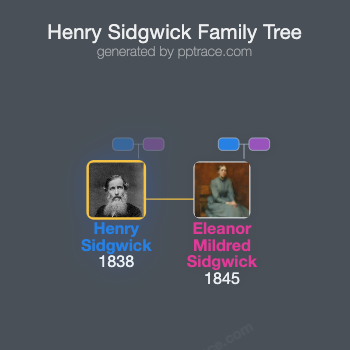
Family Tree
Tap  to expand more relatives
Introduction
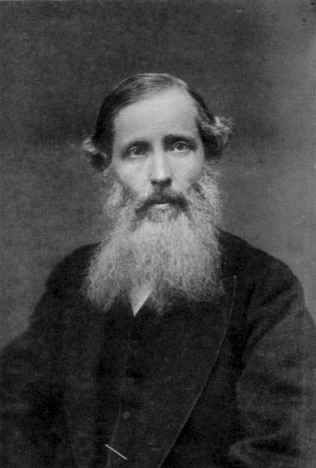
Henry Sidgwick (31 May 1838 – 28 August 1900) was an English philosopher and economist known for his contributions to utilitarian ethics and economics. He held the position of Knightbridge Professor of Moral Philosophy at the University of Cambridge from 1883 until his death.
Born in Skipton, Yorkshire, Sidgwick was the son of Reverend W. Sidgwick, who served as headmaster of Ermysted's Grammar School, and Mary Sidgwick née Crofts. His early education took place at Rugby School, where he was a student of Edward White Benson, a future Archbishop of Canterbury and his cousin and later brother-in-law. He enrolled at Trinity College, Cambridge, and joined the Cambridge Apostles, an intellectual society, in 1856. During his time at Trinity, Sidgwick achieved recognition as senior classic, 33rd wrangler, chancellor's medallist, and Craven scholar in 1859. He was elected to a fellowship at Trinity and became a lecturer in classics, a role he held for ten years.
In 1869, Sidgwick transitioned from classics to moral philosophy as his primary academic focus. That same year, he resigned his fellowship at Trinity due to his non-conformity with the Church of England, though he retained his lectureship and was later made an honorary fellow in 1881. His publication of "The Methods of Ethics" in 1874 significantly elevated his reputation, with the work later recognized as a major contribution to moral philosophy. John Rawls referred to it as the "first truly academic work in moral theory, modern in both method and spirit."
Sidgwick's academic appointments included becoming a praelector on moral and political philosophy at Trinity in 1875, and in 1883, he was appointed the Knightbridge Professor of Philosophy. In 1885, with the removal of religious tests, Sidgwick was re-elected to a fellowship at Trinity College. Besides his teaching and writing, he actively participated in university governance; he was a member of the General Board of Studies from its inception in 1882 until 1899, and was involved with the Indian Civil Service Board and the Local Examinations and Lectures Syndicate, serving as chairman of the Special Board for Moral Science. Among his students was the philosopher Bertrand Russell.
Sidgwick was involved in various social and philanthropic initiatives, notably advocating for the higher education of women. He was instrumental in establishing Newnham College, Cambridge, a women-only college, and helped initiate systems of higher local examinations for women. He resided at North Hall from 1880, living there with his wife after its establishment as a women’s residence; his wife later became principal of the college.
His personal life has been subject to scholarly investigation. A 2004 biography by Bart Schultz suggested that Sidgwick was a lifelong homosexual, although whether he ever acted on these inclinations remains uncertain. This aspect of his life was a source of internal struggle as described by Schultz.
Sidgwick was a prominent member of societies such as the Society for Psychical Research, serving as its first president, and was a participant in the Metaphysical Society. Politically, he was initially a liberal and later aligned with the Liberal Unionists in 1886.
He served as president of the second International Congress of Experimental Psychology in 1892, a key event contributing to the development of the International Union of Psychological Science. Due to ill health, Sidgwick resigned from his professorship early in 1900 and died later that year. He was buried in Terling, Essex, alongside his wife.
Sidgwick's philosophical work primarily focused on ethics, where he argued for a utilitarianism based on intuitive moral judgment. He sought to reconcile utilitarianism with common-sense morality and explored the idea that moral knowledge is objective and accessible through rational procedures. His metaethical stance included defending moral realism and anti-naturalism, rejecting the reducibility of moral properties to natural properties.
He is also associated with the concept of esoteric morality—the view that certain moral principles, such as utilitarianism, may be acceptable in principle but not suitable for broad dissemination. His methodology and analysis of utilitarian ethics have influenced subsequent philosophical research.
Sidgwick's legacy lies in his comprehensive approach to ethical theory and his methodological contributions that remain influential among ethicists and scholars of moral philosophy.