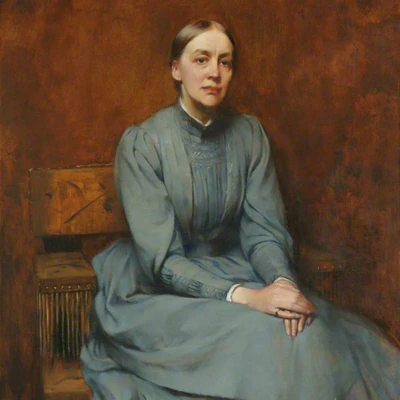
Eleanor Mildred Sidgwick
| Name | Eleanor Mildred Sidgwick |
| Title | British mathematician & college principal (1845-1936) |
| Gender | Female |
| Birthday | 1845-03-11 |
| nationality | United Kingdom |
| Source | https://www.wikidata.org/wiki/Q1156193 |
| pptrace | View Family Tree |
| LastUpdate | 2025-11-26T23:31:07.493Z |
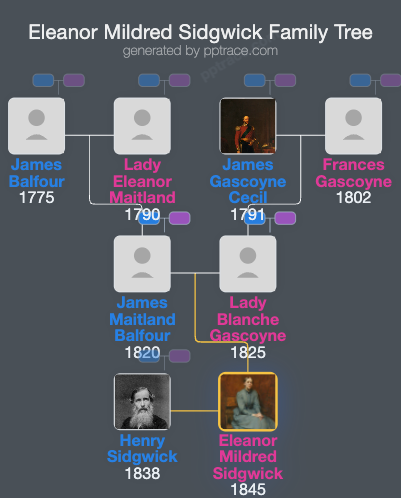
Family Tree
Tap  to expand more relatives
Introduction
Eleanor Mildred Sidgwick (née Balfour) was born on 11 March 1845 and died on 10 February 1936. She was born in East Lothian, Scotland, the daughter of James Maitland Balfour and Lady Blanche Harriet. She belonged to the Balfour family, which was prominent in 19th-century British political and social circles, often associated with the 'Hotel Cecil' political clan. Her siblings included Arthur Balfour, who became Prime Minister of the United Kingdom, Alice Blanche Balfour, a biologist, and Frank Balfour, also a biologist who died young in a climbing accident.
Eleanor was among the first students at Newnham College, Cambridge, admitted in 1876. She married philosopher Henry Sidgwick in the same year, and through this marriage, she adopted feminist perspectives that influenced her later activities. She became Vice-Principal of Newnham College in 1880 under Anne Clough, the founding principal, and succeeded Clough as Principal upon her death in 1892. Eleanor and her husband lived at Newnham until 1900, the year of Henry Sidgwick's death.
In 1890, Sidgwick was elected to the Ladies Dining Society, an informal gathering founded by Louise Creighton and Kathleen Lyttleton. The society included notable members such as the economist Mary Paley Marshall, classical scholar Margaret Verrall, Irish suffragist Mary Ward, and others involved in social reform and education.
She was appointed to the Bryce Commission on Secondary Education in 1894, becoming one of the first three women to serve on a royal commission, established by James Bryce. Aside from her work in education, Sidgwick assisted Lord Rayleigh in laboratory experiments to improve measurements of electrical resistance during her early scientific career. She later directed her analytical skills toward psychical research, testing claims of spiritual phenomena.
Sidgwick was actively involved in the Society for Psychical Research, serving as President from 1908 and receiving the honor of President of Honour in 1932. Her writings, contained mainly in the Society’s Proceedings, primarily addressed psychical phenomena, including critical investigations of physical mediumship and spirit photography. She was highly critical of physical mediumship practices and exposed fraudulent methods used by spirit photographers such as Édouard Buguet, Frederic Hudson, and William H. Mumler. Her scrutiny led to resignations of some prominent spiritualist members from the Society.
Throughout her career, Sidgwick received honorary degrees from the universities of Manchester, Edinburgh, St Andrews, and Birmingham. In 1916, she moved near Woking to live with a brother and remained there until her death.
Her published works include articles and essays on psychical phenomena, such as "Mr. Eglinton" (1886), investigations into spiritualist claims, and analyses of trance phenomena and telepathy. Notable publications include her 1891 response to Alfred Russel Wallace regarding spirit photographs and her detailed study of Mrs. Piper’s trance experiences published in 1915.
References to her life and work are included in various biographies and archives, and her contributions are preserved in the collections of the UK National Archives, Project Gutenberg, and Open Library.