Sarah Villiers, Countess Of Jersey
| Name | Sarah Villiers, Countess Of Jersey |
| Title | English noblewoman |
| Gender | Female |
| Birthday | 1785-03-04 |
| nationality | United Kingdom of Great Britain and Ireland |
| Source | https://www.wikidata.org/wiki/Q7422868 |
| pptrace | View Family Tree |
| LastUpdate | 2025-11-26T23:28:38.763Z |
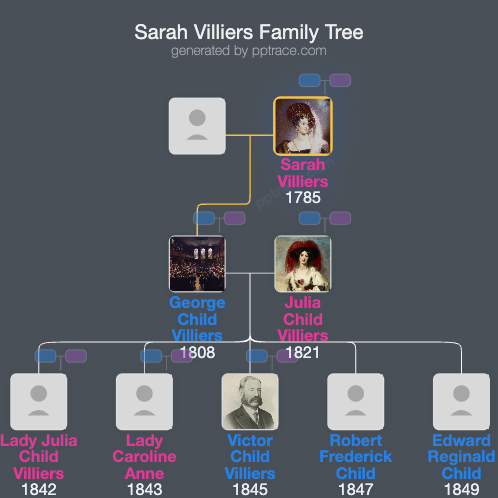
Family Tree
Tap  to expand more relatives
Introduction
Sarah Sophia Child Villiers, Countess of Jersey (born Lady Sarah Fane) was born on March 4, 1785, and died on January 26, 1867. She was an English noblewoman and banker, primarily known for her inheritance and social influence during the Regency era.
Her parents were John Fane, 10th Earl of Westmorland, and Sarah Anne Child. She was the elder sister of Maria Fane, who married John Ponsonby, Viscount Duncannon, later the 4th Earl of Bessborough, a brother of Lady Caroline Lamb. Another sister, Lady Augusta Fane, first married the 2nd Baron Boringdon; after a divorce, she eloped with Sir Arthur Paget. Her maternal grandfather was Robert Child, a principal shareholder in the banking firm Child & Co., making her a descendant of a notable banking family.
Under her grandfather's will, she was the primary beneficiary of his estate. She inherited Osterley Park and became the senior partner of Child & Co. following her grandmother Sarah Child's death. Her inheritance was substantial; in 1805, she was able to give £20,000 to four family members without impacting her income. Her husband, George Child Villiers, 5th Earl of Jersey, added the surname Child by royal license as part of their marriage.
Her political alignment was with the Tory party, although she did not engage in politics with the same fervor as some of her relatives. Reports indicate she publicly expressed grief at the fall of the Duke of Wellington in 1830 and was actively opposed to the Reform Act of 1832.
On May 23, 1804, she married George Child Villiers, in her residence in Berkeley Square. Her husband's mother, Frances Villiers, Countess of Jersey—also known as Lady Jersey—was known for being a mistress of King George IV during his time as Prince of Wales. Sarah's own personal affairs were conducted discreetly, and rumors suggest she had multiple lovers, including Henry John Temple, 3rd Viscount Palmerston.
Sarah and George Child Villiers had seven children:
- George Child Villiers, 6th Earl of Jersey (1808–1859), who married Julia Peel, daughter of Prime Minister Sir Robert Peel.
- Hon. Augustus John Villiers (1810–1847), married Georgiana Elphinstone.
- Hon. Frederick William Child Villiers (1815–1871), married Lady Elizabeth Maria van Reede.
- Hon. Francis John Robert Child Villiers (1819–1862).
- Lady Sarah Frederica Caroline Child Villiers (1822–1853), married Nikolaus Paul, 9th Prince Esterházy.
- Lady Clementina Augusta Wellington Child Villiers (1824–1858).
- Lady Adela Corisande Maria Child Villiers (1828–1860), married Lt. Col. Charles Parke Ibbetson. Her elopement with Captain Ibbetson was widely reported in 1845.
As a patroness of Almack's, the most exclusive social club in London, Lady Jersey was a leading figure of high society, nicknamed "Silence" because of her reputation for talkativeness. Contemporary critics, including Captain Gronow, described her as theatrical and ill-bred, though she was also recognized for acts of kindness and generosity.
She passed away at No. 38, Berkeley Square, Middlesex (now London). She outlived her husband and six of her seven children.
In literature, she was depicted as Zenobia in Benjamin Disraeli's novel "Endymion." Caroline Lamb ridiculed her in "Glenarvon" and, in retaliation, barred her from Almack's—a rare social punishment—though she was eventually reinstated after persuasion from Lamb's family. She is frequently portrayed as an eccentric, observant, and kind character in Georgette Heyer's Regency novels.
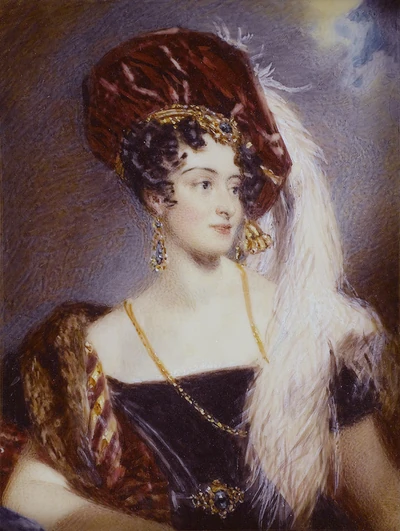
External references include portraits of her at the National Portrait Gallery and archival materials from the UK National Archives.