Humphrey Cornewall
| Name | Humphrey Cornewall |
| Title | English politician |
| Gender | Male |
| Birthday | 1616-01-01 |
| nationality | — |
| Source | https://www.wikidata.org/wiki/Q20735516 |
| pptrace | View Family Tree |
| LastUpdate | 2025-11-26T12:33:50.678Z |
Family Tree
Tap  to expand more relatives
Introduction
Sir Humphrey Cornewall (baptised 16 July 1616 – 7 July 1688) was an English landowner and politician from Herefordshire. He served as Member of Parliament for Leominster from 1661 to 1679. Cornewall was born in 1616 as the eldest son of John Cornewall and Mary Barneby. He was baptised at Eye, Herefordshire, on 14 July 1616.
During the First English Civil War, Cornewall participated on the Royalist side, serving under Sir Henry Lingen. He later claimed that his involvement was under duress, asserting that he only participated to protect himself and his neighbors from cavalier soldiers. Edward Harley noted that Cornewall was compelled to participate in an assault on Stokesay Castle and to serve on a royalist grand jury.
Following the Royalist defeat, Cornewall was fined £222 by Parliamentarians on 1 July 1647 for his support of King Charles I. Adjusted for inflation, this amount is equivalent to approximately £39,859 in 2023. Cornewall successfully argued poverty and paid only £21 16s of the fine. He was also suspected of involvement in George Booth's uprising in 1659.
The Stuart Restoration in 1660 improved Cornewall's fortunes. His name was considered for inclusion among the potential Knights of the Royal Oak. From 1660 onward, he served as a Justice of the Peace in Herefordshire until his death and was a commissioner for assessment in the county from 1660 to 1680. He was elected MP for Leominster in the Cavalier Parliament of 1661.
Cornewall's military and civic roles expanded after the Restoration. He became a major in the Herefordshire Militia by 1662, the same year he was appointed Deputy Lieutenant of Herefordshire and a commissioner for loyal and indigent officers. In 1670, he joined the Council in the Marches of Wales. He was commissioned as a captain in the Admiralty Regiment in 1672 and served as a commissioner for recusants in 1675.
After leaving Parliament in 1679, Cornewall focused on Ludlow, where he had been made a freeman in 1676. He served as an Alderman beginning in 1685 and was Mayor of Ludlow from 1686 to 1687.
In his personal life, Cornewall married Theophila Skynner (1622–1718), the eldest daughter of William Skynner of Thornton Abbey. They had nine children:
- Theophila Cornewall (1644–1731), married Edward Agborough of Ludlow on 24 September 1673
- Robert Cornewall (1647–1705), a soldier and courtier
- Cyriac Cornewall (1652–1718), captain in his cousin Henry Cornewall's Regiment of Foot
- Humphrey Cornewall (date unspecified), also a captain in Cornewall's Foot
- Edward Cornewall, a captain in Cornewall's Foot
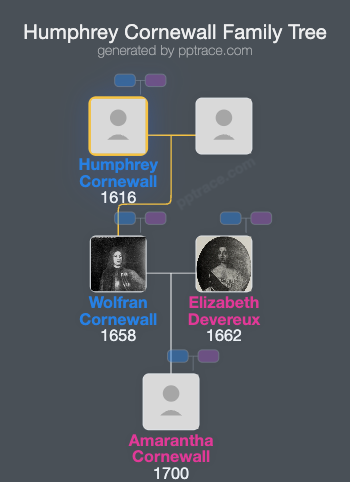
- Wolfran Cornewall (1658–1720), captain in the Royal Navy; his great-grandson was Charles Wolfran Cornwall
- Bridget Cornewall
- Winifrid Cornewall, who married a Mr. Richard Whitney
- Caroline Cornewall, who married a Mr. Roborow
Sir Humphrey Cornewall died and was buried at Ludlow on 7 July 1688.