Wolfran Cornewall
| Name | Wolfran Cornewall |
| Title | English sailor |
| Gender | Male |
| Birthday | 1658-01-01 |
| nationality | Great Britain |
| Source | https://www.wikidata.org/wiki/Q21069449 |
| pptrace | View Family Tree |
| LastUpdate | 2025-11-26T23:26:20.216Z |
Family Tree
Tap  to expand more relatives
Introduction
Captain Wolfran Cornewall (circa 1653 – 21 January 1720) was a naval officer in the Royal Navy.
**Early Life and Family Background**
He was born around 1653, the fifth son of Humphrey Cornewall, a Member of Parliament, and his wife Theophila Skynner (1622–1718).
**Military and Naval Career**
Cornewall commenced his military career in the army, joining Duke of Monmouth's Regiment as an Ensign on 12 June 1679. In 1681, he transferred to Colonel Kirke's Regiment serving in Tangier. During this period, he appears to have also served in the navy, having been appointed Lieutenant aboard HMS Tyger on 30 January 1682.
He returned to army service, being appointed as Ensign in the Duke of York's Regiment on 2 May 1684, and later transferred to the cavalry as a Cornet in the Royal Horse Guards later in 1684. In 1687, he was promoted to Lieutenant within the same regiment.
By 1688, Cornewall had transitioned back to naval service. On 23 August of that year, he was given command of HMS Dartmouth. Subsequently, he was briefly appointed to HMS Constant Warwick on 26 November 1688, and on 23 December 1688, he took command of HMS Swallow. In 1689, he escorted convoys to Ireland during the Williamite War. In April 1689, HMS Swallow participated in escorting a convoy under Colonel Cunningham involving a landing at Derry. However, the expedition was later abandoned following a council of war decision.
In late May and early June of 1689, Cornewall, along with HMS Bonaventure and HMS Dartmouth, continued convoy escort duties under Major-General Percy Kirke. In September of that year, Cornewall participated as a volunteer in the assault on the breach during the Siege of Cork, serving under the Earl of Marlborough.
In 1690, he was appointed commander of HMS Suffolk and participated in the Battle of Beachy Head on 30 June. Historical accounts note that he "behaved with the greatest gallantry" during this engagement. Despite his service, Cornewall fell out of favor with King William III and was dismissed from his command. Admiral Edward Russell intervened on his behalf, writing to the king in his support, emphasizing Cornewall’s merit and bravery, and requesting reinstatement. His plea was successful, and Cornewall received command of HMS Royal Katherine in 1691.
In 1692, he commanded HMS Sandwich and took part in the Battle of Barfleur on 19 May. He continued to serve aboard this vessel in 1693, acting as a second to Vice Admiral Matthew Aylmer. In recognition of his naval service, Cornewall was granted command of a troop from his former regiment, the Royal Horse Guards, in 1693.
His final naval command was the 100-gun first-rate HMS St Andrew in 1694. In 1696, he served as second-in-command to Rear Admiral Edward Whitaker. Following the Treaty of Ryswick in 1697, Cornewall retired from active service and lived on a pension equivalent to that of a first-rate captain.
**Personal Life**
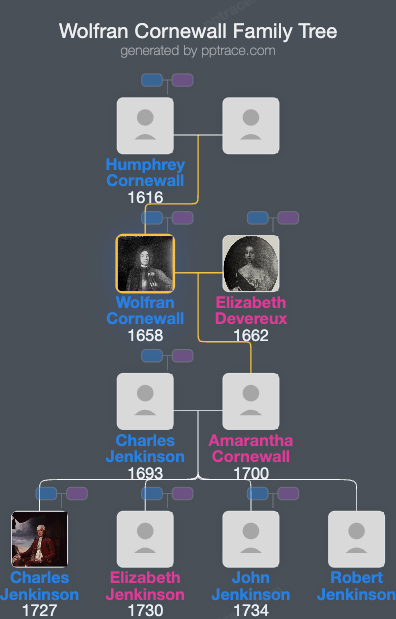
Cornewall married twice. His first wife was Elizabeth Humfrey; they had a daughter, Rose Cornewall, who married Robert Forder and was the maternal grandmother of Charles Wolfran Cornwall. His second wife was Elizabeth Devereux (d. 1741), with whom he had two daughters: Amarantha Cornewall (1700–1785), who married Colonel Charles Jenkinson and was the mother of Charles Jenkinson, 1st Earl of Liverpool; and Bette Cornewall (born 1705).
His great-grandson was Robert Jenkinson, who served as the 23rd Prime Minister of the United Kingdom.
Cornewall died on 21 January 1720 and is commemorated with a stone in the nave of Bath Abbey.