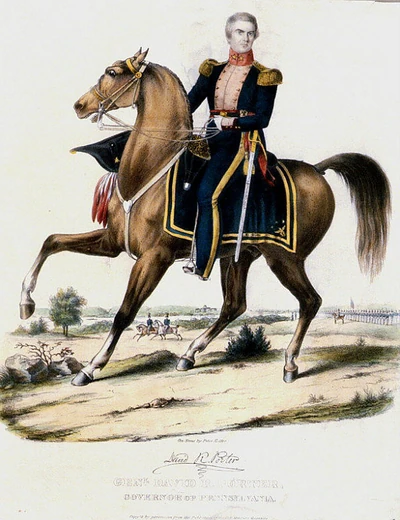
David R. Porter
| Name | David R. Porter |
| Title | ninth Governor of Pennsylvania (1788-1867) |
| Gender | Male |
| Birthday | 1788-10-31 |
| nationality | United States of America |
| Source | https://www.wikidata.org/wiki/Q768487 |
| pptrace | View Family Tree |
| LastUpdate | 2025-11-17T06:40:20.294Z |
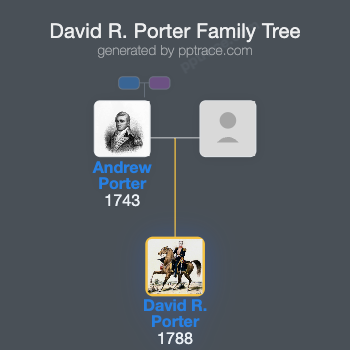
Family Tree
Tap  to expand more relatives
Introduction
David Rittenhouse Porter (October 31, 1788 – August 6, 1867) was an American politician who served as the ninth governor of Pennsylvania. He was born near Norristown, Montgomery County, Pennsylvania, and spent his childhood at Selma Mansion, a residence constructed by his father in 1794. Porter was the son of Elizabeth (née Parker) and Andrew Porter, a Revolutionary War officer. He had siblings who also held notable positions: George Bryan Porter served as the Territorial Governor of Michigan from 1831 to 1834, and James Madison Porter was the Secretary of War from 1843 to 1844.
Porter received a classical education at Norristown Academy. In 1813, he relocated to Huntingdon, Pennsylvania, where he studied law under Edward Shippen. He also became involved in the iron manufacturing business by purchasing an iron works. He was a member of the Huntingdon Lodge of Freemasons, attaining positions such as Grand Master of his lodge and Deputy Grand Master of the Masonic district. Following the economic recession after the War of 1812 that led to his business failure, Porter moved into public service and political life.
In 1819, Porter began his political career as a member of the Pennsylvania House of Representatives, representing Huntingdon County in 1819 and 1820. He later served in various local offices in Huntingdon County and was a member of the Pennsylvania Senate representing the 8th district from 1835 to 1838.
In 1838, Porter was nominated for governor by the Jacksonian Democrats. His candidacy aimed to bridge divisions within the Democratic Party and oppose incumbent Governor Joseph Ritner. His support included prominent figures such as U.S. Senator James Buchanan. His election campaigns were notably contentious, during which supporters of Ritner contested the results, leading to the violent "Buckshot War." Despite the conflict, the election results were certified just days before Porter's inauguration, which took place on January 15, 1839.
As governor, Porter faced a statewide recession that began in 1837. He implemented fiscal policies including a tax on trades and professions similar to an income tax and introduced Pennsylvania’s first capital stock share tax. He also reduced state expenditures and expanded infrastructure projects, notably canal and railroad systems, with efforts to connect Pennsylvania to the Mississippi River and Midwestern cities.
Porter was re-elected in 1840 and began his second term in 1841. His administration continued fiscal reforms, including the passage of legislation to abolish imprisonment for debt and responded to the Philadelphia nativist riots of 1844 by deploying state military forces to quell anti-Catholic violence. During his tenure, Pennsylvania's total debt increased by approximately 25%, but the state managed to pay off the interest on its debt using revenues collected during this period.
His second term concluded in 1845, as the Pennsylvania Constitution prohibited him from seeking immediate re-election. Due to political disagreements and opposition from within his party regarding tariffs, Porter chose to retire from public office. He returned to the iron manufacturing industry, overseeing the construction of the first anthracite coal furnace for iron production in south central Pennsylvania and managing a railroad linking his furnace to existing transportation networks.
Porter also engaged in political activities beyond his governorship, endorsing James Buchanan’s presidential bid in 1856 and supporting the expansion of the transcontinental railroad through Texas by assisting with the incorporation of the New Mexican Railway Company in 1860. A staunch opponent of secession, his son, Horace Porter, served as aide-de-camp to Union General Ulysses S. Grant during the Civil War, participating in events such as the surrender at Appomattox Court House and later serving as the U.S. Ambassador to France from 1897 to 1905.
In the winter of 1866-1867, Porter became ill after attending a church meeting in Harrisburg. His health declined over several months, and he died on August 6, 1867, at the age of 78. He was interred in Harrisburg Cemetery.
The town of Portersville, Pennsylvania, known initially as Stewartsville, is believed to have been renamed in his honor when the community applied for a post office between 1826 and 1828; however, Porter did not serve as governor until 1839. Porter Street in Philadelphia bears his name. His grandson, William Wagener Porter, was a notable attorney and legal author in Philadelphia.