Horace Walpole
| Name | Horace Walpole |
| Title | English writer, art historian, man of letters, antiquarian and Whig politician (1717-1797) |
| Gender | Male |
| Birthday | 1717-09-24 |
| nationality | Great Britain |
| Source | https://www.wikidata.org/wiki/Q309903 |
| pptrace | View Family Tree |
| LastUpdate | 2025-11-26T23:20:20.643Z |
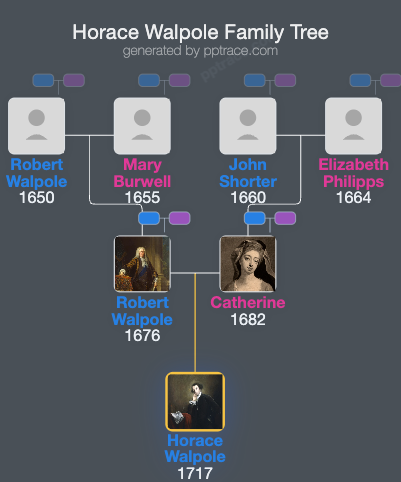
Family Tree
Tap  to expand more relatives
Introduction
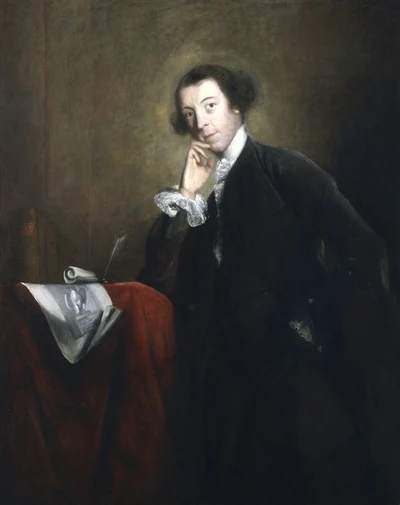
Horatio Walpole, 4th Earl of Orford (24 September 1717 – 2 March 1797), commonly known as Horace Walpole, was an English politician, writer, historian, and antiquarian. He was the youngest son of Sir Robert Walpole, the first Prime Minister of Great Britain, and his wife, Catherine. Walpole was born in London and received early education in Bexley, partially supervised by Edward Weston. He later attended Eton College and King's College, Cambridge, but left without attaining a degree.
Walpole's early years were marked by close relationships with his cousins Francis and Henry Conway. At Eton, he formed a group called the "Triumvirate" with Charles Lyttelton and George Montagu, and was also a member of the "Quadruple Alliance" along with Thomas Gray, Richard West, and Thomas Ashton. During his time at Cambridge, Walpole was influenced by the unorthodox theologian Conyers Middleton, which led him to adopt a skeptical approach to Christian doctrines and to develop a distaste for superstition and bigotry, despite being a nominal Anglican.
In 1737, his mother died, an event described as a significant emotional influence on him. Throughout his life, Walpole did not engage in serious romantic relationships or marriage, and he is described as having remained largely celibate, with some biographers suggesting he was asexual. His close friendships included women such as Anne Seymour Damer and Mary Berry, whom some sources suggest had lesbian orientations. Contemporaries often described him as effeminate, leading to various interpretations of his sexuality; some biographers have characterized him as asexual.
Walpole received income from several sinecures secured by his father, including positions such as Inspector of Imports and Exports in the Custom House and later as Usher of the Exchequer. These positions, which contributed to his financial stability, allowed him to travel extensively. Upon reaching adulthood, he became the Comptroller of the Pipe and Clerk of the Estreats, with an income of around £300 annually, which increased after his appointment as Collectorship of Customs.
Between 1739 and 1741, Walpole undertook the Grand Tour with his friend Thomas Gray, traveling through France and Italy. Their journey included visits to Calais, Boulogne, Amiens, Paris, Reims, Dijon, Lyon, Aix-les-Bains, Geneva, Florence, and Rome. Walpole documented parts of this journey in letters and developed friendships, notably with Horace Mann in Florence. During the trip, a falling-out occurred between Walpole and Gray, primarily due to differences in interests and personal conduct, leading to the end of their friendship.
Walpole’s political career began around 1735, with local political involvement in Norwich. In the 1741 general election, he was elected as a Member of Parliament for Callington, Cornwall, a borough he never visited. His parliamentary career coincided with the fall of his father from power. He delivered his maiden speech in 1742 opposing inquiries into his father's tenure as prime minister. Walpole’s political views aligned with classical liberalism; he was opposed to slavery and the American Revolution, paralleling the views of contemporary philosopher Edmund Burke.
Following his father’s death in 1745, Walpole inherited personal property and offices, including the lease of a house on Arlington Street in London and the office of Collector of the Customs, though his father’s estate was in significant debt. Walpole resumed his friendship with Gray in 1745, during which time he was impacted by the Jacobite Rising, due to his and his family’s support for the Hanoverian dynasty.
In 1749, Walpole began building Strawberry Hill in Twickenham, which became his primary residence. The house is notable for its revival of the Gothic architectural style and is considered a pioneering example of Gothic Revival architecture. The palace received both ridicule and admiration, and it played a significant role in shaping Gothic Revival trends. Walpole also associated with the Blue Stockings Society and hosted its members at Strawberry Hill.
Throughout his life, Walpole was recognized for his contributions to literature and culture, particularly for his work "The Castle of Otranto" (1764), regarded as the first Gothic novel, and for his extensive collection of letters, published in 48 volumes by Yale University Press. A volume of selected letters was published in 2017. Walpole became the 4th and last Earl of Orford of the second creation in 1791, following the death of his nephew.