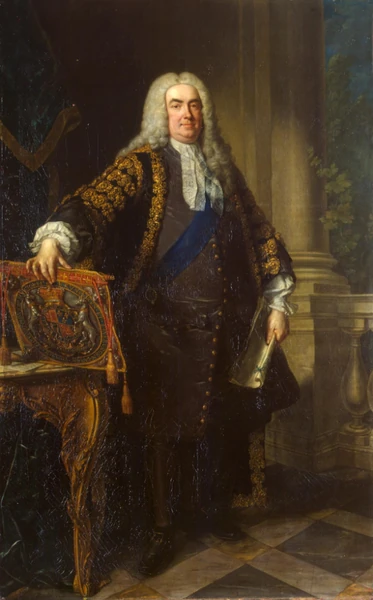
Robert Walpole
| Name | Robert Walpole |
| Title | British statesman and art collector, 1st Earl of Orford (1676–1745) |
| Gender | Male |
| Birthday | 1676-08-26 |
| nationality | Kingdom of England |
| Source | https://www.wikidata.org/wiki/Q104190 |
| pptrace | View Family Tree |
| LastUpdate | 2025-11-26T23:20:19.584Z |
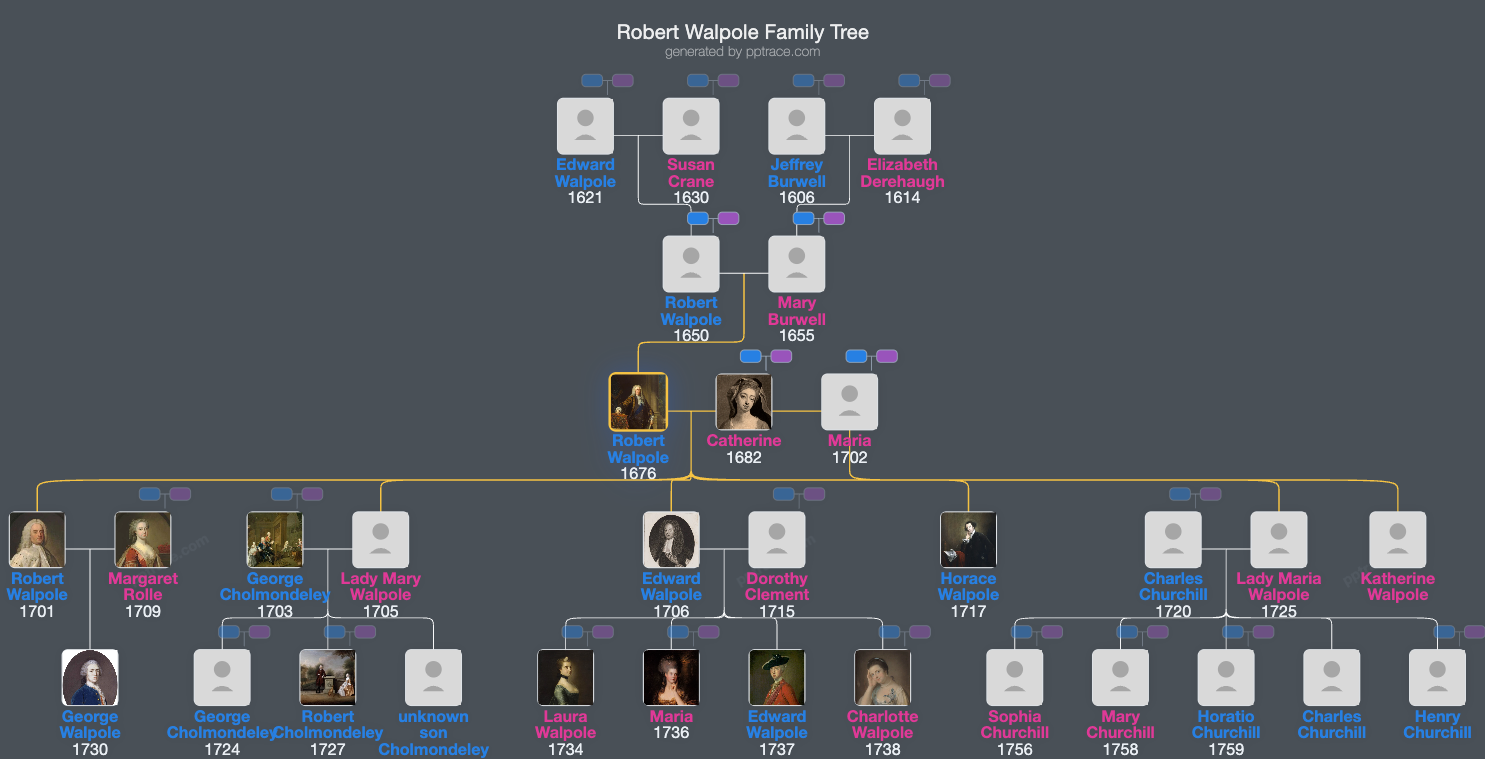
Family Tree
Tap  to expand more relatives
Introduction
Robert Walpole, 1st Earl of Orford (26 August 1676 – 18 March 1745), was a British statesman associated with the Whig party. His political influence is primarily recognized during the period from 1721 to 1742, a phase often referred to as the "Robinocracy," during which he served as the de facto first Prime Minister of Great Britain. His titles included First Lord of the Treasury, Chancellor of the Exchequer, and Leader of the House of Commons. Walpole's tenure is distinguished for its length, making him the longest-serving Prime Minister in British history.
Born in Houghton, Norfolk, Walpole was the third son in a family of nineteen children. His father, Robert Walpole, was a gentry member and a Whig politician representing Castle Rising in the House of Commons. His mother was Mary Burwell, daughter and heiress of Sir Geoffrey Burwell. Walpole's younger brother was Horatio Walpole, 1st Baron Walpole.
Walpole attended private school at Massingham, Norfolk, before enrolling at Eton College in 1690, where he was a King's Scholar. He subsequently matriculated at King's College, Cambridge, in 1696. He left Cambridge in 1698 following the death of his elder brother, Edward, to assist his father in managing the family estate, which comprised nine manors in Norfolk and one in Suffolk. He initially planned to pursue a career in the clergy but abandoned this idea after inheriting the family estate upon his father's death in 1700.
Walpole's parliamentary career began in January 1701 when he was elected as a representative for Castle Rising. In 1702, he transitioned to represent King's Lynn, a pocket borough. He was affiliated with the Whig party and earned the nickname "Robin." His political abilities gained recognition, leading to appointments such as member of Queen Anne's council for her husband, Prince George of Denmark, in 1705. In 1708, he was appointed Secretary at War, and briefly served as Treasurer of the Navy in 1710.
During the political turmoil following Queen Anne's death in 1714, Walpole aligned with the Whigs as they ascended to power under King George I. He became a Privy Councillor and advanced to roles including Paymaster of the Forces, First Commissioner of the Treasury, and Chancellor of the Exchequer by 1716. He was involved in efforts to reduce the national debt using a sinking fund and often navigated factional divisions within the cabinet, especially over foreign policy.
Walpole faced accusations of venality and corruption related to forage contracts in Scotland in 1712, leading to impeachment by the House of Commons and conviction in the House of Lords. He was imprisoned in the Tower of London for six months but was regarded as a political martyr after his release. Subsequently, he returned to Parliament and re-entered government, steadily consolidating political power.
He played a key role in maintaining the stability of the Whig party, safeguarding the Hanoverian succession, and supporting the constitutional principles established by the Glorious Revolution. His leadership style combined moderation, diplomacy, and effective use of parliamentary and royal powers, which allowed him to sustain his influence for over two decades.
Walpole's early life was characterized by extensive education and inheritance, which laid the groundwork for his political career. His political trajectory was marked by resilience amid controversies and his ability to adapt to changing political landscapes.