John Hall Gladstone
| Name | John Hall Gladstone |
| Title | British chemist (1827-1902) |
| Gender | Male |
| Birthday | 1827-03-07 |
| nationality | United Kingdom of Great Britain and Ireland |
| Source | https://www.wikidata.org/wiki/Q901118 |
| pptrace | View Family Tree |
| LastUpdate | 2025-11-26T23:32:13.528Z |
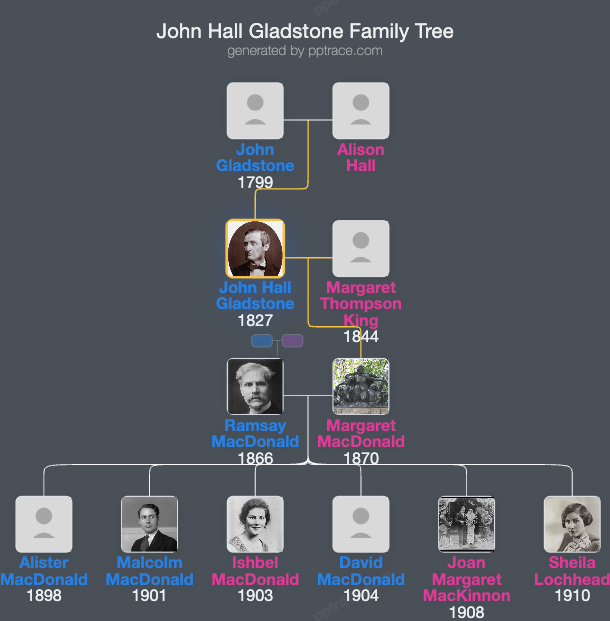
Family Tree
Tap  to expand more relatives
Introduction
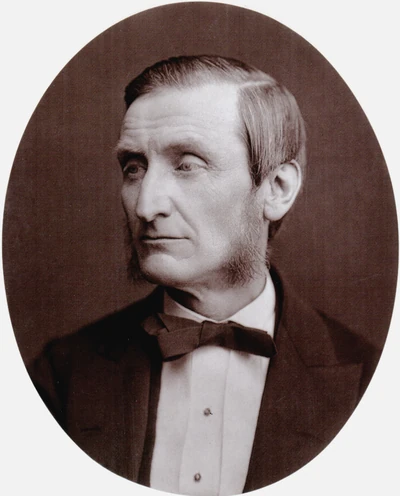
John Hall Gladstone (7 March 1827 – 6 October 1902) was a British chemist known for his contributions to chemistry, optics, and spectroscopy. He served as President of the Physical Society from 1874 to 1876 and was President of the Chemical Society during 1877–1879.
Born in Hackney, London, Gladstone was the eldest son of John Gladstone, a wholesale draper, and Alison Hall. He had two younger brothers. The family was educated at home by private tutors, and from an early age, Gladstone displayed a strong interest in natural sciences. In 1842, after his father retired from business, the family traveled throughout Europe, including time spent in Italy with friends Charles Tilt, his wife, and daughter May, who later married Gladstone in 1852. Gladstone and his wife had seven children, among whom were Isabella Holmes, a social reformer and expert on London's burial grounds, and Margaret, who married Ramsay MacDonald.
Gladstone initially expressed an intention to pursue a career in Christian ministry, influenced by his religious inclinations. However, both his father and Charles Tilt dissuaded him, leading him to enroll at University College, London, in December 1844. There, he attended lectures by Sir William Henry Barlow and John Stenhouse (Graham's lectures on chemistry) and conducted laboratory work. His earliest scientific publication was on "Analysis of Sand from St. Michael's Bay, Normandy," read before the Royal Chemical Society on 16 November 1846. In 1847, he received a gold medal from University College for his studies on "Gun Cotton and Xyloidine." That same year, he matriculated at the University of Giessen under Justus von Liebig, earning his Doctor of Philosophy (Ph.D.) in April 1848, with a dissertation possibly titled "Artificial Formation of Urea from Fulminic Acid."
Throughout his life, Gladstone maintained active religious commitments, teaching in Sunday Schools and conducting services in missions, notably in Clapham. He was also involved with the Young Men's Christian Association.
In 1850, Gladstone was appointed Lecturer in Chemistry at St. Thomas's Hospital, a position he held for two years. At age 26, in June 1853, he was elected a Fellow of the Royal Society. His personal life faced tragedies when he lost his wife, their eldest daughter, and son in 1864. Nevertheless, his scientific and social engagement continued; he served on the Royal Society's Council during 1863–1864 and 1866–1868, and was involved in the Royal Commission on Lighthouses, Buoys, and Beacons (1859–1862) as well as the Gun Cotton Committee (1864–1868).
Politically, Gladstone was a Liberal and contested the borough of York unsuccessfully in 1868. He married Margaret Thompson King in 1869, daughter of the Reverend Dr. David King and niece of Lord Kelvin. Margaret died in 1870, leaving a daughter, Margaret, who later became a social reformer and wife of Ramsay MacDonald.
From 1874 to 1877, Gladstone held the Fullerian Professorship of Chemistry at the Royal Institution and was a founder and first president of the Physical Society. He served as President of the Chemical Society from 1877 to 1879. In recognition of his scientific contributions, he was awarded honorary degrees including Doctor of Science from Trinity College Dublin in 1892 and received the Davy Medal from the Royal Society in 1897 for his work in optical methods applied to chemistry.
Throughout his life, Gladstone was active in scientific research. His early studies included phosphamide and nitrogen iodide. He published significant investigations on chemical affinity and optical phenomena, such as chromatic phenomena, fluorescence, and spectral lines of elements. His research on the absorption spectrum of didymium and the solar spectrum contributed to the understanding of atmospheric constituents and element identification.
His notable scientific achievements also include the discovery of the zinc-copper couple in collaboration with Alfred Tribe around 1872, which became widely used in chemical laboratories for reduction processes. He was also a member of the Company of Wheelwrights and participated in civic activities such as the election of the Lord Mayor at the Guildhall.
Gladstone died on 6 October 1902, having presided over a Christian Evidence Society meeting shortly before his death. He was found deceased in his study due to heart failure and was buried in Kensal Green Cemetery.