John Alden
| Name | John Alden |
| Title | Mayflower passenger and New World colonist (1599-1687) |
| Gender | Male |
| Birthday | 1599-00-00 |
| nationality | Kingdom of England |
| Source | https://www.wikidata.org/wiki/Q6218491 |
| pptrace | View Family Tree |
| LastUpdate | 2025-11-29T00:59:56.380Z |
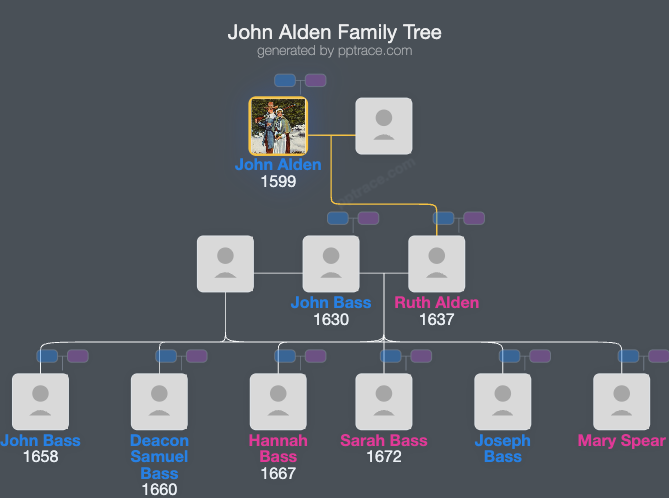
Family Tree
Tap  to expand more relatives
Introduction
John Alden (circa 1598 – September 12, 1687) was an English individual notable for his participation in the Mayflower voyage and his subsequent role in the establishment of Plymouth Colony in Massachusetts.
Alden is believed to have been born around 1598 in England. He was employed in Southampton, England, as a cooper—an artisan responsible for maintaining barrels—for the ship captained by Christopher Jones. According to William Bradford's "Of Plymouth Plantation," Alden was a young man considered promising and was hired in Southampton as a cooper for the Mayflower voyage. Bradford noted that Alden was "much desired" but had the choice to stay in England or voyage to America; he chose to stay and ultimately remained in Plymouth Colony.
In September 1620, Alden was hired by Capt. Christopher Jones to serve as the ship's cooper during the Mayflower's transatlantic crossing. The vessel departed from Plymouth, England, on September 6, 1620, carrying approximately 102 passengers and a crew of about 20 to 30. The voyage lasted approximately two months, during which the ship experienced cramped conditions, illness, and two deaths—one crew member and one passenger. The ship arrived at Cape Cod on November 9, 1620, after initially heading toward the Hudson River area, but due to strong currents, navigational difficulties, and health concerns, the Mayflower anchored in Provincetown Harbor on November 11.
The Mayflower carried a patent granting authority to the settlers' elected leaders within Virginia Colony, but upon arrival in New England, they chose to establish their community outside the original patent's jurisdiction. To formalize their collective governance, they signed the Mayflower Compact on November 11, 1620. Alden was among the signatories, indicating his commitment to abide by the colony's self-governing laws. He was the youngest of the signers and the last surviving individual who signed this document.
Though initially a crew member rather than a settler, Alden elected to stay in Plymouth after the Mayflower's return to England. Following the landing, the colonists decided to settle in Plymouth, which offered strategic advantages such as a good harbor and access to fresh water. A tribe known as the Patuxet, part of the Wampanoag peoples, had previously inhabited the area but had been decimated by disease likely contracted through contact with English fishermen.
The first winter in Plymouth proved perilous, with many settlers succumbing to illness. Priscilla Mullins, a passenger and Alden's future wife, lost her entire family, including her father William Mullins, her mother, and her brother Joseph. The surviving colonists began constructing their settlement, which included a fort on Burial Hill and small houses. The site at which Alden built his initial house was located near Burial Hill; a marker was placed there in 1930 by the Alden Kindred of America. A reconstructed residence is featured at the Plimoth Patuxet Museum today.
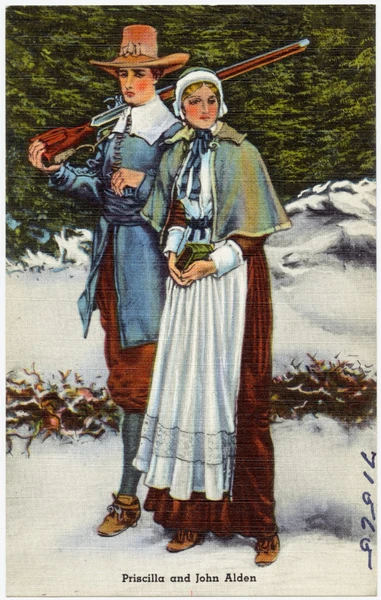
Alden married Priscilla Mullins, though the specific date of their marriage has not been recorded in the available sources. Their marriage became a symbol of early Plymouth history and was later romanticized in Henry Wadsworth Longfellow's 1858 narrative poem "The Courtship of Miles Standish" for its association with Victorian notions of Pilgrim romance.
Throughout his life, John Alden was actively involved in the governance of Plymouth Colony. He served on the Colony’s Governor's Council multiple times, from approximately 1640 until 1686, and held various other official positions such as Treasurer of Plymouth Colony, Deputy to the General Court, member of the Council of War, and member of the Committee on Kennebec Trade.
Alden was the last surviving signer of the Mayflower Compact at the time of his death in 1687. He was buried in the Myles Standish Burial Ground; a memorial stone was placed there in 1930 to mark his presumed gravesite. His descendants and early colonists maintained a society called the Alden Kindred of America, which oversees the preservation of the Alden House Historic Site in Duxbury, Massachusetts. The original house was likely built by his son, Captain Jonathan Alden.
The precise origins of John Alden in England remain uncertain, with various theories proposed regarding his family background and place of birth. Among these are hypotheses linking him to families in Harwich, Essex, and to other Alden families in England. However, definitive primary source evidence establishing his English origins is lacking; much of his early background remains subject to speculation and scholarly research.
Word count: approximately 590