Anthony Addington
| Name | Anthony Addington |
| Title | English physician |
| Gender | Male |
| Birthday | 1713-01-01 |
| nationality | Great Britain |
| Source | https://www.wikidata.org/wiki/Q4771975 |
| pptrace | View Family Tree |
| LastUpdate | 2025-11-26T23:25:50.463Z |
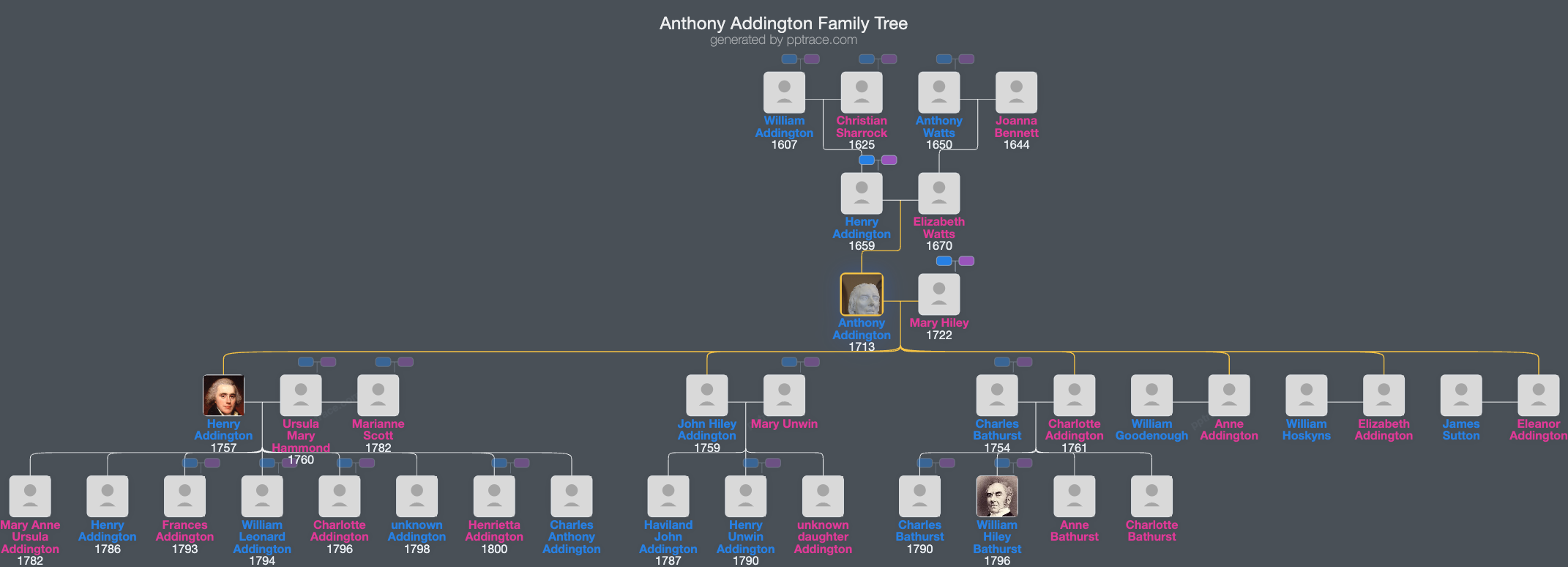
Family Tree
Tap  to expand more relatives
Introduction
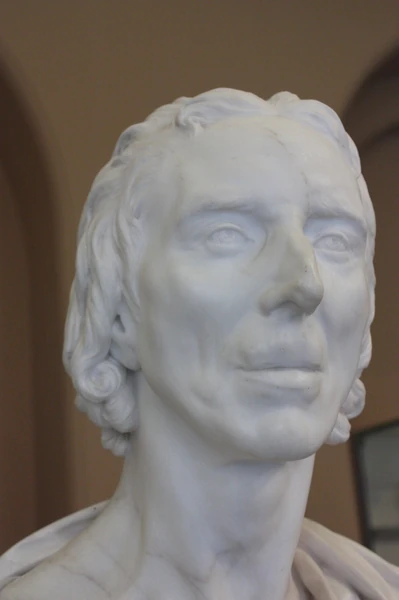
Anthony Addington (1713 – 22 March 1790) was an English physician known for his contributions to medical practice and public health. He was born in Fringford, a village in Oxfordshire, as the youngest son of Henry Addington (1659–1729), a landowner with a "moderately sized" estate in the area. His mother was Elizabeth (circa 1670–1746), the daughter of Anthony and Joanna Watts of Sulgrave, Northamptonshire.
Addington attended Winchester College for his early education. He subsequently matriculated at Trinity College, Oxford, earning his Bachelor of Arts degree in 1737. He continued his studies at Oxford and was awarded the degree of Doctor of Medicine (M.D.) on 24 January 1744. He was admitted as a fellow of the Royal College of Physicians, which facilitated his medical practice in London.
Due to health issues, Addington relocated from London to the countryside. His professional reputation was notably marked by his role as an expert witness in 1752 during the prosecution of Mary Blandy, who was accused of poisoning her father, Francis Blandy. After this case, he retired to Reading, Berkshire, where he practiced medicine and earned a substantial income until his death in 1790.
Addington specialized in the treatment of mental illnesses and was among the physicians consulted when King George III first exhibited symptoms of mental disorder. He also maintained a close professional and confidential relationship with William Pitt the Elder, 1st Earl of Chatham, acting as his advisor. Addington was involved in diplomatic negotiations aimed at forming a political coalition between Lord Chatham and Lord Bute, although these efforts were ultimately unsuccessful.
Regarding his written works, Addington authored "An Essay on the Sea Scurvy," published in Reading in 1753. In this work, he described the disease based on accounts from others rather than personal observation. He proposed an easy method for curing scurvy at sea and for preserving water during voyages. His recommended treatments included depletion therapies, the use of seawater as a purgative, and acidulated beverages with muriatic acid (hydrochloric acid). He suggested that meat was detrimental to those suffering from scurvy but considered biscuit suitable. Furthermore, he claimed that adding an ounce and a half of muriatic acid to a tun of water would prevent decomposition and keep it potable for extended periods.
Addington’s role in the political and medical arenas extended to documenting events such as the involvement of the late Earl Chatham in a transaction in early 1778; however, this attribution is no longer considered his work.
In his personal life, Addington married in 1745 to Mary Hiley, daughter of Reverend Haviland John Hiley, who was the headmaster of Reading Grammar School. They had several children, including Henry Addington, who became the 1st Viscount Sidmouth and served as Prime Minister of the United Kingdom from 1801 to 1804. Their other children included John Hiley Addington, Anne (who married William Goodenough, M.D., in 1770), Eleanor (married James Sutton of Devizes), Elizabeth (married William Hoskins), and Charlotte (married Charles Bragge Bathurst in 1788).
**References**
- Long, George. *The Biographical Dictionary of the Society for the Diffusion of Useful Knowledge.* London: Longman, Brown, Green & Longmans, 1842–1844. 4 vols.
- Espinasse, Francis (1885). "Addington, Anthony". In Leslie, Stephen (ed.). *Dictionary of National Biography.* Vol. 1. London: Smith, Elder & Co.