Henry Addington, 1st Viscount Sidmouth
| Name | Henry Addington, 1st Viscount Sidmouth |
| Title | Prime Minister of the United Kingdom, 1801 to 1804 |
| Gender | Male |
| Birthday | 1757-05-30 |
| nationality | Great Britain |
| Source | https://www.wikidata.org/wiki/Q312577 |
| pptrace | View Family Tree |
| LastUpdate | 2025-11-26T23:25:49.535Z |
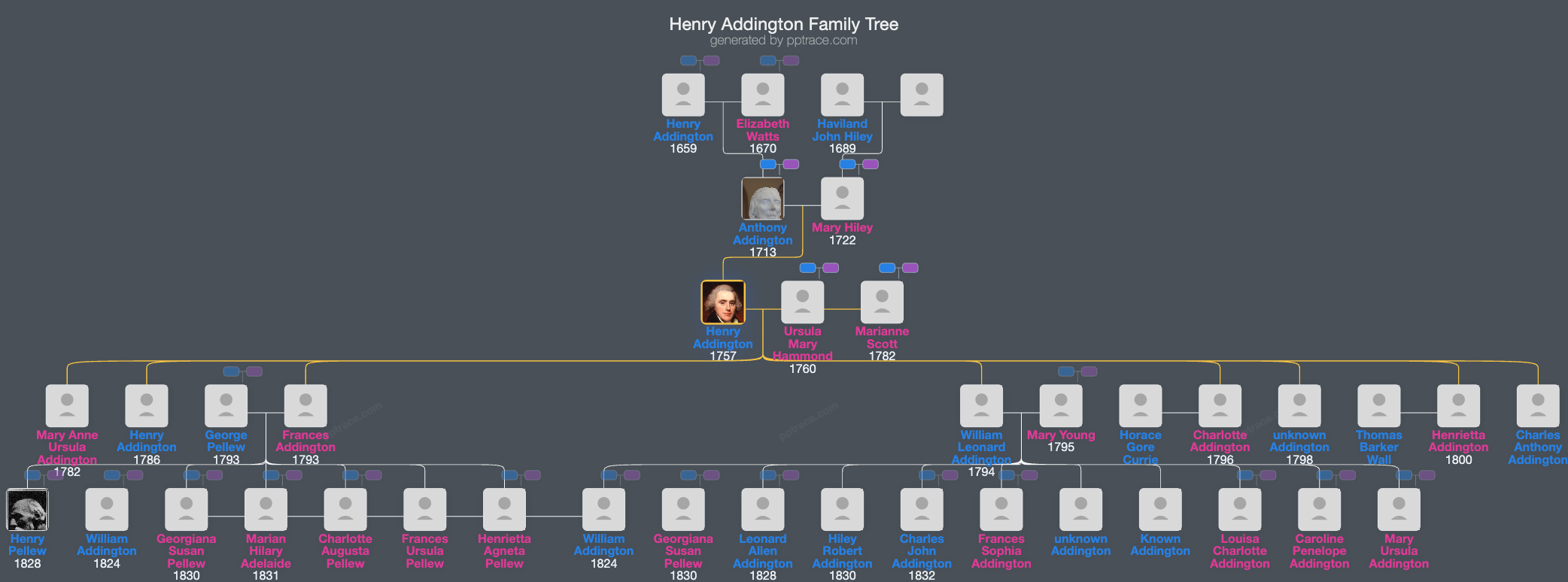
Family Tree
Tap  to expand more relatives
Introduction
Henry Addington, 1st Viscount Sidmouth (30 May 1757 – 15 February 1844), was a British Tory politician. He served as Prime Minister of the United Kingdom from 1801 to 1804 and as Speaker of the House of Commons from 1789 to 1801.
Born in 1757, Addington was the son of Anthony Addington, who was the physician to William Pitt the Elder, and Mary Addington, daughter of Reverend Haviland John Hiley, headmaster of Reading School. His early education took place at Reading School, Winchester, and Brasenose College, Oxford. He also studied law at Lincoln's Inn. In 1791, he married Ursula Mary Hammond, who brought an income of £1,000 annually; the couple had eight children, six of whom survived to adulthood. Ursula died in 1823, and Addington later married Marianne Townsend, widow of William Scott, 1st Baron Stowell.
Addington was elected to the House of Commons in 1784 as a Member of Parliament for Devizes. He was appointed Speaker of the House of Commons in 1789, a position he held until 1801. In March 1801, following William Pitt the Younger's resignation, Addington became Prime Minister, a resignation influenced by the political restrictions on Roman Catholics in Ireland, economic difficulties, social unrest, and internal divisions within the cabinet. His tenure was primarily focused on foreign policy, including the negotiation of the Treaty of Amiens in 1802, which temporarily peaceably concluded hostilities with Napoleonic France and ended the Second Coalition during the French Revolutionary Wars.
The Treaty of Amiens was seen as a minimal acceptance by Britain, largely due to economic hardship and military exhaustion. In early 1803, Britain declared war on France when peace negotiations failed, particularly over defenses of Malta and the threat of French invasion. Addington's conduct during the ensuing war was criticized as weak and defensive; however, he increased military forces, raised revenue through taxation, and seized French colonies. He also sought better diplomatic relations with Russia, Austria, and Prussia, leading to the formation of the Third Coalition shortly after he left office.
In 1802, Addington was appointed vice-president for life of the Court of Governors of the Foundling Hospital in London. His government faced criticism and loss of support due to his inability to manage a parliamentary majority and his limited oratory skills, which led to tensions with William Pitt. In May 1804, faced with partisan criticism of his war policies, Addington's government was replaced.
Despite his fall from the premiership, he remained an influential figure, being reconciling with Pitt in December 1804 and joining the Cabinet as Lord President of the Council in January 1805, upon being created Viscount Sidmouth. Later, he served as Lord Privy Seal and again as Lord President, participating in the Ministry of All the Talents in 1806. He opposed limited Catholic emancipation during this period.
In 1812, Addington was appointed Home Secretary, a role he held until 1822. His tenure included the suspension of habeas corpus in 1817, the passage of the Six Acts in 1819, and the aftermath of the Peterloo Massacre. He continued in the House of Lords, opposing Catholic emancipation and electoral reform until his final parliamentary votes in the early 1830s.
Addington maintained residences in Upottery, Devon, and Bulmershe Court near Reading, as well as White Lodge in Richmond Park during his time as Prime Minister. He was involved in local philanthropy, donating land for the Royal Berkshire Hospital and funding the construction of the Market Cross in Devizes. He was also High Steward of Reading and commander of the Woodley Yeomanry Cavalry.
He died in London on 15 February 1844 at age 86 from influenza and was buried in St Mary the Virgin churchyard at Mortlake.