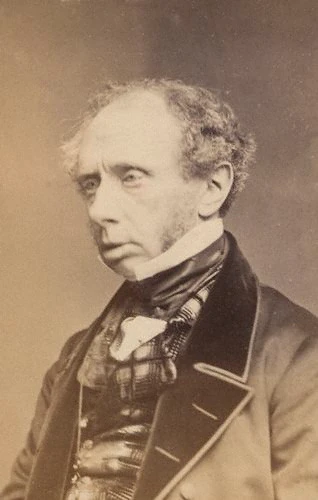
Henry Grey, 3rd Earl Grey
| Name | Henry Grey, 3rd Earl Grey |
| Title | British politician (1802-1894) |
| Gender | Male |
| Birthday | 1802-12-28 |
| nationality | United Kingdom of Great Britain and Ireland |
| Source | https://www.wikidata.org/wiki/Q320291 |
| pptrace | View Family Tree |
| LastUpdate | 2025-11-26T23:27:47.129Z |
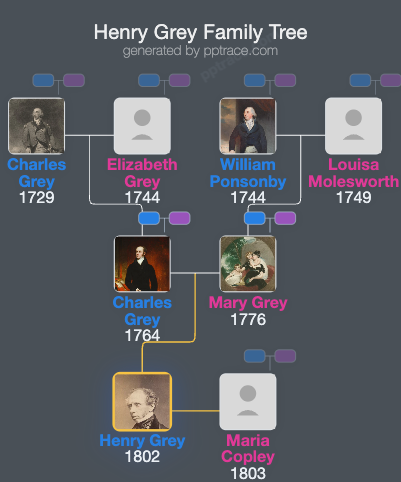
Family Tree
Tap  to expand more relatives
Introduction
Henry George Grey, 3rd Earl Grey (28 December 1802 – 9 October 1894), was an English politician and cabinet minister. He was born in 1802, the eldest son of Charles Grey, 2nd Earl Grey, and The Honorable Mary Ponsonby. His father served as Prime Minister of the United Kingdom in the 1830s. Henry Grey attended Trinity College, Cambridge, where he matriculated in 1821 and graduated with a Master of Arts in 1823.
Grey entered the British Parliament in 1826, initially representing Winchelsea under the title of Viscount Howick. He subsequently represented Higham Ferrers briefly before serving as the member for Northumberland, from 1831, following the Great Reform Act of 1832, and then for North Northumberland. Throughout his parliamentary career, he was affiliated with the Whig Party and served in government during the era of Lord Melbourne's premiership.
In 1830, upon his father's appointment as Prime Minister, Grey was appointed Under-Secretary of State for War and the Colonies. In this role, he managed responsibilities pertaining to Britain's colonial possessions. He was associated with colonial reform movements aligned with Edward Gibbon Wakefield’s views on land and emigration. Discontent with the gradual emancipation of slaves prompted him to resign from his position in 1834.
In 1835, Grey became Secretary at War in Lord Melbourne's cabinet, where he implemented administrative reforms, including measures to prevent malpractices affecting troops in India. He resigned in 1839 due to disagreements over party policies. He was known for his frequent resignations, which contributed to perceptions of his temperament.
Grey was re-elected as an MP for North Northumberland after losing his seat in 1841 but subsequently was elected for Sunderland in a by-election in September 1841. He was a proponent of free trade and predicted the decline of the Corn Laws earlier than many of his contemporaries.
In July 1845, Grey succeeded his father as Earl Grey. When Lord John Russell's government was formed in December 1845, Grey declined to join if Lord Palmerston served as Foreign Secretary but later accepted Palmerston's inclusion in the cabinet in July 1846. That same year, Grey was appointed Colonial Secretary.
As Colonial Secretary, Grey promoted policies emphasizing self-governance for colonies, including reorganization and the expansion of local authority. He was involved in colonial conflicts, such as suppressing insurrection in Ceylon and Australia’s governance restructuring, notably the formation of the colony of Victoria in 1850 through the Australian Colonies Government Act, which he introduced.
Grey's administration attempted to develop a currency system modeled on a currency board, notably establishing one in Mauritius in cooperation with James Wilson and the colonial government there. His tenure in colonial administration was marked by efforts to improve colonial governance, although some policies, such as the handling of the Cape of Good Hope's convict question, encountered difficulties.
He also engaged in political writings, including works defending colonial policy, advocating for parliamentary reform, and addressing issues related to Ireland and U.S. tariffs. Grey was a supporter of Irish emigration schemes, notably the Grey Scheme, which facilitated the transportation of over 4,000 Irish orphan girls to Australia between 1848 and 1850.
In 1848, he was elected to the New South Wales Legislative Council representing the City of Melbourne, though he did not attend the council sessions and his seat was declared vacant in 1850. That same year, he introduced the legislation that led to the separation of Victoria from New South Wales.
Grey did not hold ministerial office after 1852, although he remained active in public affairs. His later writings include analyses of parliamentary reform, land issues, and Irish affairs. He regularly contributed to The Times newspaper with letters on various public issues.
He married Maria Copley on 9 August 1832; the marriage produced no children. Maria died in September 1879. Grey died on 9 October 1894 at the age of 91. His nephew, Albert Grey, succeeded him as the 4th Earl Grey.
The suburb of Howick in Auckland, New Zealand, is named after him. Grey authored several books, including “Colonial Policy of the Administration of Lord John Russell” (1853), “Parliamentary Government Considered” (1858), and “Parliamentary Government Considered” (1864), advocating electoral reforms such as proportional representation.