Charles Seymour, 6th Duke Of Somerset
| Name | Charles Seymour, 6th Duke Of Somerset |
| Title | English noble (1662–1748) |
| Gender | Male |
| Birthday | 1662-08-13 |
| nationality | Great Britain |
| Source | https://www.wikidata.org/wiki/Q1066062 |
| pptrace | View Family Tree |
| LastUpdate | 2025-11-26T23:25:56.308Z |
Family Tree
Tap  to expand more relatives
Introduction
Charles Seymour, 6th Duke of Somerset, KG, PC, was born on 13 August 1662 and died on 2 December 1748. He was an English aristocrat and courtier, known for his involvement in court ceremonial and his efforts in rebuilding Petworth House in Sussex. He was the second son of Charles Seymour, 2nd Baron Seymour of Trowbridge, who died in 1665, and Elizabeth Alington (1635–1692). His paternal lineage traced back to Edward Seymour, 1st Duke of Somerset, brother of Queen Jane Seymour and uncle to King Edward VI, making him a member of a noble family with significant historical connections.
Charles Seymour received his education at Harrow School and later at Trinity College, Cambridge. A portrait of him by Nathaniel Dance-Holland is preserved at Trinity College. In 1675, his elder brother, Francis Seymour, 5th Duke of Somerset, inherited the dukedom from their first cousin, John Seymour, 4th Duke of Somerset, though the estate was divided, with substantial properties like Wulfhall and lands of the feudal barony of Hatch Beauchamp passing to other heirs.
In 1678, following the death of his brother, the 5th Duke of Somerset, Charles, then aged 16, became the 6th Duke of Somerset and 4th Baron Seymour of Trowbridge. In 1682, at the age of 20, he married Lady Elizabeth Percy, the heiress of Joceline Percy, 11th Earl of Northumberland. She was 15 at the time of marriage. This union brought him extensive estates, including Alnwick Castle, Petworth House, Leconfield Castle, Cockermouth Castle, Egremont Castle, Syon House, and Northumberland House in London.
The marriage settlement stipulated that their descendants would adopt the Percy surname to preserve the noble family name. Although both parties were minors when married, Elizabeth Percy later waived this stipulation upon reaching majority, a change that was later formalized when their granddaughter, Lady Elizabeth Seymour, and her husband Sir Hugh Smithson, 4th Baronet, obtained a private Act of Parliament in 1749 allowing them to use the Percy name and arms. This act was partly motivated by the desire to honor the late Duke of Somerset's wish to have the Percy name preserved.
Between 1688 and 1696, the Duke reconstructed Petworth House on a grand scale, adopting a French château style, featuring a central dome and decorative parapets adorned with urns and statues, although many of these elements were altered or lost by subsequent restorations and renovations. The property included a medieval chapel with a Percy family armorial window.
Throughout his career, Seymour held various court appointments. He served in King Charles II’s royal household from 1683 and was appointed Colonel of the Queen Consort's Light Dragoons in August 1685. He fell from royal favor in 1687 after refusing to escort the Papal Nuncio. During the Glorious Revolution of 1689, he supported William III. He became a favorite of Queen Anne after befriending her in 1692 and was appointed Master of the Horse in 1702, a position he held until 1712. His political alliances shifted over time, and he maintained influence with the Tory faction while continuing to be a confidante of Queen Anne.
In 1711, his wife became Mistress of the Robes to Queen Anne, replacing Sarah Churchill, Duchess of Marlborough, who was a target of Swift’s satire, "The Windsor Prophecy." During the crisis upon Queen Anne’s death, Seymour was among the nobles who insisted upon their right to be present at the Privy Council, thereby securing the Hanoverian succession. He retained the office of Master of the Horse until 1715, after which he retired from court life.
In his later years, the Duke was a founding governor of the Foundling Hospital in London, established as the country's first children's home for foundlings, with his second wife, Charlotte Finch, serving as the first subscriber. Charles Seymour died at Petworth House on 2 December 1748.
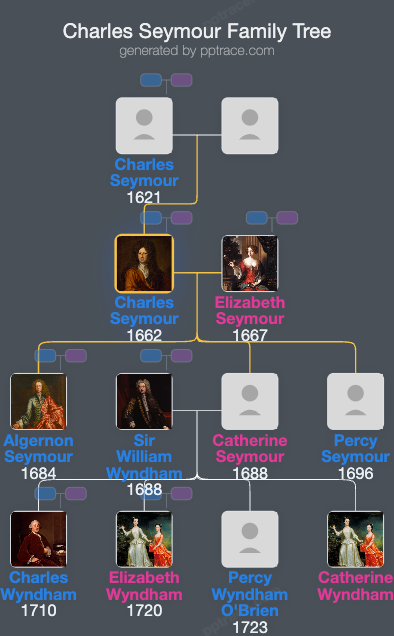
He married twice. His first marriage was in 1682 to Lady Elizabeth Percy, with whom he had one son, Charles Seymour, Earl of Hereford, who died in infancy, and three daughters. His successor was his eldest surviving son, Algernon Seymour, who became the 7th Duke of Somerset. After his first wife’s death in 1722, he developed an attachment to Sarah Churchill, Duchess of Marlborough, but she remained loyal to her late husband's memory.