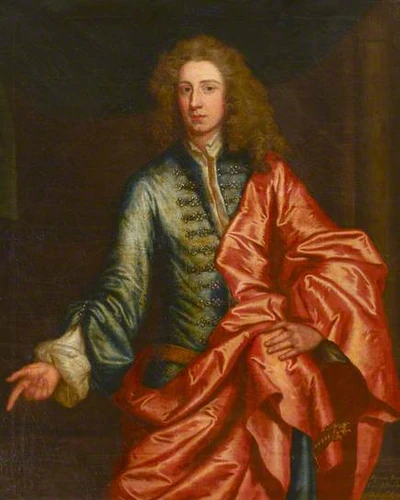
Algernon Seymour, 7th Duke Of Somerset
| Name | Algernon Seymour, 7th Duke Of Somerset |
| Title | British soldier, politician and landowner (1684-1750) |
| Gender | Male |
| Birthday | 1684-11-11 |
| nationality | Kingdom of England |
| Source | https://www.wikidata.org/wiki/Q3611562 |
| pptrace | View Family Tree |
| LastUpdate | 2025-11-26T23:25:58.848Z |
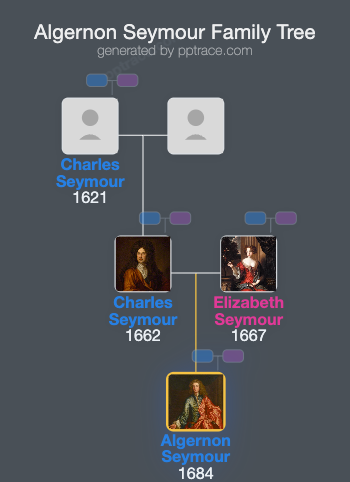
Family Tree
Tap  to expand more relatives
Introduction
General Algernon Seymour, 7th Duke of Somerset (11 November 1684 – 7 February 1750), was a British Army officer, member of the Whig political party, and peer who served in the House of Commons from 1708 until 1722. Upon his elevation to the peerage as Baron Percy in 1722, he took his seat in the House of Lords.
**Early Life and Background**
He was the only son of Charles Seymour, 6th Duke of Somerset, and Lady Elizabeth Percy, who was the heiress to the Percy family. Lady Elizabeth Percy was recognized as Baroness Percy in her own right and was the only surviving child of Joceline Percy, 11th and last Earl of Northumberland. Algernon Seymour embarked on a Grand Tour at age 17, visiting Italy from 1701 to 1703 and Austria in 1705.
**Political and Military Career**
In 1705, while still in Austria, Seymour was elected as Member of Parliament (MP) for Marlborough in a by-election held on 27 November, on his father's recommendation. He was appointed Lord-Lieutenant of Sussex in 1706, a position he held for life. During the summer of 1708, he traveled to Flanders to serve as a volunteer under John Churchill, 1st Duke of Marlborough, and reported on the relief of Brussels in November of that year.
In the 1708 general election, Seymour was elected as a Whig MP for both Marlborough and Northumberland; he chose to represent Northumberland. He became colonel of the 15th Foot in 1709 and was returned again as MP after a by-election. His political actions included acting as a teller for the Whigs and voting for the impeachment of Dr. Henry Sacheverell in 1710. He was re-elected in 1710 and 1713 for Northumberland and supported notable figures such as Richard Steele.
In 1711, Seymour was appointed Governor of Tynemouth Castle and also became a justice of the peace for Northumberland. He continued his parliamentary career, voting on significant issues such as the motion "No Peace without Spain" in December 1711 and supporting Steele against expulsion in 1713. In 1714, he was appointed Groom of the Bedchamber to George, Prince of Wales.
He was returned unopposed as a Whig MP for Northumberland in 1715 and served as colonel of the 2nd Life Guards. Seymour participated in parliamentary debates, such as proposing Spencer Compton as Speaker in 1715 and advocating for the impeachment of William Gordon, 6th Viscount of Kenmure, in 1716. His political standing included voting against the government on William Cadogan in 1717. Following the deterioration of relations between King George I and the Prince of Wales, Seymour resigned from his post as Groom of the Bedchamber to the prince in 1717. He continued to serve as MP until 1722.
**Peerage and Later Positions**
Upon the death of his mother in November 1722, Seymour was summoned to the House of Lords as Baron Percy, thereby vacating his seat in the House of Commons. He held the title of Custos Rotulorum of Wiltshire from 1726 to 1750. His military career advanced as he became a brigadier-general in 1727 and was appointed Governor of Minorca, serving until 1742. He was promoted to major-general in 1735 and to lieutenant-general in 1739. From 1740 to 1750, he served as colonel of the Royal Horse Guards, and from 1742 to 1750, he was Governor of Guernsey.
In 1748, Seymour succeeded his father as Duke of Somerset.
**Land Ownership and Titles**
His only son, Lord Beauchamp, died unmarried in 1744 at age 19. In the same year, Seymour was created Baron Warkworth of Warkworth Castle in Northumberland and Earl of Northumberland, with the remainder to his son-in-law Sir Hugh Smithson, 4th Baronet. This arrangement aimed to pass most of the Percy estates through Seymour's daughter. He was also granted the titles of Baron Cockermouth and Earl of Egremont, with remainder to his nephews.
**Family**
In March 1715, Seymour married Frances Thynne, daughter of Henry Thynne and granddaughter of Thomas Thynne, 1st Viscount Weymouth. Thomas Thynne was the first cousin of "Tom of ten thousand," who had been the second husband of Seymour's mother, Elizabeth. They produced two children: George Seymour, Viscount Beauchamp (1725–1744), who predeceased his father and died unmarried; and Elizabeth Percy (1716–1776), who became suo jure 2nd Baroness Percy and married Sir Hugh Smithson, later Earl and Duke of Northumberland.
**Death and Legacy**
Algernon Seymour died in 1750 and was interred in the Northumberland Vault within Westminster Abbey. As the owner of substantial landholdings, his estates were divided after his death due to the lack of a surviving male heir. The ducal title was inherited by a distant cousin, Edward Seymour, 8th Duke of Somerset. The Earldom of Northumberland and the majority of Percy estates passed to his daughter and her husband. Petworth House in Sussex became the residence of his nephew Charles Wyndham, 2nd Earl of Egremont. Subsequent Dukes of Somerset resided at Maiden Bradley, Stover House, and Berry Pomeroy in Devon.