Francis Egerton, 1st Earl Of Ellesmere
| Name | Francis Egerton, 1st Earl Of Ellesmere |
| Title | British politician, writer, traveller and patron of the arts (1800-1857) |
| Gender | Male |
| Birthday | 1800-01-01 |
| nationality | United Kingdom of Great Britain and Ireland |
| Source | https://www.wikidata.org/wiki/Q1149445 |
| pptrace | View Family Tree |
| LastUpdate | 2025-11-26T23:25:45.188Z |
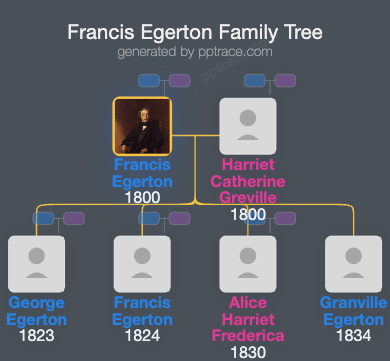
Family Tree
Tap  to expand more relatives
Introduction
Francis Egerton, 1st Earl of Ellesmere (born 1 January 1800, died 18 February 1857), was a British political figure, writer, traveler, and patron of the arts. He was known prior to 1833 as Lord Francis Leveson-Gower. The Ellesmere Island in Nunavut, Canada, is named after him.
Biographical details indicate that Egerton was born at 21 Arlington Street, Piccadilly, London. He was the third son of George Leveson-Gower, who was at the time known as Lord Gower, and Elizabeth Gordon, the 19th Countess of Sutherland in her own right. Egerton received his education at Eton College and Christ Church, Oxford. He initially held a commission in the Life Guards, resigning from military service upon his marriage.
In October 1803, Egerton's father became Marquess of Stafford after inheriting the wealth of Francis Egerton, 3rd Duke of Bridgewater. According to the stipulations of the will, the Bridgewater estates were to pass to Egerton, rather than his elder brother George.
Egerton entered the British Parliament in 1822, representing the pocket borough of Bletchingley until 1826. Subsequently, he served as the Member of Parliament for Sutherland between 1826 and 1831, and for South Lancashire from 1835 to 1846. During his time in Parliament, he was regarded as a Conservative, with political sympathies aligned with the Duke of Wellington, and supported Sir Robert Peel on various policies, with some exceptions such as the Ten-Hour movement.
His political career included roles such as a junior member of the mission led by FitzRoy Somerset to Madrid in 1823, a Lord of the Treasury in 1827, and later Under-Secretary of State for War and the Colonies in February 1828. He was promoted to Privy Councillor and became Chief Secretary for Ireland in June 1828, serving until July 1830. He briefly served as Secretary at War during the last Tory ministry.
Egerton was involved in various political debates relating to religion and education, opposing the opening of universities to Dissenters, and advocating for the endowment of Roman Catholic clergy in Ireland. He was notably resistant to certain parliamentary reform measures supported by his family, which led to disagreements within his family, particularly as his father supported reform policies.
Following the death of his father in 1833, Egerton inherited the Bridgewater estates, which were held under a trust that excluded him from direct management. The principal assets were the Bridgewater Canal and collieries at Worsley, which significantly influenced the local economy and employment. In 1837, Egerton expressed that his influence over Worsley and its approximately three to four thousand residents was substantial.
Egerton worked to develop Worsley as a model estate village, investing in infrastructure and social amenities such as churches, schools, a reading-room, and recreational facilities. His residence at Worsley Hall was reconstructed in an Elizabethan style, replacing the earlier structure. The estate aimed to improve the living conditions of the workers and promote a community-centered environment.
The Bridgewater Canal, a significant asset of the estate, was highly profitable through price-fixing arrangements and a duopoly with the Mersey and Irwell Navigation. These arrangements, along with opposition from other industrial centers such as Liverpool and Manchester, influenced regional trade and transportation policies. Egerton's family was also involved in the development of the Liverpool and Manchester Railway, with Egerton himself subscribing to the railway's capital and holding shares.
Throughout his life, Egerton was active in civic and scientific circles, presiding over the 1842 meeting of the British Association of Science in Manchester, although his political stance was conservative and protectionist, contrasting with the reformist and free-trade policies favored by groups in Manchester.
He passed away in 1857, leaving a legacy of political service, estate development, and contributions to regional infrastructure and social improvements.