Richard FitzPatrick
| Name | Richard FitzPatrick |
| Title | British Army general |
| Gender | Male |
| Birthday | 1748-01-24 |
| nationality | Great Britain |
| Source | https://www.wikidata.org/wiki/Q7325687 |
| pptrace | View Family Tree |
| LastUpdate | 2025-11-26T23:25:16.053Z |
Family Tree
Tap  to expand more relatives
Introduction
Richard FitzPatrick was born on 24 January 1748 and died on 25 April 1813. He held the courtesy title "The Honourable" from birth. FitzPatrick was an Anglo-Irish individual known for his roles as a soldier, poet, politician, and wit.
Family and early life:
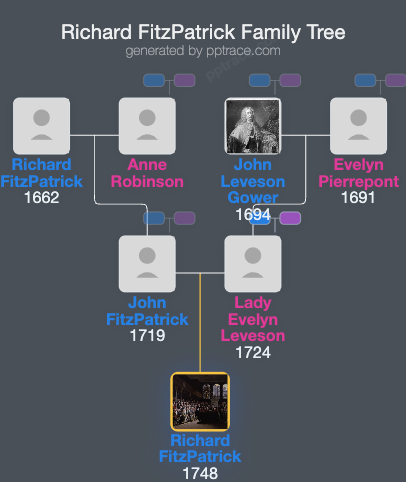
He was the younger son of John FitzPatrick, 1st Earl of Upper Ossory, and Lady Evelyn, daughter of John Leveson-Gower, 1st Earl Gower. His elder brother was John FitzPatrick, 2nd Earl of Upper Ossory. FitzPatrick had two sisters: Mary, who married Charles James Fox's brother Stephen Fox, 2nd Baron Holland, and Louisa, who became the second wife of William Petty, 2nd Earl of Shelburne. After their father's death in 1758, FitzPatrick's mother relocated the family to England and remarried Richard Vernon, an original member of the Jockey Club. Lady Evelyn died in 1763, leaving each of her children £100 in trust. Following her death, the children were under the care of their aunt, Gertrude Russell, Duchess of Bedford.
Education:
FitzPatrick was educated at Eton College, where he met Charles James Fox, who would become a lifelong friend. It is suggested that his early military career was influenced by his connection through family to General Waldegrave, enabling him to enlist in 1765 as an ensign in the First Foot Guards.
Military career:
In 1772, FitzPatrick was promoted to lieutenant and captain. Despite opposing the American Revolutionary War, he did not resign his commission when his regiment was ordered to New York in winter 1777. Instead, he participated in the Philadelphia campaign, fighting at the Battle of Brandywine and the Battle of Germantown. He was soon promoted to captain and lieutenant colonel. Later that year, he returned to England on personal matters. His experience in the war led him to oppose it in Parliament. He was promoted through the ranks to major general (1793), lieutenant general (1798), and full general (1803). FitzPatrick served as Secretary at War during the Rockingham administration in 1783 and again in 1806 under the Ministry of All the Talents. He was colonel of the 47th (Lancashire) Regiment of Foot from 1807 until his death.
Political career:
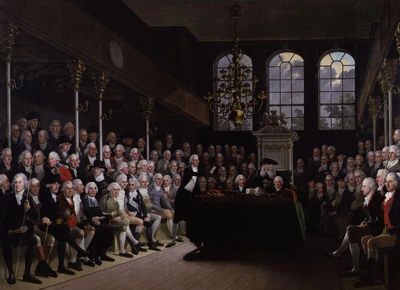
FitzPatrick was elected Member of Parliament (MP) for Okehampton in 1770 and served until 1774, when he was elected MP for Tavistock, a constituency controlled by his cousin, the 5th Duke of Bedford. His parliamentary service lasted over forty years. He was associated with Charles James Fox in forming a Whig faction that opposed the Tory government of Lord North, notably supporting Fox’s opposition to issues such as the American colonies. FitzPatrick served as Chief Secretary for Ireland during the brief Rockingham government and was appointed Secretary at War in 1806 when the Foxite Whigs took power again.
Literary pursuits:
FitzPatrick also engaged in literary work. His first publication was an anonymous parody of Thomas Gray in 1768. Subsequent works included "The Bath Picture" (1772) and "Dorinda, a Town Eclogue" (1774). He wrote a prologue for "The Critic" by Richard Brinsley Sheridan (1777). Between 1784 and 1785, he co-authored "Criticisms on the Rolliad," a political satire. He also authored verses inscribed at the Temple of Friendship at Charles Fox’s residence, and a quatrain dedicated to Fox’s memory.
Character and reputation:
FitzPatrick was known for his poetry, characterized by smoothness and clarity, and was regarded as a politician without personal ambition and a poet without vanity. Contemporary accounts described him as tall, elegant, and possessing agreeable manners. He was well-connected socially and frequently engaged in gambling at clubs such as Brooks’s.
Personal life:
He never married but was involved with numerous romantic relationships, including Lady Caroline Carpenter and Lady Anne Foley. His lifestyle was marked by excess and financial difficulties, accentuated by gambling losses. In 1791, he purchased Beech Grove in Sunninghill, near Windsor.
Later years and death:
In his later years, FitzPatrick's health declined due to gout and infirmities. He received a bequest from the Duke of Queensberry in 1810, which alleviated some financial issues. Toward the end of his life, he was observed to be frail. He died in London on 25 April 1813 and was buried near his country house at Sunninghill. His epitaph noted his long friendship with Charles James Fox.
Family reflections:
His nephew, Lord Holland, described FitzPatrick as exceptionally agreeable, possessing wit, manners, taste, judgment, and worldly experience.