Matthew Fontaine Maury
| Name | Matthew Fontaine Maury |
| Title | United States Navy officer |
| Gender | Male |
| Birthday | 1807-01-14 |
| nationality | United States of America |
| Source | https://www.wikidata.org/wiki/Q114385 |
| pptrace | View Family Tree |
| LastUpdate | 2025-11-29T01:00:42.760Z |
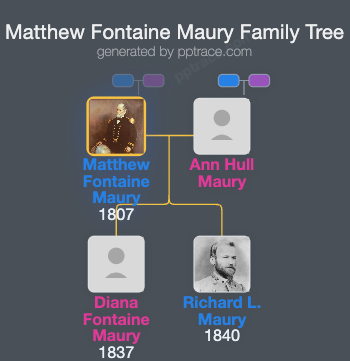
Family Tree
Tap  to expand more relatives
Introduction
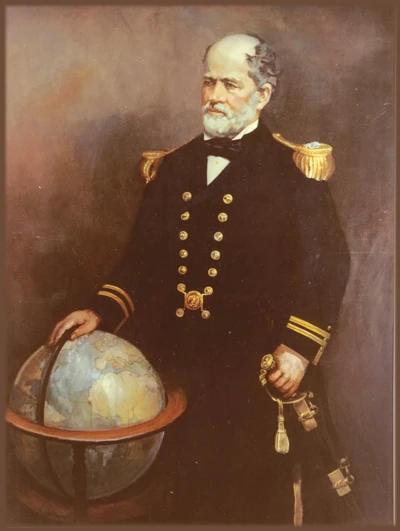
Matthew Fontaine Maury (January 14, 1806 – February 1, 1873) was an American oceanographer and naval officer. He served the United States Navy and later joined the Confederate States Navy during the American Civil War. Maury is recognized for contributions to oceanography and navigation, and has been called the "Pathfinder of the Seas." His work laid foundational principles for modern oceanography, and his publication, "The Physical Geography of the Sea" (1855), is considered the first comprehensive work on the subject.
Born in Spotsylvania County, Virginia, Maury was a descendant of the Maury family, a prominent Virginia family of Huguenot heritage tracing back to 15th-century France. His grandfather, Reverend James Maury, was an educator to Thomas Jefferson. Maury also had Dutch-American ancestry through the Minor family of Virginia. His parents were Richard Maury and Diane Minor Maury. When he was five years old, his family relocated to Franklin, Tennessee.
Initially aspiring to a naval career following the example of his older brother, John Minor Maury, a U.S. Navy officer who died from yellow fever, Maury obtained a midshipman's warrant through Tennessee Representative Sam Houston in 1825. He joined the U.S. Navy as a midshipman aboard the frigate USS Brandywine, which was transporting Marquis de Lafayette back to France after his 1824 visit to the United States. During his early career, Maury engaged in studying navigation techniques and the Seas, gaining experience through voyages such as circumnavigating the globe aboard the USS Vincennes.
Maury’s active seagoing career was interrupted at age 33 after a stagecoach accident resulted in a broken leg. Subsequently, he dedicated himself to the study of naval meteorology, wind patterns, ocean currents, and navigation. In 1842, he became officer-in-charge of the Depot of Charts and Instruments in Washington, D.C., later renamed the United States Naval Observatory. At the observatory, Maury organized the collection of thousands of ships’ logs and sea records, establishing a systematic approach to collecting oceanographic data.
His efforts led to the publication of the "Wind and Current Chart of the North Atlantic," which demonstrated methods for sailors to leverage ocean currents and wind for more efficient voyages. This work significantly reduced transit times and influenced maritime navigation worldwide. Maury's systematic recording of oceanographic data was adopted internationally and contributed to the development of navigational charts for key trade routes.
Maury was an advocate for naval reform and education, supporting the establishment of a naval academy comparable to the Army's West Point. He contributed to the founding of the American Association for the Advancement of Science (AAAS) in 1848. He also proposed a transcontinental railroad with Memphis, Tennessee, as an eastern terminus and recommended an interoceanic route through Panama, emphasizing the importance of improving transportation infrastructure.
He was elected to the American Philosophical Society in 1852 and played a role in advocating for an international meteorological system. Maury called for cooperation among maritime nations to establish a universal weather service, organizing a pioneering international conference in Brussels in 1853 to promote scientific collaboration in meteorology.
With the outbreak of the Civil War, Maury resigned his U.S. Navy commission and joined the Confederate Navy. He served as a Confederate envoy to Europe, attempting to secure aid and ships for the Confederacy, including assisting in the acquisition of CSS Georgia. After the war, he was pardoned and accepted a position at the Virginia Military Institute in Lexington, Virginia.
Maury died in 1873 at the Virginia Military Institute. Before his death, he completed a tour of the United States on weather forecasting and authored additional works, including the "Geological Survey of Virginia" and a series of geography books aimed at young readers.