Moritatsu Hosokawa
| Name | Moritatsu Hosokawa |
| Title | Japanese minister |
| Gender | Male |
| Birthday | 1883-10-21 |
| nationality | Q188712 |
| Source | https://www.wikidata.org/wiki/Q11606006 |
| pptrace | View Family Tree |
| LastUpdate | 2025-11-17T06:47:35.674Z |
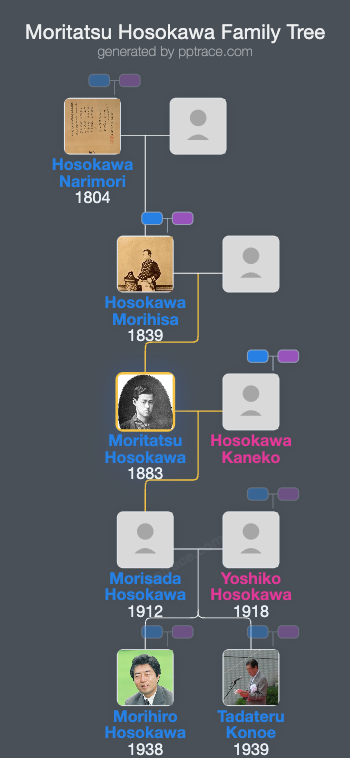
Family Tree
Tap  to expand more relatives
Introduction
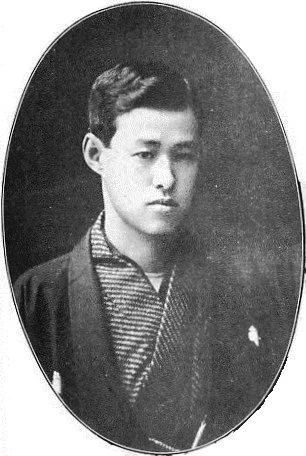
Moritatsu Hosokawa (born October 21, 1883, Meiji 16 – November 18, 1970, Showa 45) was a Japanese Imperial Court official and politician. His court rank was Junior Second Rank, his decoration was First Class Order of the Sacred Treasure, and he held the noble title of Marquis. His pseudonym was Seikan, and he was the 16th head of the Hosokawa family of the former Higo Kumamoto Domain. His family line held the baronial title and was later elevated to marquis.
Regarding his life, he was born in Takada Rōmatsu-chō, Koishikawa Ward, Tokyo City (presently Meguro-dai, Bunkyō City, Tokyo) as the fourth son of Moritaku Hosokawa. His mother was Hiroko, the fifth daughter of Naoshige Nabeshima, lord of Saga Domain. During his youth, he was physically frail, and those around him predicted he would only live until age 20. However, he developed a keen interest and talent in art, calligraphy, and swords, which he later excelled in.
On September 16, 1898, while attending Gakushuin, he became the adopted son of his elder brother Moriao Hosokawa, who had split from the family in 1896, thereby inheriting the Hosokawa baronial estate. He graduated from Gakushuin High School in July 1906 and subsequently dropped out of Tokyo Imperial University. On October 7, 1914, following his brother's death, he succeeded to the family headship, and on October 26 of the same year, he inherited the title of Marquis, becoming a member of the House of Peers as a marquis peer. Even after the war, he did not withdraw from public life or cede the family headship to his son.
He served as a deliberation official within the Imperial Household Ministry’s 'Kunitchiryō' (Court Ceremonies Department), actively working as an Imperial Court official related to the Imperial family. In 1936, he reconstructed the traditional Hosokawa residence in Meguro-dai, a building which was later used as the main building of the Waken Juku Foundation.
He was also involved in cultural heritage preservation activities. In 1948, he founded the Japan Sword Art Preservation Society and served as its first president. In 1950, he established the Eikō Bunko, dedicated to the preservation of artworks and ancient manuscripts handed down through his family. Furthermore, from 1951, he served as chairman of the Toyo Bunko, succeeding Kijūrō Shidehara.
He had connections with the sumo world as well. Before and after World War II, the Hosokawa residence hosted the award ceremonies for Yokozuna license certificates and the first ring entering of sumo wrestlers, including yokozuna Musashiyama, Manji no Kawa, Futabayama, Hakkōzan, Akinoumi, Terukun, and Maedayama.
In terms of honors, he received the Junior Fifth Rank in 1903 (Meiji 36), the Senior Fifth Rank in 1909 (Meiji 42), and, in 1915 (Taishō 4), awards such as a silver cup and a wooden cup. In 1916 (Taishō 5), he was awarded the Fourth Order of the Sacred Treasure.
He died on November 18, 1970, at his home in Bunkyō, Tokyo, due to acute pneumonia at the age of 87. His funeral was held on the 25th of the same month at Aoyama Cemetery.