John Quincy
| Name | John Quincy |
| Title | American soldier and politician |
| Gender | Male |
| Birthday | 1689-07-21 |
| nationality | United States of America |
| Source | https://www.wikidata.org/wiki/Q6253686 |
| pptrace | View Family Tree |
| LastUpdate | 2025-11-16T10:01:13.617Z |
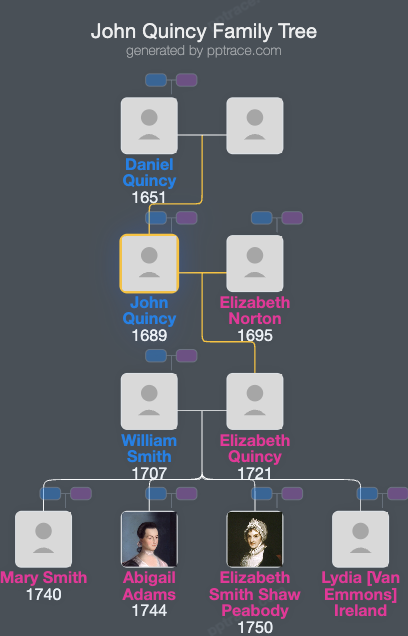
Family Tree
Tap  to expand more relatives
Introduction
John Quincy (July 21, 1689 – July 13, 1767) was a colonial American figure known for his roles as a soldier and politician. He was a member of the Quincy family, a prominent political family in colonial Massachusetts. The city of Quincy, Massachusetts, is named after him. His granddaughter was Abigail Adams, who named her son, John Quincy Adams, after him.
Early Life
John Quincy was born in Boston, Massachusetts, to Daniel Quincy (1651–1690) and Anna Shepard (1663–1708). Shortly after his birth, the family relocated to Braintree, Massachusetts, where they established a homestead at Mount Wollaston, also known as Merry Mount, in what is present-day Quincy. His father died when he was approximately one year old; subsequently, his mother married Reverend Moses Fiske.
He graduated from Harvard College in 1708. His paternal grandparents were Edmund Quincy II (1628–1698), and his first wife, Joanna Hoare Quincy. Edmund Quincy II built the Dorothy Quincy House in 1685. His paternal great-grandfather, also named Edmund Quincy (1602–1636), was an early settler of the Massachusetts Bay Colony and is referred to as "the Puritan."
Historical records note that John Quincy was named after his great-grandfather. His father, Daniel Quincy, died shortly after his birth. His grandmother, Anna Shepard, left him a farm at Mount Wollaston, which he inherited and where he resided until his death.
Career
John Quincy began his political career in 1717 when he was elected to represent Braintree at the Massachusetts General Court. He was re-elected in 1719 and served continuously until 1740. From 1729 to 1741, he held the position of Speaker of the House. Although he was voted out in 1741, he was re-elected to the General Court in 1744, serving four additional years.
In recognition of his abilities, he was later elevated to the Governor’s Council. His reputation was built on his sound judgment and service to colonial governance. During his civic career, he was chosen as moderator for meetings and was elected as a selectman. His political involvement demonstrated a commitment to public service, consistent with the practices of a democratic society of that period.
Personal Life
On September 3, 1715, John Quincy married Elizabeth Norton (1696–1769), daughter of Reverend John Norton of Hingham, Massachusetts. They had four children: Norton Quincy (1716–1801), Anna Quincy (1719–1799), Elizabeth Quincy (1721–1775), and Lucy Quincy (1729–1785). His children married into other notable families, including the Smiths, Thaxters, and Tufts.
John Quincy held the rank of major in the colonial militia, though he was commonly referred to as "Colonel." His death occurred on July 13, 1767, at the age of 77, just two days after the birth of his grandson, John Quincy Adams. His death also occurred approximately one month after the tax on tea was imposed by the British Parliament in June 1767.
Descendants and Legacy
His descendants included Elizabeth Quincy Smith, the mother of Abigail Smith Adams. Abigail Adams married John Adams, who became the second President of the United States, and their son, John Quincy Adams, served as the sixth President of the United States.
Honors
The city of Quincy, Massachusetts, bears his name, commemorating his influence and legacy in the region.
References
Sources include the book "John Quincy, Master of Mount Wollaston," published in 1909 by Daniel Munro Wilson and Charles Francis Adams.