Zhu Youlang, Prince Of Gui
| Name | Zhu Youlang, Prince Of Gui |
| Title | Chinese Emperor (1623-1662) |
| Gender | Male |
| Birthday | 1623-01-01 |
| nationality | Qing dynasty |
| Source | https://www.wikidata.org/wiki/Q1326844 |
| pptrace | View Family Tree |
| LastUpdate | 2024-10-10T10:50:19Z |
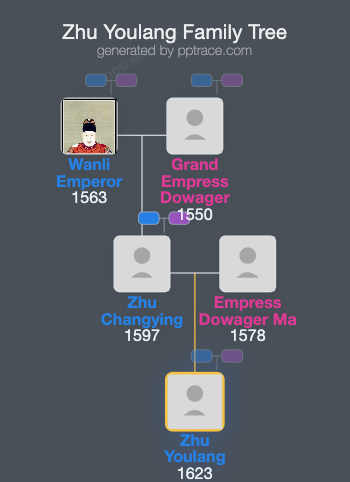
Family Tree
Tap  to expand more relatives
Introduction
The Yongli Emperor (1623–1662), born Zhu Youlang, was the fourth and last emperor of the Southern Ming dynasty in China. He was the son of Zhu Changying, the seventh son of the Wanli Emperor, and Empress Dowager Ma. During his early life, Zhu Youlang held the title Prince of Gui and lived relatively obscurely as a minor member of the Ming imperial family until the fall of Beijing.
Following the capture of Beijing by peasant rebels led by Li Zicheng in 1644 and the subsequent suicide of the last Ming emperor, Chongzhen, the Ming dynasty's authority rapidly declined as the Manchu-led Qing forces extended control over northern China and Central China. Zhu Youlang inherited the throne in November 1646 as the "Caretaker of the State" after the death of the Longwu Emperor. He formally ascended as the Yongli Emperor on 24 December 1646. His accession was supported by Empress Dowager Wang, his adoptive mother, who served as his principal adviser during the initial years of his reign.
Throughout his rule, Zhu Youlang's regime faced relentless military pressure from the Qing dynasty, which gradually pushed the Ming loyalist forces southward. The emperor retreated successively from Guangxi to Jiangxi, Hunan, and finally Yunnan, where he continued to resist Qing advances using a coalition of loyalist armies and local warlords. A notable supporter was Li Dingguo, who expanded Ming territory in southwestern China for a time. Despite these efforts, in 1658, Zhu Youlang was forced back into Yunnan Province.
In 1658, Zhu Youlang sought refuge in Burma, specifically under the protection of Pindale Min, the ninth king of the Taungoo dynasty. He was allowed to live in Sagaing, near Ava, provided his followers surrendered their weapons. However, the presence of Zhu Youlang and his forces ignited conflict with the Burmese authorities. After Pindale Min was overthrown by Pye Min in May 1661, the situation worsened, leading to internal disputes and violent confrontations among the Burmese and Chinese factions.
In January 1662, a Qing army led by Wu Sangui arrived in Burma and demanded Zhu Youlang's surrender. The emperor and his family were taken to Wu Sangui's camp near Ava and later transported to Yunnanfu, where, in June 1662, Wu Sangui personally executed Zhu Youlang by strangulation. Zhu Youlang is reported to have condemned Wu Sangui as a traitor during his final moments.
Zhu Youlang's death marked the end of the Southern Ming resistance. His surviving relatives included Zhu Shugui, Prince of Ningjing, and Zhu Hónghuán, Prince of Lu, who continued to oppose Qing rule from Taiwan until 1683. Zhu Youlang was survived by his consort, Empress Xiaogangkuang of the Wang clan, and several children, including his sons Zhu Cixuan (Crown Prince Aimin) and Zhu Cijue (Crown Prince Huaimin).
His reign was characterized primarily by attempts to restore Ming authority amid a period of widespread upheaval, and he is recognized historically as the last emperor of the Southern Ming dynasty.