David Sinton Ingalls
| Name | David Sinton Ingalls |
| Title | American flying ace (1899-1985) |
| Gender | Male |
| Birthday | 1899-01-28 |
| nationality | United States of America |
| Source | https://www.wikidata.org/wiki/Q5239831 |
| pptrace | View Family Tree |
| LastUpdate | 2025-11-17T06:42:56.003Z |
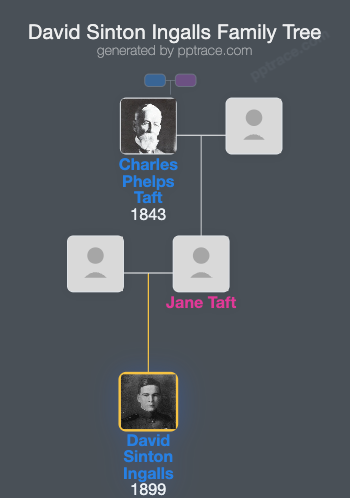
Family Tree
Tap  to expand more relatives
Introduction
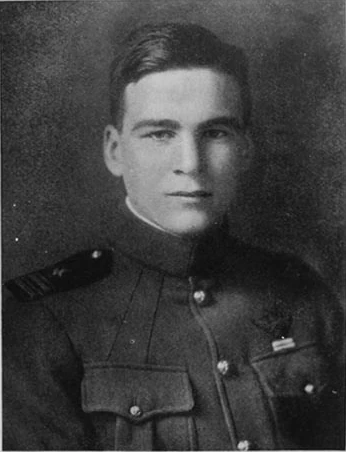
David Sinton Ingalls (January 28, 1899 – April 26, 1985) was an American military aviator and public official. He was the only flying ace in the United States Navy during World War I, credited with six confirmed aerial victories, thereby becoming the first ace in the history of the U.S. Navy.
**Early Life and Family Background**
Ingalls was born in Cleveland, Ohio. His parents were Albert S. Ingalls and Jane (née Taft) Ingalls; his mother was the niece of President William Howard Taft. His paternal lineage included Melville E. Ingalls, a railroad executive, and his great-grandfather was industrialist David Sinton, after whom he was named.
**Education**
He completed his secondary education at the University School in Cleveland, followed by attendance at St. Paul's School in Concord, New Hampshire. Ingalls enrolled at Yale University in 1916, initially studying medicine. He graduated in 1920 with a Bachelor of Arts degree in English. While at Yale, he joined the First Yale Unit, becoming a member of the Naval Reserve Flying Corps. By 1917, he had obtained his pilot's license.
**Athletic Involvement**
At Yale, Ingalls participated in men's ice hockey, playing for the Yale Bulldogs and serving as captain of the Boston Athletic Association ice hockey team during the 1921–22 season.
**Military Service**
On March 26, 1917, Ingalls enlisted as Naval Aviator No. 85. He was called to active duty on April 4, 1917, preceding the United States' entry into World War I. His aviation training included instruction at West Palm Beach, Florida, and later in Huntington, Long Island, New York. He completed training on September 1, 1917, attaining the rank of lieutenant (junior grade).
In September 1917, he arrived in Europe, reporting to U.S. naval forces operating out of London, then transferred to training facilities in the United Kingdom including RAF Gosport and Ayr. He was stationed in Dunkirk and Clermont, where he received training in day bombing and gunnery. In March 1918, he was assigned to the Royal Air Force's No. 213 Squadron, flying Sopwith Camel fighters, and was temporarily with No. 218 Squadron RAF to gain bomber experience.
**Combat and Aerial Victories**
During his service with No. 213 Squadron, Ingalls engaged in combat against German aircraft and had notable success in aerial combat. His victories include shooting down German observation planes and enemy fighters, such as Fokker D.VII aircraft. Notably, he participated in an attack that destroyed thirty-eight planes at a German aerodrome. He achieved his sixth and final victory on September 24, 1918, after surviving an engine failure and making a crash landing behind enemy lines, from which he then managed to destroy a Fokker D.VII fighter.
His combat record earned him six confirmed kills, qualifying him as an ace, and his contributions earned him several honors, including the Navy Distinguished Service Medal, the British Distinguished Flying Cross, and the French Legion of Honour. On January 1, 1919, he was Mentioned in Despatches by the British. He was released from military service on January 2, 1919.
**Post-War Career**
Following the war, Ingalls returned to Yale University and received an honorary Doctor of Laws degree from Harvard University in 1923. He entered legal practice with Squire, Sanders & Dempsey and was elected to Ohio's General Assembly in 1926, co-sponsoring the Ohio Aviation Code. He served as a member of the Ohio House of Representatives from 1927 to 1929.
In early 1929, Ingalls was appointed Assistant Secretary of the Navy (AIR), a position he held through personal connections and recommendations. During his tenure, he significantly increased naval aviation capabilities and advocated for a fully deployable aircraft carrier force. He also ran an unsuccessful gubernatorial campaign in Ohio in 1932. Later, he served as director of Cleveland's Department of Public Health and Welfare.
**Military Reserve and World War II**
In the mid-1930s, Ingalls held the rank of lieutenant commander in the Naval Reserve. During World War II, he became Vice President and General Manager of Pan Am Air Ferries, and after the attack on Pearl Harbor, he helped develop the Naval Air Station in Honolulu. He reported for active duty in the Navy, serving as Chief of Staff for the Forward Area Air Center Command and as Commander of the Pearl Harbor Naval Air Station.
**Later Public and Private Roles**
Post-World War II, Ingalls held various positions, including director roles at Pan Am, involvement in political campaigns, and leadership in media enterprises. He was president and publisher of the Cincinnati Times-Star and Vice Chairman of Taft Broadcasting Company until 1958. He also assisted Charles Lindbergh in developing navigation and communication for transoceanic flights and served as a director of the Cleveland Trust Company.
**Personal Life**
Ingalls was married to Louise Hale Harkness, a granddaughter of Daniel M. Harkness, an associate of Standard Oil; they had three children: Edith Ingalls (1923–2005), who married Dr. Paul Joseph Vignos Jr.; Louise Ingalls (1928–1998); and David Sinton Ingalls Jr. (1934–1993).
He was actively involved in various social and professional organizations, including the American Legion, Freemasons, and multiple social clubs. He was a co-owner of quail plantations, including Ring Oak and Foshalee.
**Honors and Legacy**
The Ingalls Hockey Rink at Yale University bears his name, funded largely by his family. In 1983, he was inducted into the National Aviation Hall of Fame in Dayton, Ohio. David Ingalls died in 1985 in Ohio.
**Philanthropic Contributions**
In 2003, the Ingalls Foundation endowed the Paul J. and Edith Ingalls Vignos Curator of European Painting and Sculpture at the Cleveland Museum of Art.
**References and External Links**
[No references or external links are included here as per instruction.]