William Cavendish-Scott-Bentinck, Marquess Of Titchfield
| Name | William Cavendish-Scott-Bentinck, Marquess Of Titchfield |
| Title | British politician |
| Gender | Male |
| Birthday | 1796-08-21 |
| nationality | United Kingdom of Great Britain and Ireland |
| Source | https://www.wikidata.org/wiki/Q8011923 |
| pptrace | View Family Tree |
| LastUpdate | 2025-11-26T12:22:06.079Z |
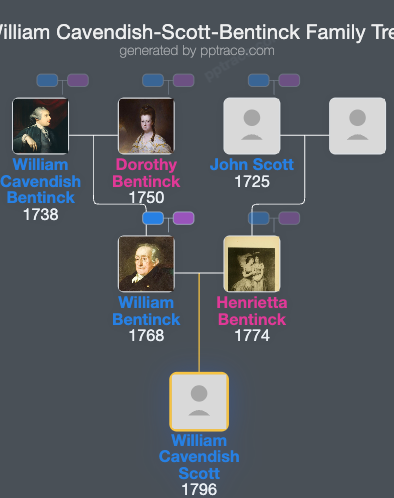
Family Tree
Tap  to expand more relatives
Introduction
William Henry Cavendish-Scott-Bentinck, Marquess of Titchfield, was born on 21 August 1796 and died on 5 March 1824. He was a member of the British nobility and held the courtesy title of Viscount Woodstock until 1809, after which he was known as the Marquess of Titchfield.
He was the eldest son of William Cavendish-Bentinck, 4th Duke of Portland, and Henrietta Scott. His paternal grandfather was William Cavendish-Bentinck, the 3rd Duke of Portland, who served as Prime Minister of Great Britain and Prime Minister of the United Kingdom. His maternal grandfather was Scottish General John Scott, and Henrietta was one of three daughters and heiresses of his family.
The family name was hyphenated to Cavendish-Scott-Bentinck following the marriage of his parents. Upon his birth, the third Duke of Portland commissioned the Portland Baptismal Font, a unique gold font designed by Humphrey Repton and crafted by Paul Storr, which remained in the family until 1986, when it was acquired by the British Museum.
In 1809, following his father's accession to the dukedom, William Henry was styled as the Marquess of Titchfield. He received a private education before enrolling at Christ Church, Oxford, in 1815. During his time at Oxford, he distinguished himself in classical literature and was praised for his character by the Reverend Thomas Maurice. However, among his contemporaries, some, such as George Agar-Ellis, described him negatively, characterizing him as a talkative and affected individual. His uncle Charles Greville noted that his privileged upbringing and early habits contributed to a certain reserve and selfishness, although he later showed a kind disposition. His uncle, George Canning, the Prime Minister, spoke highly of his character, describing him as "the best of creatures," with good sense and warmth.
In 1819, William Henry joined the Nottinghamshire Yeomanry Cavalry as a captain. That same year, he was elected Member of Parliament for Bletchingley, serving until 1822. Subsequently, he was elected MP for King's Lynn in 1822, a position he held until his death. His parliamentary activity included a single recorded speech on 14 May 1819, in which he criticized the Game Laws, and he voted against public lotteries as well as supporting inquiries into charitable foundation abuses.
William Henry Cavendish-Scott-Bentinck died at the family residence in London in March 1824, at the age of 27. His death was attributed to a brain abscess. He was buried in the family vault at Marylebone Parish Church in London. His younger brothers, John and George, also served as Members of Parliament. John succeeded him as the Marquess of Titchfield and MP for King's Lynn, and ultimately became the fifth Duke of Portland.
His titles included Viscount Woodstock from 1796 until 1809 and Marquess of Titchfield from 1809 until 1824.