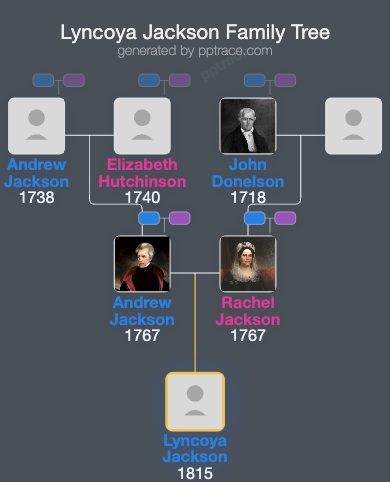
Lyncoya Jackson
| Name | Lyncoya Jackson |
| Title | Creek Indian child adopted by Andrew Jackson |
| Gender | Male |
| Birthday | 1815-00-00 |
| nationality | — |
| Source | https://www.wikidata.org/wiki/Q20709225 |
| pptrace | View Family Tree |
| LastUpdate | 2025-11-16T10:05:35.297Z |
Family Tree
Tap  to expand more relatives
Introduction
Lyncoya Jackson was born circa 1812 to Muscogee (Creek) parents, likely associated with the Red Stick faction of the Upper Creek tribal group. His birthplace was in the Muscogee town of Tallasseehatchee Creek, located in what is now eastern Alabama. During the Creek War, part of the larger conflict known as the Creek Civil War and intertwined with the War of 1812, Lyncoya's family was attacked and killed on November 3, 1813, at the Battle of Tallushatchee, led by John Coffee against the Red Stick faction. The battle resulted in the deaths of approximately 186 Creek individuals, with an additional 84 taken as prisoners. During the destruction, Lyncoya was found wounded or orphaned, lying beside his deceased mother.
Following the battle, Lyncoya was among two Creek children rescued by Tennessee militiamen from Nashville. He was transported to Andrew Jackson's Hermitage estate in 1813–14, becoming one of three Native American war orphans brought to Jackson's household. The other two children, Theodore and Charley, did not survive long after their arrival. Lyncoya was integrated into Jackson's household, initially referred to as a "pett" for Jackson's other white male wards, with whom he was educated at a local school. Jackson expressed interest in furthering Lyncoya's education, considering the opportunity to send him to West Point. However, Lyncoya was ultimately apprenticed to a saddler in Nashville.
Lyncoya contracted a respiratory illness, specifically tuberculosis, and was taken back to the Hermitage for care. Despite healthcare efforts, he died at around 16 years of age in July 1828. He was buried in an unmarked grave near the Hermitage, within Davidson County, Tennessee.
Historically, Jackson's associates and political supporters framed Lyncoya's survival as a counterpoint to allegations that Jackson was a "bloodthirsty killer of Indians." During the 1828 presidential campaign between Jackson and John Quincy Adams, Lyncoya's story was included in biographical narratives and obituaries used to depict Jackson positively. Jackson himself maintained in correspondence that Lyncoya was the child found suckling his dead mother's breast and was adopted and educated by Jackson's household. There is, however, no documented legal adoption of Lyncoya. His presence in Jackson's household has been described as an informal adoption or kinship arrangement, part of broader practices among Anglo-American settlers who often incorporated Native War captives into their households.
Lyncoya's name does not originate from the Muscogee language but was reportedly created by a young white caretaker, Maria Pope. Some accounts suggest the name means "abandoned one" in Muscogee, a translation that appears to be folkloric. His survival and presence were sometimes used to justify Jackson's actions in the Creek War, portraying Jackson as a protector or caretaker of Native children, and during his presidency, Jackson explicitly acknowledged that he had received Lyncoya from military officers involved in the Creek conflict.
Jackson's correspondence reveals an ongoing concern for Lyncoya's well-being, as exemplified by a letter from September 1816, in which Jackson expressed affection and plans for his education. This letter also reflected the racial and social attitudes of the period, as Jackson discussed Lyncoya's placement among enslaved people and the social hierarchy within his household.
Lyncoya Jackson's life was characterized by recurring themes of loss, assimilation, and political symbolism, illustrating broader narratives of Native American displacement during the early 19th century.