Rachel Jackson
| Name | Rachel Jackson |
| Title | wife of Andrew Jackson, 7th President of the United States (1767–1828) |
| Gender | Female |
| Birthday | 1767-06-15 |
| nationality | United States of America |
| Source | https://www.wikidata.org/wiki/Q238387 |
| pptrace | View Family Tree |
| LastUpdate | 2025-11-17T06:38:23.403Z |
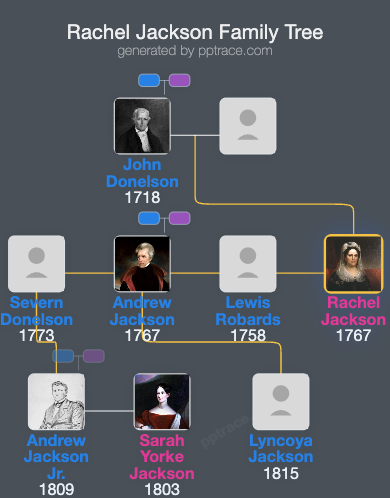
Family Tree
Tap  to expand more relatives
Introduction
Rachel Jackson, born Rachel Donelson on June 15, 1767, near the Banister River in Pittsylvania County, Virginia, was the wife of Andrew Jackson, the seventh President of the United States. She was the daughter of Colonel John Donelson (1718–1785), a co-founder of Nashville, Tennessee, and Rachel Shockley Donelson (1730–1801). Her great-grandfather, Patrick Donelson, was born in Scotland around 1670. Rachel had ten siblings: seven brothers—Alexander Donelson, John Donelson, William Donelson, Samuel Donelson, Severn Donelson, Leven Donelson, and others—and three sisters, including Mary Donelson Caffery and Jane Donelson Hays.
From approximately 1770 to 1779, her father operated the Washington Iron Furnace at Rocky Mount in Franklin County, Virginia. The Donelson family relocated to Tennessee when Rachel was about 12 years old, moving along the Cumberland River to what would become Nashville. Her family was among the earliest European settlers in the region.
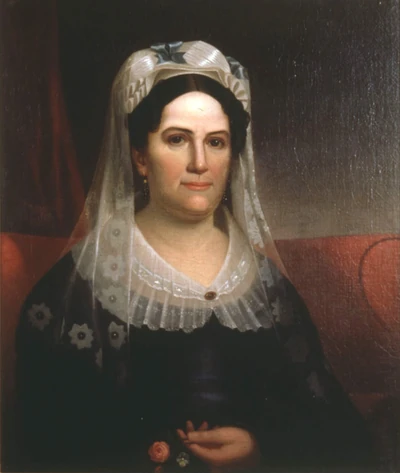
Rachel Donelson was noted for her physical beauty and personality. She was described as having "lustrous black eyes, dark glossy hair, full red lips, a brunette complexion, and a sweet oval face." She attracted many suitors during her youth. Her demeanor contrasted with Andrew Jackson's tall and slender figure; she was known for her country manners and full figure. Despite this, her love for her husband was evident, and she was often anxious when Jackson was away attending to military or political duties.
A devout Presbyterian, Rachel was recognized for her deep religious piety. She was an avid reader of the Bible, religious works, and poetry. In her correspondence, her sister Jane Donelson Hays described the close-knit relationships among her family members and friends in Middle Tennessee.
Rachel Jackson's first marriage was to Captain Lewis Robards of Harrodsburg, Kentucky. The marriage was reportedly unhappy, and they separated in 1790. Rumors indicated Robards was cruel and jealous. Believing he was in the process of obtaining a divorce, Rachel left to return to her family home. However, it was later revealed that Robards had not yet finalized the divorce, making her marriage to Jackson, whom she married in Natchez, Mississippi, in 1791, bigamous and invalid. There is some dispute over whether Rachel was aware of Robards's unresolved divorce; some accounts suggest she believed her marriage was lawful, while others imply she knowingly eloped with Jackson.
The couple's marriage was complicated by the legal and territorial changes of the time, including the transfer of control over Tennessee from North Carolina and Virginia. The divorce from Robards was finalized in 1794, and Rachel and Andrew Jackson remarried in Davidson County, Tennessee, with the marriage officiated by her brother-in-law, Robert Hays. Scholars note that some narratives regarding her first marriage have been influenced by political motives, particularly during Jackson's 1828 presidential campaign, to protect her reputation from accusations of adultery or bigamy.
Rachel and Andrew Jackson did not have biological children but adopted several. In 1809, they adopted her nephew, Andrew Jackson Jr., who later managed the Hermitage farm and married Sarah Yorke. They also adopted a Muscogee orphan, Lyncoya, during the Creek War; Lyncoya was educated together with Jackson's adopted son. He died of tuberculosis in 1828. Additionally, Jackson and Rachel adopted Andrew Jackson Hutchings, the grandson of Rachel's sister and the son of Jackson’s associate John Hutchings; he attended college and later moved to Alabama. Jackson served as guardian for children of Rachel's brother Samuel Donelson and Captain Edward Butler’s children, though these children did not reside permanently at the Hermitage.
Rachel Jackson was active in her religious and familial circles and maintained close relationships with her sisters. She was not inclined to seek public attention and advised her husband to be cautious of political fame. During Jackson's campaigns, especially in 1828, she was subjected to negative political attacks, which Jackson believed contributed to her declining health. Rachel Jackson died on December 22, 1828, at the Hermitage, just days after Jackson's election and prior to his inauguration in 1829. She did not serve as First Lady; the role was fulfilled by her niece, Emily Donelson.
Rachel's personal history was marked by her early life in Virginia, her migration to Tennessee, her complex marriage history, and her role as the wife of a prominent military and political figure, ultimately becoming part of the historical narrative surrounding Andrew Jackson's presidency.