William Hartley Carnegie
| Name | William Hartley Carnegie |
| Title | English Anglican priest and author |
| Gender | Male |
| Birthday | 1859-02-27 |
| nationality | United Kingdom |
| Source | https://www.wikidata.org/wiki/Q21175296 |
| pptrace | View Family Tree |
| LastUpdate | 2025-11-26T23:32:25.094Z |
Family Tree
Tap  to expand more relatives
Introduction
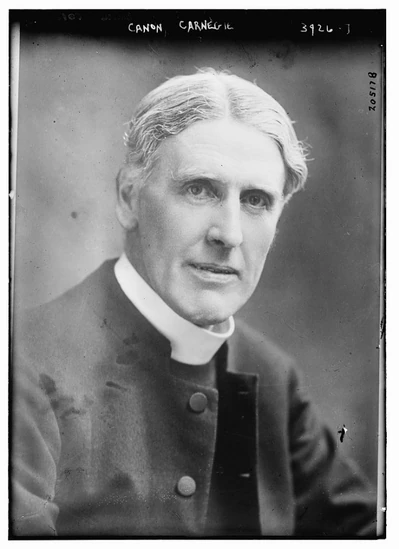
William Hartley Carnegie was born on 27 February 1859. He received his higher education at Magdalen College, Oxford, where he matriculated in 1878 and attained a Bachelor of Arts degree in 1884. Following his graduation, he spent a period of two years traveling around the world, during which he engaged in yachting and shooting activities.
Carnegie was ordained as an Anglican priest in 1888. His early clerical work included serving as a curate in Pudsey. In 1889, he became the Rector of Great Witley, a position he held until 1903. Subsequently, he served as Rector of the Cathedral Church of St Philip in Birmingham.
In 1912, Carnegie was appointed as Rector of St Margaret's Church in Westminster. During World War I, in 1916, he became chaplain to the Speaker of the House of Commons. He held the position of Archdeacon of Westminster from 1918 to 1919 and was appointed sub-dean of Westminster Abbey in 1919, a role he maintained until his death in 1936. Carnegie served concurrently as Rector of St Margaret's, chaplain to the Speaker, Archdeacon of Westminster, and sub-dean of Westminster Abbey until his death on 18 October 1936.
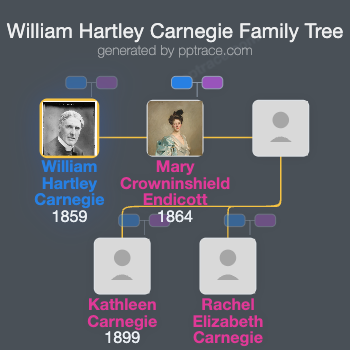
Regarding his family, Carnegie married Albinia Frances Crawley-Boevey on 15 June 1892. She was the daughter of Sir Thomas Hyde Crawley-Boevey, 5th Baronet of Flaxley Abbey, and Frances Elizabeth Peters. The couple had five daughters, named Frances, Mary Albinia, Kathleen, Jocosa, and Rachel Elizabeth. Albinia Frances Crawley-Boevey died at the Great Witley rectory on 12 May 1902, approximately seven months after the birth of their youngest daughter. In 1916, Carnegie remarried to Mary Endicott, widow of politician Joseph Chamberlain (1836–1914).
William Hartley Carnegie died on 18 October 1936. His ashes were interred in the nave of Westminster Abbey.
He was also an author of several works focusing on religious belief, churchmanship, and social issues. His published writings include:
- "Through Conversion to the Creed: Being a Brief Account of the Reasonable Character of Religious Conviction" (1893)
- "Some Principles of Religious Education" (1896)
- "Faith and Reason. Three Addresses" (1904)
- "Churchmanship and Character" (1909)
- "Why and What I Believe in Christianity" (1910)
- "Democracy and Christian Doctrine" (1914)
- "Resentment: Three Sermons" (1916)
- "Democracy and Personal Leadership" (1918)
- "Personal Religion and Politics" (1920)
- "Anglicanism: An Introduction to Its History and Philosophy" (1925)
- "Parliament and the Prayer Book" (1928)