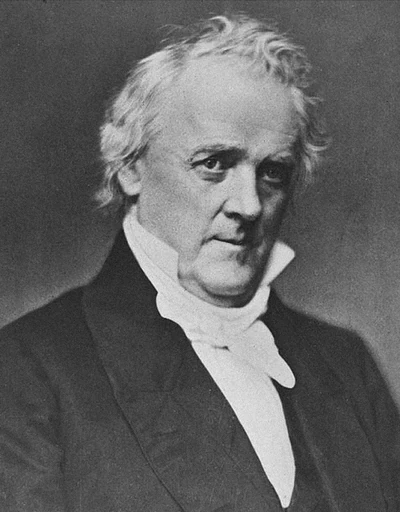
James Buchanan
| Name | James Buchanan |
| Title | president of the United States from 1857 to 1861 |
| Gender | Male |
| Birthday | 1791-04-23 |
| nationality | United States of America |
| Source | https://www.wikidata.org/wiki/Q12325 |
| pptrace | View Family Tree |
| LastUpdate | 2025-11-17T06:39:52.061Z |
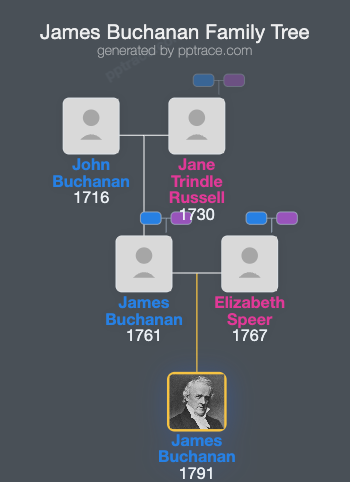
Family Tree
Tap  to expand more relatives
Introduction
James Buchanan Jr. was born on April 23, 1791, in a log cabin near Cove Gap in the Allegheny Mountains of southern Pennsylvania. His family was of Scotch-Irish descent; his father, James Buchanan Sr., was an Ulster-Scot immigrant from County Donegal, Ireland, who arrived in the United States in 1783. The family relocated shortly after Buchanan's birth to a farm near Mercersburg, Pennsylvania, and later settled in the town in 1794. Buchanan was the second of eleven children, with six sisters and four brothers. His father became a prominent merchant, farmer, and real estate investor, and the family was among the wealthiest in the region.
Buchanan's early education was primarily influenced by his mother, who discussed politics and poetry with him, quoting authors such as John Milton and William Shakespeare. He attended the Old Stone Academy in Mercersburg and later Dickinson College in Carlisle, Pennsylvania, where he graduated with honors in 1809 after nearly being expelled for disorderly conduct. Following his college education, Buchanan studied law for two and a half years under James Hopkins in Lancaster, Pennsylvania, studying the U.S. Code, the Constitution, and legal authorities like William Blackstone.
In 1812, Buchanan was admitted to the Pennsylvania bar and began practicing law in Lancaster, quickly establishing a successful legal career. He became a Freemason, serving as Worshipful Master of Masonic Lodge No. 43 in Lancaster and as District Deputy Grand Master of the Grand Lodge of Pennsylvania. Politically, he supported the Federalist Party, which favored federal development projects, tariffs, and a central banking system. During the War of 1812, Buchanan, though not serving in the militia, participated in horse thefts for the U.S. Army during British occupation.
He was elected to the Pennsylvania House of Representatives from 1814 to 1816, becoming its youngest member. In 1820, Buchanan was elected to the U.S. House of Representatives, where he served five terms. During his tenure, he was associated with the "Amalgamator" faction, a coalition of Democratic-Republicans and former Federalists transitioning into the Democratic Party. He initially supported Henry Clay in the 1824 presidential election but later shifted allegiance to Andrew Jackson, aligning with Jacksonian Democrats.
In 1832, Buchanan was appointed as U.S. Minister to Russia by President Andrew Jackson, a position he held during Jackson's second term. He served as a diplomat in St. Petersburg, although he viewed the posting as a form of political exile. Following his diplomatic service, Buchanan returned to the United States and was elected U.S. senator from Pennsylvania in 1834, a position he held for eleven years.
Buchanan accepted the position of Secretary of State under President James K. Polk in 1845. During his term, he was involved in diplomatic negotiations and domestic policy matters. In 1853, he was appointed as Minister to the United Kingdom by President Franklin Pierce, a role he served in until 1856. That year, Buchanan secured the Democratic Party’s nomination for president and was elected as the 15th president of the United States.
Buchanan’s presidency lasted from 1857 to 1861. He supported the Supreme Court’s decision in the Dred Scott v. Sandford case and advocated for Southern interests, including the Lecompton Constitution in Kansas, which aimed to admit Kansas as a slave state. His administration was marked by increased sectional tensions over slavery and states’ rights, leading to the secession of Southern states after his term and the outbreak of the American Civil War.
He chose not to seek re-election in 1860 and supported Vice President John C. Breckinridge’s presidential bid. His leadership during the lead-up to the Civil War has been widely criticized, with scholars ranking him among the worst U.S. presidents. Buchanan spent his final years defending his reputation, passing away on June 1, 1868.