Tanzan Ishibashi
| Name | Tanzan Ishibashi |
| Title | Prime Minister of Japan from 1956 to 1957 |
| Gender | Male |
| Birthday | 1884-09-25 |
| nationality | Japan |
| Source | https://www.wikidata.org/wiki/Q351656 |
| pptrace | View Family Tree |
| LastUpdate | 2025-11-17T06:46:25.153Z |
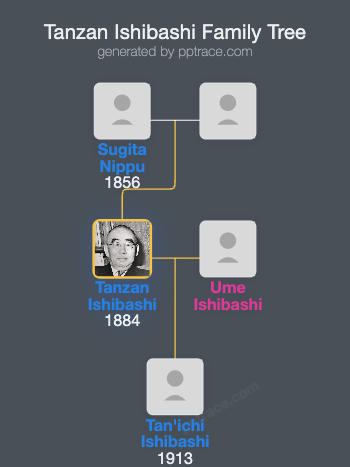
Family Tree
Tap  to expand more relatives
Introduction
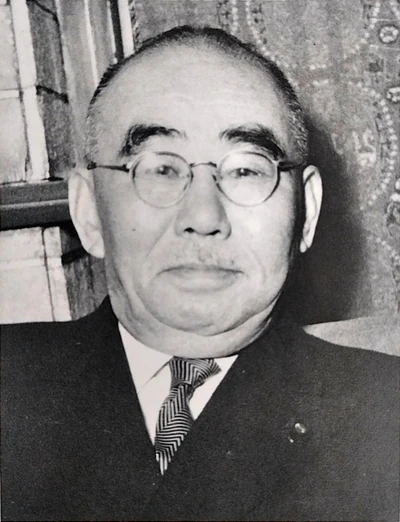
Tanzan Ishibashi (石橋 湛山, Ishibashi Tanzan; 25 September 1884 – 25 April 1973) was a Japanese journalist and politician. He served as the Prime Minister of Japan from 1956 to 1957.
Ishibashi was born in the Shibanihonenoki district of Azabu ward, Tokyo, in 1884. His father was Sugita Tansei (1856–1931), a Nichiren Buddhist priest and the 81st head of Kuon-ji temple in Yamanashi Prefecture. Ishibashi adopted his mother's surname and became a Nichiren priest himself. His Buddhist name was Tanzan, and his birth name was Seizō (省三).
He studied philosophy at Waseda University, graduating from the literature department in 1907. After completing military service, he worked as a journalist at the Mainichi Shimbun. In 1911, Ishibashi joined the staff of the Tōyō Keizai Shimpo ("Eastern Economic Journal") and later became its editor-in-chief in 1925. In 1941, he also assumed the position of president of the publication, which he held until 1946.
During the 1930s, Ishibashi was an outspoken critic of Japanese imperialism and developed a reputation as a liberal economist. He promoted ideas of individualism and was one of the few voices against the expansionist policies of Japan at the time. He supported the "Small Japan" policy (小日本主義, shō-Nihon-shugi), advocating for Japan to abandon colonial holdings such as Manchuria and refocus on domestic economic and cultural development. Along with Tanaka Ōdō, he championed free trade and international cooperation, opposing militarism and colonialism.
Ishibashi's political career began post-World War II. From 1946 to 1947, he served as Japan's Minister of Finance under Prime Minister Shigeru Yoshida. In the April 1947 general elections, he was elected to the National Diet representing Shizuoka's second district but was soon purged due to his opposition to U.S. occupation policies. He was reinstated in 1951 and aligned with Ichirō Hatoyama, serving as Minister of Industry in 1953.
He was a founding member of the Liberal Democratic Party (LDP) in 1955. When Hatoyama retired in 1956, Ishibashi was elected LDP president and became Prime Minister. During his brief tenure, he aimed to restore diplomatic relations with the People's Republic of China and sought cooperation with political opposition. However, ill health forced him to resign after two months, with Nobusuke Kishi succeeding him.
After stepping down as Prime Minister, Ishibashi remained influential within the party as a faction leader and was actively involved in issues such as opposing Kishi’s efforts to revise the U.S.-Japan Security Treaty in 1960. He also played a role in Japan's diplomatic engagement with China, including a visit to China in 1963.
From 1952 to 1968, Ishibashi served as president of Rissho University. He died on 25 April 1973. In 2001, Waseda University established the Waseda Journalism Award in his memory.
Ishibashi’s political philosophy was grounded in liberalism, individualism, and feminism. He opposed Japanese imperialism, colonialism, and militarism, promoting policies for economic and cultural self-development. His honors include the Grand Cordon of the Order of the Rising Sun awarded in 1964, and posthumously, the Grand Cordon of the Order of the Rising Sun with Paulownia Flowers in 1973.