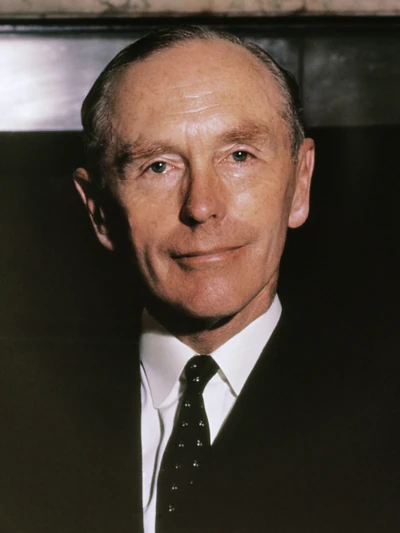
Alec Douglas-Home
| Name | Alec Douglas-Home |
| Title | Prime Minister of the United Kingdom from 1963 to 1964 |
| Gender | Male |
| Birthday | 1903-07-02 |
| nationality | United Kingdom |
| Source | https://www.wikidata.org/wiki/Q128976 |
| pptrace | View Family Tree |
| LastUpdate | 2025-11-26T23:33:23.897Z |
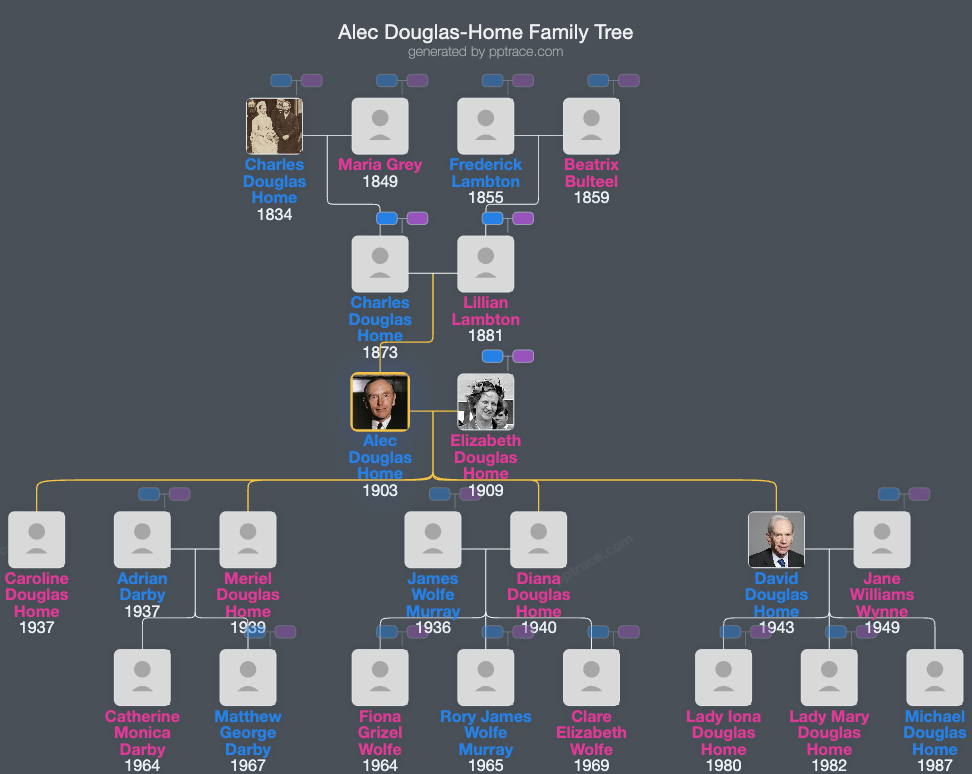
Family Tree
Tap  to expand more relatives
Introduction
Alexander Frederick Douglas-Home, Baron Home of the Hirsel (HEWM; born 2 July 1903, died 9 October 1995), was a British politician affiliated with the Conservative Party. He held several political offices throughout his career, including serving as Prime Minister of the United Kingdom from 1963 to 1964. Prior to his premiership, he was recognized for his roles as Foreign Secretary and Leader of the House of Lords.
Born in Mayfair, London, at 28 South Street, he was the eldest son of Lord Dunglass, the heir apparent to the 12th Earl of Home, and Lady Lilian Lambton, daughter of the 4th Earl of Durham. His family held noble titles and had a history of political engagement. Following the death of the 12th Earl of Home in 1918, his father succeeded to the earldom, and Alexander Douglas-Home adopted the courtesy title Lord Dunglass until 1951.
His education included Ludgrove School and Eton College, where his contemporaries included Cyril Connolly. At Eton, he was associated with sports like cricket and fives. Subsequently, he studied Modern History at Christ Church, Oxford, earning a third-class honours BA in 1925. He was also a talented sportsman, representing Eton in cricket and playing first-class cricket for Oxford University, Middlesex, and the Marylebone Cricket Club between 1924 and 1927.
In 1924, Douglas-Home joined the Territorial Army as a lieutenant in the Lanarkshire Yeomanry and was promoted to captain in 1928. His early political involvement began with an unsuccessful Labour candidacy for Coatbridge in the 1929 general election. However, in 1931, he was elected as a Member of Parliament (MP) for Lanark as a pro-coalition Unionist during a period of national economic crisis. He lost this seat in 1935 but regained it in 1950.
In 1951, upon his father's death, he inherited the earldom of Home, which at that time precluded him from sitting in the House of Commons due to the peerage's presence in the House of Lords. Nevertheless, in 1963, he renounced his peerage to run successfully for a seat in the House of Commons, becoming the Member of Parliament for Kinross and Western Perthshire.
Throughout the 1950s and early 1960s, he served in various senior government positions, including Leader of the House of Lords and Foreign Secretary. As Foreign Secretary from 1960 to 1963, he supported the United States during the Cuban Missile Crisis, and in August 1963, he was the UK signatory to the Partial Nuclear Test Ban Treaty.
In October 1963, following Harold Macmillan's resignation due to health issues, Douglas-Home was appointed Prime Minister. His appointment was controversial because it involved inheriting the premiership from the House of Lords, which was increasingly considered unsuitable for the office. To address this, he resigned his peerage and successfully contested the general election as a Member of Parliament. His tenure as Prime Minister lasted nearly a year, from October 1963 to October 1964, making it the second shortest in the 20th century.
During his tenure, the government passed legislation such as the abolition of resale price maintenance. The 1964 general election resulted in a narrow defeat for his party, leading to his resignation as Conservative leader. Later, from 1970 to 1974, he served in the cabinet of Edward Heath as Secretary of State at the Foreign and Commonwealth Office, an expanded role from his earlier position as Foreign Secretary.
Following the defeat of Heath's government, he returned to the House of Lords as a life peer and withdrew from active politics. His early life and education shaped much of his career, with a background steeped in aristocratic tradition, sports, and public service.