Eijirō Iwasaki
| Name | Eijirō Iwasaki |
| Title | Japanese linguist (1922–2017) |
| Gender | Male |
| Birthday | 1922-04-29 |
| nationality | Japan |
| Source | https://www.wikidata.org/wiki/Q11474550 |
| pptrace | View Family Tree |
| LastUpdate | 2025-11-17T10:08:36.212Z |
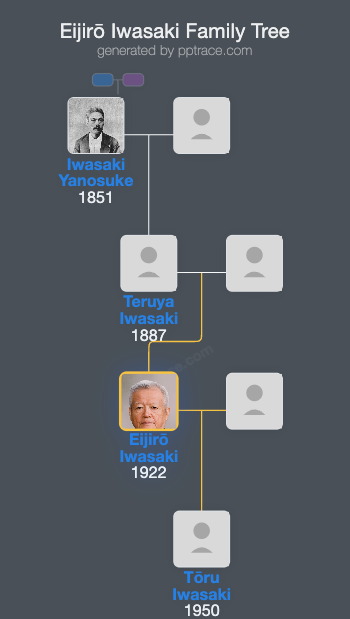
Family Tree
Tap  to expand more relatives
Introduction
Eiichirō Iwasaki (April 29, 1922 – July 11, 2017) was a Japanese linguist specializing in German language studies. He was born in Tokyo Prefecture (currently Shinagawa City, Tokyo). He was an emeritus professor at Keio University and a member of the Japan Academy. The family name "﨑" is read as "Tatsusaki," but since it is not included in the JIS X 0208 character standard, it is sometimes written as "Iwasaki Eiichirō."
Early Life
He was born as the second son of Teruya Iwasaki, who operated the Koyasu Farm, in Shinagawa-machi, Ebara District, Tokyo Prefecture (now Shinagawa Ward, Tokyo). He had two older sisters and an older brother. His eldest sister married Nagataka Okabe, a senior official. Etsuko, the eldest daughter of Takaki Kato, was Eiichirō’s second cousin. His grandfather was the second head of the Mitsubishi conglomerate, Iwasaki Yanosuke, and his father was Teruyoshi Iwasaki, the third son of Yanosuke, known as a pioneer of railway fans. His great-grandfather was Soejō Goto.
From childhood, he suffered health problems. In 1929, he entered Seijo Elementary School (now Seijo Gakuen Elementary School), but due to long-term illness, he moved to Kamakura and Zushi for treatment. He later transferred to Seikei Elementary School in 1931 and entered the former Seikei High School in 1935. He graduated from high school in 1939 and enrolled in the Department of German Literature at the Faculty of Letters, University of Tokyo. However, in 1942, he was drafted into the Yokosuka Musashiyama Marine Barracks due to the student mobilization. In 1944, he entered the Naval Communications School and graduated from university in December of the same year under wartime special provisions.
Military Service
He joined the Musashiyama Marine Barracks in Yokosuka in December 1943 and entered the Naval Communications School in Kurihama in July 1944. By December 1944, he was considered to have graduated from university under wartime special provisions. In June 1945, he was dispatched to a naval air base in Kyushu, where he experienced the end of the war.
Academic Career
After demobilization, he worked as a faculty member at multiple educational institutions, including the University of Tokyo and Keio University. His roles included assistant at the University of Tokyo's Faculty of Letters, professor at the former Seikei High School, teacher at Seikei High School, lecturer at Saitama University’s Faculty of Arts and Sciences, associate professor at Tokyo University of Education, professor at the University of Tokyo’s College of Liberal Arts, professor at Keio University’s Faculty of Letters, director of the Institute of Language and Culture at Keio, and professor at Dokkyo University’s Faculty of Foreign Languages. He retired in March 1988 from Keio University, whereupon he was named professor emeritus.
Research Activities
He specialized in German linguistics, focusing on the study of adverbs, speech act words, and modal words. He was particularly known for attempting a semantic classification and description of invariable words in German from a Japanese perspective. He also contributed extensively to the editing of German-Japanese and Japanese-German dictionaries.
Family
He married Tachiko, the eldest daughter of Hakushū Kitahara, a renowned poet, and had two sons. His eldest son, Tōru, worked at Mitsubishi Corporation and later served as president of Harayama Ranch (a Brazilian farm management company). His second son, Jun, served as president and executive officer of Nikon Corporation in Tochigi and later became a special contractual officer of the company.
Education
He attended the Department of German Literature at the Faculty of Letters, University of Tokyo.