Teruya Iwasaki
| Name | Teruya Iwasaki |
| Title | Japanese businessperson (1887-1956) |
| Gender | Male |
| Birthday | 1887-06-18 |
| nationality | Japan |
| Source | https://www.wikidata.org/wiki/Q11474557 |
| pptrace | View Family Tree |
| LastUpdate | 2025-11-17T09:48:42.639Z |
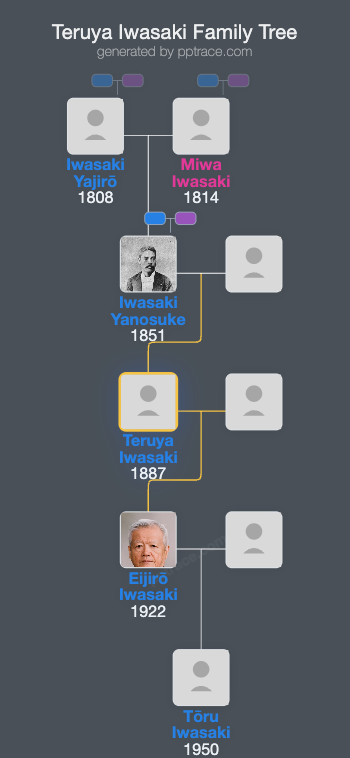
Family Tree
Tap  to expand more relatives
Introduction
Teruya Iwasaki (June 18, 1887 – September 17, 1956) was a Japanese businessman and a pioneer in railway enthusiasm.
Life
Teruya Iwasaki was born in Tokyo Prefecture (now Tokyo) as the third son of the couple Yanosuke Iwasaki and Sanae. In 1899 (Meiji 32), he graduated from the Elementary School attached to the Higher Normal School (now the University of Tsukuba Elementary School), and in 1905 (Meiji 38), from the Middle School attached to the Tokyo Higher Normal School (now the University of Tsukuba Junior and Senior High School). He then graduated from the Practical Department of the Imperial University of Tokyo's Agriculture University (now the Faculty of Agriculture at Tokyo University of Agriculture and Technology).
Family Background
The Iwasaki family is the founding family of the Mitsubishi conglomerate; his father, Yanosuke, was the second president of Mitsubishi. His mother, Sanae, was the eldest daughter of the politician Soejirō Gōtō. His spouse was Sumi, the second daughter of Fusaki Sakurai, who was the first director of the Tokyo Physics Institute. His relatives by marriage include Shozo Sakurai (a shipbuilding scholar), Jōji Sakurai (a chemist), and his uncles Toshiki Sakurai (president of Mitsubishi Heavy Industries) and Akira Fujimura (an architect and president of Mitsubishi Estate).
Business Career
After graduating from university, Teruya entered the business world, primarily engaging in dairy farming. He was involved with Takigawa pig farm and Ko-yasu Farm, which is believed to be the model for the "People of the Ataka Family" novel. However, compared to his father and brothers, he did not achieve significant accomplishments in business and was mainly known for his activities as a railway enthusiast.
Railway Hobby and Contributions
From 1902 (Meiji 35) to 1907 (Meiji 40), together with Shiro Watanabe, founder of Watanabe Bank, Teruya commissioned photographer Kōzō Ogawa to take photographs of railways across Japan. Shiro Watanabe was said to have become interested in railways after being influenced by railway engineers. The photographs taken encompass steam locomotives, passenger cars, station buildings, tunnels, bridges, and more, mainly captured on glass plates with high detail and unique angles.
Management and Impact of the Photographs
The photographs were donated by Teruya himself to the Railway Museum at Manseibashi in Tokyo (later the Transportation Museum) in 1940 (Showa 15). Subsequently, they were stored as the "Iwasaki-Watanabe Collection" at the Railway Museum in Saitama City. These photographs significantly influenced railway research and hobbyist activities of the time, and are also regarded as valuable historical materials from the Meiji period.
Features of the Railway Photography
Despite being taken over a short period, these photographs are characterized by vividness, precise angles, and systematic subject selection, laying a foundational resource for railway research in Japan during the Meiji era.
Awards and Honors
Teruya was awarded the Purple Ribbon Medal in 1940 (Showa 15).
Other Contributions
Through his activities related to railway hobbies, particularly railway photography and collecting, Teruya Iwasaki is regarded as a pioneer among Japanese railway enthusiasts.