Sir Robert Furnese, 2nd Baronet
| Name | Sir Robert Furnese, 2nd Baronet |
| Title | British politician |
| Gender | Male |
| Birthday | 1687-08-01 |
| nationality | — |
| Source | https://www.wikidata.org/wiki/Q7528773 |
| pptrace | View Family Tree |
| LastUpdate | 2025-11-26T12:28:32.445Z |
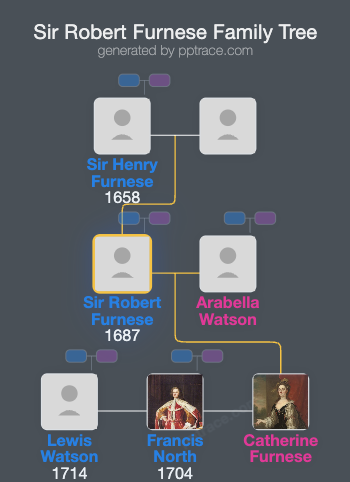
Family Tree
Tap  to expand more relatives
Introduction
Sir Robert Furnese, 2nd Baronet, was born on August 1, 1687. He was the son of Sir Henry Furnese, 1st Baronet, and his first wife, Anne Brough, daughter of Robert Brough. He received his education at Eton College in 1697 and spent some time living in Germany and Austria during his youth.
In terms of his political career, Furnese was abroad during the 1708 British general election. Shortly after returning from the European continent, he was elected unopposed as a Whig Member of Parliament (MP) for Truro in a by-election held on December 16, 1708. He cast votes in favor of the impeachment of Dr. Sacheverell in 1710. Although there was pressure for him to stand for Thetford in the 1710 general election, he instead was appointed to the Commission of the Peace for Kent and successfully contested as a Whig MP for New Romney.
Furnese voted for the "No Peace Without Spain" motion on December 7, 1711. On November 30, 1712, following the death of his father, he inherited the baronetcy and a substantial estate at Waldershare, Kent. He was re-elected unopposed as MP for New Romney in the 1713 general election. On March 18, 1714, he voted against the expulsion of Richard Steele.
In the 1715 general election, Furnese was elected in a contested election as a Whig representing New Romney. He supported the septennial bill and aligned with Robert Walpole's opposition in 1717. He opposed the Peerage Bill in 1719. In subsequent elections, he continued to serve as MP; he was returned unopposed for New Romney in 1722 and in 1727, elected as MP for Kent. Despite losing at New Romney, he was awarded that seat on petition but elected to sit as MP for Kent, where he remained after the 1727 election. From 1729 onward, he consistently voted against the Government.
Regarding his personal life, Furnese was married three times. His first wife was Anne Balam, his stepsister, whom he married on October 1, 1708. She was the daughter of his father's second wife, Matilda Vernon, and her first husband Anthony Balam. They had one daughter, Anne, who married Hon. John St John, son of Henry St John, 1st Viscount St John. Anne Balam died on May 29, 1713, at the age of 25.
Furnese's second marriage took place on July 8, 1714, to Arabella Watson, daughter of Lewis Watson, 1st Earl of Rockingham. This marriage produced his only son, Henry, and a second daughter, Catherine, who married her first cousin Lewis Watson, 2nd Earl of Rockingham. Arabella died on September 5, 1727.
His third marriage was on May 15, 1729, at Teddington, Middlesex, to Lady Anne Shirley, daughter of Robert Shirley, 1st Earl Ferrers. With his third wife, he had a daughter named Selina, who married Edward Dering, and another daughter who predeceased him.
Sir Robert Furnese died on March 7, 1733, at Waldershare, Kent. Contemporary reports suggested that he died due to a cold he had been suffering from, worsened by heavy drinking, and that he was not sober for ten days prior to his illness. He was buried at Waldershare on March 14, 1733. His son, Henry Furnese, became the 3rd Baronet but died unmarried and without issue at the age of 19 in March 1735 in Montpellier, France. Consequently, the baronetcy became extinct, and the estate was divided among Sir Robert's three surviving daughters: Anne, Catherine (who became Countess of Rockingham), and Selina.
His widow, Lady Anne Shirley Furnese, lived for another 46 years after his death, passing away in Dover Street, London, on February 25, 1779, aged 70. She was interred at Grosvenor Chapel in Westminster.