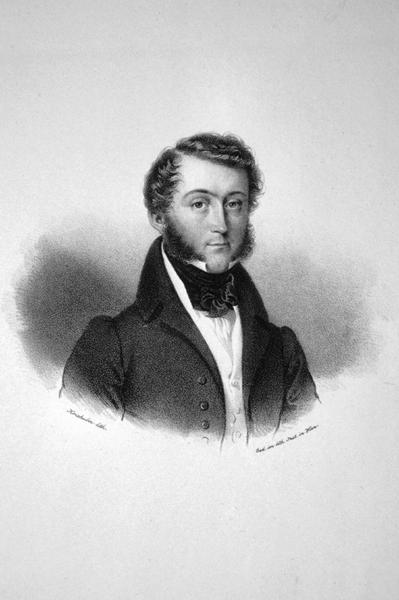
Prince Karl, 3rd Prince Of Leiningen
| Name | Prince Karl, 3rd Prince Of Leiningen |
| Title | German prince (1804-1856); maternal half-brother of Queen Victoria |
| Gender | Male |
| Birthday | 1804-09-12 |
| nationality | Q154195 |
| Source | https://www.wikidata.org/wiki/Q63076 |
| pptrace | View Family Tree |
| LastUpdate | 2025-11-12T01:18:04.564Z |
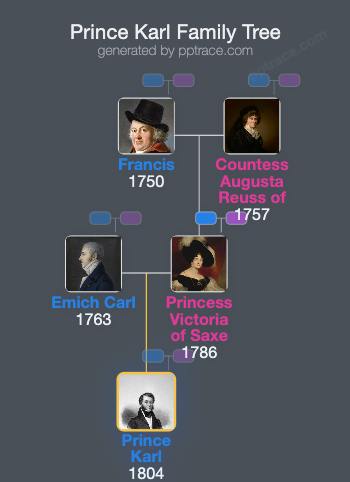
Family Tree
Tap  to expand more relatives
Introduction
Karl, Prince of Leiningen, KG (German: Karl Friedrich Wilhelm Emich; 12 September 1804 – 13 November 1856), was a member of the House of Leiningen and held the title of the third Prince of Leiningen. He was born in Amorbach, in the Electorate of Bavaria. His parents were Prince Emich Carl of Leiningen (1763–1814) and Princess Victoria of Saxe-Coburg-Saalfeld (1786–1861). He was a maternal half-brother of Queen Victoria of the United Kingdom through his mother.
Prince Emich Carl received the Principality of Leiningen during the German mediatisation in 1803, as compensation for lost estates, and primarily resided at Amorbach Abbey. Following the mediatisation, the territory passed to Baden, Bavaria, and Hesse. Prince Emich Carl died on 4 July 1814, after which Karl succeeded as the third Prince of Leiningen.
In 1818, Karl's widowed mother married Prince Edward Augustus, Duke of Kent and Strathearn, the fourth son of King George III of the United Kingdom, at Kew Palace. Subsequently, in 1819, Karl and his sister Princess Feodora were taken to London to be with their mother, and his maternal half-sister Princess Victoria of Kent was born at Kensington Palace.
On 13 February 1829, Karl married Countess Marie von Klebelsberg-Thumburg (1806–1880). They produced two sons: Ernst, Prince of Leiningen (1830–1904), who married Princess Marie of Baden and had two children; and Prince Eduard Friedrich Maximilian Johann of Leiningen (1833–1914), who was unmarried.
Karl received education through a private school in Bern and studied law at the University of Göttingen starting in 1821. His studies included work with jurist Karl Friedrich Eichhorn, a leading figure in German constitutional law. His interests extended to arts, and in 1828 he commissioned the construction of Waldleiningen Castle near Mörschenhardt, designed in a Neo-Gothic style comparable to British castles like Abbotsford House.
As a mediatized prince, he was involved in the aristocratic political structures of Baden, Bavaria, and Hesse, and served as president of the Bavarian upper house (Reichsrat) in 1842. He also pursued a military career, attaining the rank of Lieutenant general in the Bavarian Army. Additionally, he was involved in the founding of the Adelsverein in 1842, an organization aimed at supporting German emigration to Texas; he was elected its president.
In the revolutionary upheavals of 1848–1849, Karl gained prominence as a liberal reformer and became the first Prime Minister of the Provisional Central Authority (Provisorische Zentralgewalt) government established by the Frankfurt Parliament in 1848. He was appointed by Regent Archduke John of Austria. His tenure was brief; he resigned in September 1848 over disagreements regarding the Schleswig-Holstein Question, specifically after King Frederick William IV of Prussia unilaterally signed an armistice with Denmark. He was succeeded by Anton von Schmerling.
After his resignation from political office and his role as president of the Adelsverein in 1851, Karl experienced health issues, culminating in a severe apoplectic attack in 1855. He died at Waldleiningen Castle on 13 November 1856 at the age of 52, with his sister Princess Feodora at his bedside. Queen Victoria, his half-sister, expressed her grief in her journal upon his death.
Throughout his life, Karl received various honors, including the Grand Cross of the Zähringer Lion and the House Order of Fidelity from Baden, the Grand Cross of the Royal Guelphic Order from Hanover, the Knight of St. Hubert from Bavaria, and the Order of the Rue Crown from Saxony, among others. He was also a Knight of the Garter in the United Kingdom.
His ancestry traces back to the House of Leiningen and connects to various European royal families through his mother and paternal lineage.