
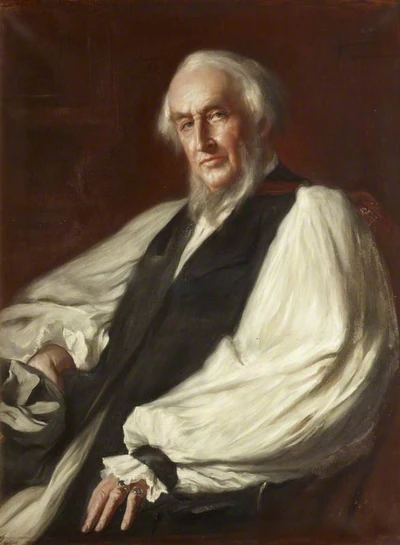
Arthur Charles Hervey
| Name | Arthur Charles Hervey |
| Title | English Anglican bishop |
| Gender | Male |
| Birthday | 1808-08-20 |
| nationality | United Kingdom of Great Britain and Ireland |
| Source | https://www.wikidata.org/wiki/Q6678927 |
| pptrace | View Family Tree |
| LastUpdate | 2025-11-26T23:26:30.160Z |
Family Tree
Tap  to expand more relatives
Introduction
Lord Arthur Charles Hervey (20 August 1808 – 9 June 1894) was an English bishop who served as the Bishop of Bath and Wells from 1869 until his death in 1894. He was commonly referred to by his courtesy title, "Lord," rather than the traditional episcopal style, the Right Reverend.
**Background and Education**
Hervey was the fourth son of Frederick Hervey, 1st Marquess of Bristol, and Elizabeth Albana Upton, daughter of Clotworthy Upton, 1st Baron Templetown. His paternal grandfather was Frederick Hervey, 4th Earl of Bristol, who also served as the Bishop of Derry. He was born at his father's residence in London, 6 St James's Square, on 20 August 1808. Between 1817 and 1822, Hervey lived abroad with his parents, primarily in Paris, where he was educated by a private tutor. He attended Eton College from 1822 to 1826. In 1827, he enrolled at Trinity College, Cambridge, where he graduated with a Bachelor of Arts degree in 1830 after obtaining a first-class in the classical tripos.
**Career**
Hervey was ordained as a deacon and as a priest in October 1832. In November of the same year, he was instituted to the small ecclesiastical benefice comprising Ickworth and Chedburgh in Suffolk, a position he held until 1869. When Chedburgh was separated from Ickworth in 1844 and joined to Horningsheath or Horringer, Hervey also served as curate of Horringer until 1856, when he was instituted to the rectory of Ickworth, which he held concurrently with his parish duties until 1869. He was actively involved in clerical work and played a prominent role in the organization of educational institutions in Bury St. Edmunds, notably serving as president of the Bury and West Suffolk Archaeological Institute. Hervey was believed to be the first to propose a system of university extension.
In 1862, Hervey was appointed archdeacon of Sudbury. Following the resignation of Lord Auckland as Bishop of Bath and Wells in 1869, Hervey was appointed to the episcopal office based on the recommendation of William Ewart Gladstone. He was consecrated as bishop on 21 December 1869 and served in this capacity until his death.
**Contributions and Works**
Hervey was known for his linguistic skills and antiquarian interests. He participated as a member of the committee responsible for revising the Authorized Version of the Old Testament, a task carried out between 1870 and 1884. In recognition of his contributions, he received the honorary degree of Doctor of Divinity from the University of Oxford in 1885. He contributed extensively to William Smith's *Dictionary of the Bible* and to the *Speaker’s Commentary*. His published works include sermons, lectures, charges, pamphlets, and the book *The Genealogies of our Lord* (1853).
**Family**
Hervey married Patience Singleton, daughter of John Singleton of Hazeley, Hampshire, and Mell, Drogheda, on 30 July 1839. They had twelve children, with five sons and three daughters surviving him. Their children included John Frederick Arthur Hervey (1840–1926), George Henry William Hervey (1843–1933), Sydenham Henry Augustus Hervey (1846–1946), Katherine Georgina Hervey (1848–1915), who married Charles Hoare in 1872, Constantine Rodney William Hervey (1850–1949), Patience Mary Hervey (1853–1914), James Arthur Hervey (1854–1948), and Caroline Augusta Hervey (1857–1949).
Hervey died at Hackwood House near Basingstoke, the residence of his son-in-law Charles Hoare, on 9 June 1894, at the age of 85. He was interred in Wells.
**Additional Note**
In the 1870s, one of Hervey’s daughters trained mute swans in the moat at the Bishop’s Palace to ring bells by pulling strings, enabling them to beg for food.
