John Custis IV
| Name | John Custis IV |
| Title | American politician |
| Gender | Male |
| Birthday | 1678-08-01 |
| nationality | Great Britain |
| Source | https://www.wikidata.org/wiki/Q6228004 |
| pptrace | View Family Tree |
| LastUpdate | 2025-11-17T06:36:29.141Z |
Family Tree
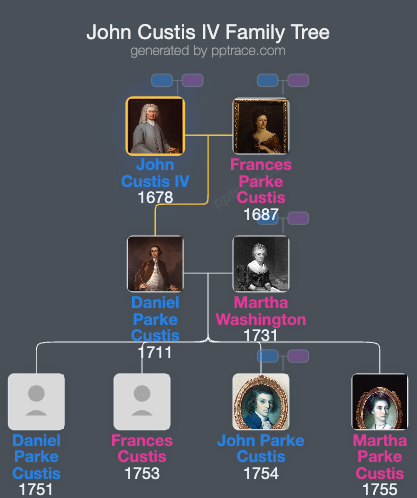
Tap  to expand more relatives
Introduction
John Custis IV was born in August 1678 at the Arlington plantation in Northampton County, Virginia. His father was John Custis III, also known as John Custis of Wilsonia, a prominent planter and member of the Virginia Governor's Council. His mother was Margaret Michael Custis, who experienced the death of her second child during childbirth. Custis was the eldest son in his family and received education from private tutors.
In his early adulthood, Custis was sent to London to study the tobacco trade under Micajah Perry, a tobacco merchant and politician. He returned to Virginia in 1699 and was introduced to plantation management, specifically overseeing enslaved labor at Arlington.
Custis was elected to the Virginia House of Burgesses representing Northampton County for a single term from 1705 to 1706. In 1706, he married Frances Parke, the eldest daughter of Daniel Parke. Custis was appointed justice of the peace in the same year. His father, John Custis III, died in 1714, during which time Custis inherited considerable land holdings including two plantations and approximately 30 slaves.
His wife, Frances, died in 1715 from smallpox. In 1717, Custis relocated to Williamsburg, Virginia, where he re-engaged with political affairs and was elected again to the House of Burgesses for a term from 1718 to 1719. His residency in Williamsburg marked a shift from his family's earlier plantation focus toward urban life. Custis purchased the White House plantation along the Pamunkey River in 1735 and delegated its management to his son Daniel.
In 1727, Custis was appointed to the Governor's Council of Virginia. Over time, he established himself in Williamsburg, where he launched an interest in horticulture, cultivating a large garden next to his colonial mansion, Six Chimney House. His correspondence with notable naturalists like John Bartram, Mark Catesby, and Peter Collinson indicates his engagement with emerging botanical sciences.
Custis was commissioned as a colonel in the Virginia militia by 1735. He was also involved in land acquisition, purchasing the White House plantation in 1735, inherited from John Lightfoot III. His son Daniel, age 25 at the time, was sent to manage the plantation and oversee enslaved labor there.
As Custis aged, health issues emerged, prompting correspondence with horticultural contacts regarding treatments. In 1742, he received medical advice from Peter Collinson, although he emphasized the necessity of personal examination for effective treatment. He continued expanding his garden in Williamsburg, planting trees such as fir and pine.
In 1744, Custis petitioned the Virginia governor, Sir William Gooch, for the manumission of an enslaved child he had fathered, advocating for the child's freedom—an unusual step for a Virginia planter of his status. His family life included a marriage to Frances, which reportedly was strained, with limited communication between the spouses.
Custis and Daniel's romantic relationship, particularly Daniel's courtship of Martha Dandridge, was notable. Daniel married Martha in 1750. Custis's later years were marked by illness, leading to his removal from the Governor's Council in August 1749. He completed his last will on November 14, 1749, and died on November 22 in Williamsburg.
He was buried in the Custis family cemetery near Cheapside, Virginia. His estate, including the plantations and enslaved people, was inherited by his son Daniel. Custis's gravestone inscription highlighted the length of his bachelorhood, and his legacy was intertwined with prominent Virginia families and American history through his descendants, including Martha Washington and George Washington Parke Custis.