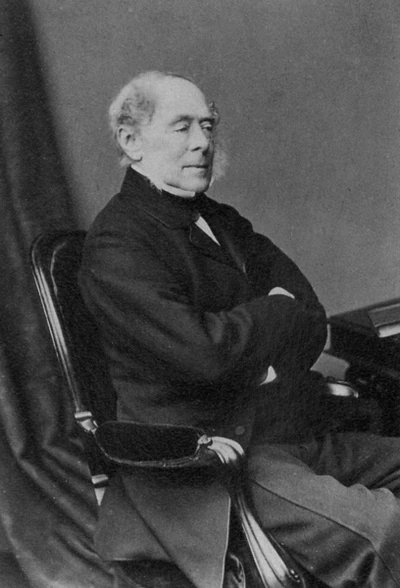
George Villiers, 4th Earl Of Clarendon
| Name | George Villiers, 4th Earl Of Clarendon |
| Title | British diplomat (1800-1870) |
| Gender | Male |
| Birthday | 1800-01-12 |
| nationality | United Kingdom of Great Britain and Ireland |
| Source | https://www.wikidata.org/wiki/Q335305 |
| pptrace | View Family Tree |
| LastUpdate | 2025-11-26T23:29:27.974Z |
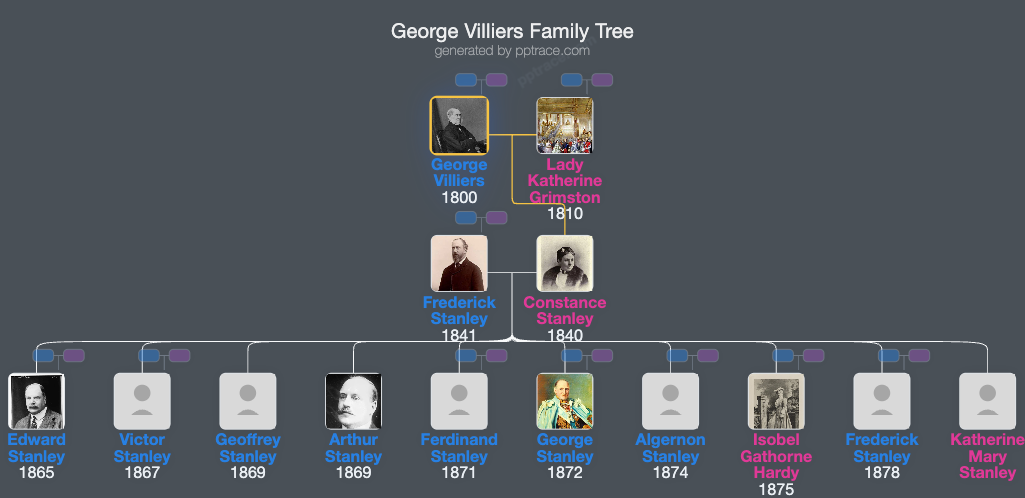
Family Tree
Tap  to expand more relatives
Introduction
George William Frederick Villiers, 4th Earl of Clarendon (12 January 1800 – 27 June 1870), was an English diplomat and politician associated with the Whig and Liberal parties. He held various governmental positions, including as Viceroy of Ireland during the Irish famine and multiple terms as Foreign Secretary, notably leading the British delegation at the Congress of Paris that concluded the Crimean War.
Born in London, Villiers was the son of Hon. George Villiers and Hon. Theresa Parker, daughter of John Parker, 1st Baron Boringdon. He was the second-born and eldest surviving child among ten siblings. His paternal grandfather was Thomas Villiers, 1st Earl of Clarendon, and his maternal lineage connected him to the Parker family and the aristocracy. Following his father's death in 1827, Villiers became the heir to the earldom after the death of his uncles, Thomas Villiers, 2nd Earl of Clarendon, and John Villiers, 3rd Earl of Clarendon, both of whom died without heirs.
Villiers was educated at Christ's Hospital and later matriculated at St John's College, Cambridge, at the age of sixteen in 1816. He obtained his Master of Arts degree in 1820, under the university statutes applicable to the eldest sons of earl's brothers of royal descent.
His diplomatic career began with an appointment as attaché at the British embassy in Saint Petersburg in 1820, where he resided for three years, gaining practical experience in diplomacy. Returning to England in 1823, Villiers was appointed a commissioner of customs, a position he held for approximately ten years. In 1831, he was sent to France in an unsuccessful effort to negotiate a commercial treaty.
In 1833, Villiers was appointed Minister at the Court of Spain. His tenure coincided with the death of King Ferdinand VII and the subsequent succession of Queen Isabella II, which led to the First Carlist War over the succession dispute rooted in the Salic law. Villiers supported the Liberal faction and worked to uphold the constitutional monarchy, aligning with the Quadruple Treaty of 1834, in which Britain and France pledged support for Isabella’s rule.
During his diplomatic service in Spain, Villiers was awarded the Grand Cross of the Order of the Bath in 1838. That same year, he succeeded his uncle as Earl of Clarendon. In 1839, he married Lady Katharine Foster-Barham, née Grimston, daughter of James Grimston, 1st Earl of Verulam.
Relocating to Britain, Villiers entered politics as part of Lord Melbourne’s Whig administration in 1840. He served as Lord Privy Seal and Chancellor of the Duchy of Lancaster until 1841. He supported the promotion of Anglo-French relations and was involved in the repeal of the Corn Laws during Lord John Russell’s ministry, assuming the presidency of the Board of Trade in 1846.
In 1847, Clarendon was appointed Lord Lieutenant of Ireland during the Great Famine, a period marked by significant suffering and political unrest. His administration faced criticism for the response to the crisis; he implemented martial law and suspended Habeas Corpus in parts of Ireland. He hosted Queen Victoria in Ireland in 1849, aiming to foster national unity, although with limited success.
Despite difficulties in Ireland, Clarendon continued to hold significant government roles. His contributions were formally recognized in 1848 when he was acknowledged in the Queen’s Speech and invested as a Knight of the Garter in 1849.
In 1853, Villiers succeeded Lord John Russell as Foreign Secretary in Lord Aberdeen’s coalition government. During this period, the United Kingdom was engaged in the Crimean War (1853–1856). Clarendon supported the war effort and maintained close diplomatic relations with France, particularly with Emperor Napoleon III and Empress Eugénie. He was the British plenipotentiary at the Congress of Paris in 1856, where the peace treaty ending the Crimean War was negotiated. This marked the first occasion since the Congress of Vienna that a British Foreign Secretary participated personally in such negotiations.